Department of Cardiovascular Magnetic Resonance, Bristol Cardiovascular Biomedical Research Unit, Bristol Heart Institute, University Hospitals Bristol NHS Foundation Trust, Bristol, UK.
School of Physiology, Pharmacology & Neuroscience, Faculty of Biomedical Science, University of Bristol, Bristol, UK.
J Cardiovasc Magn Reson. 2019 Nov 7;21(1):68. doi: 10.1186/s12968-019-0578-8.
It has been estimated that 20-30% of repaired aortic coarctation (CoA) patients develop hypertension, with significant cardiovascular morbidity and mortality. Vertebral artery hypoplasia (VAH) with an incomplete posterior circle of Willis (ipCoW; VAH + ipCoW) is associated with increased cerebrovascular resistance before the onset of increased sympathetic nerve activity in borderline hypertensive humans, suggesting brainstem hypoperfusion may evoke hypertension to maintain cerebral blood flow: the "selfish brain" hypothesis. We now assess the "selfish brain" in hypertension post-CoA repair.
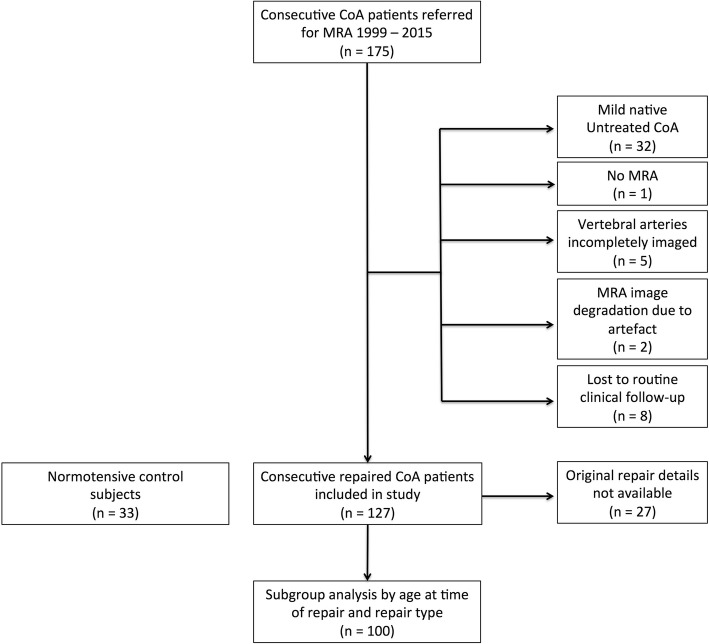
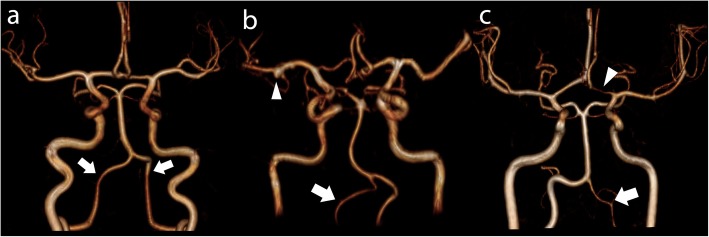
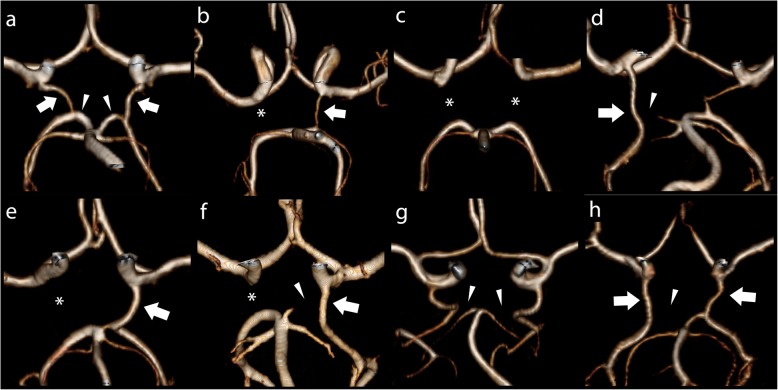
Time-of-flight cardiovascular magnetic resonance angiography from 127 repaired CoA patients (34 ± 14 years, 61% male, systolic blood pressure (SBP) 138 ± 19 mmHg, diastolic blood pressure (DBP) 76 ± 11 mmHg) was compared with 33 normotensive controls (42 ± 14 years, 48% male, SBP 124 ± 10 mmHg, DBP 76 ± 8 mmHg). VAH was defined as < 2 mm and ipCoW as hypoplasia of one or both posterior communicating arteries.
VAH + ipCoW was more prevalent in repaired CoA than controls (odds ratio: 5.8 [1.6-20.8], p = 0.007), after controlling for age, sex and body mass index (BMI). VAH + ipCoW was an independent predictor of hypertension (odds ratio: 2.5 [1.2-5.2], p = 0.017), after controlling for age, gender and BMI. Repaired CoA subjects with VAH + ipCoW were more likely to have difficult to treat hypertension (odds ratio: 3.3 [1.01-10.7], p = 0.049). Neither age at time of CoA repair nor any specific repair type were significant predictors of VAH + ipCoW in univariate regression analysis.
VAH + ipCoW predicts arterial hypertension and difficult to treat hypertension in repaired CoA. It is unrelated to age at time of repair or repair type. CoA appears to be a marker of wider congenital cerebrovascular problems. Understanding the "selfish brain" in post-CoA repair may help guide management.
High Blood Pressure; Hypertension; Magnetic Resonance Imaging (MRI); Cardiovascular Surgery; Cerebrovascular Malformations.
据估计,20-30%的修复性主动脉缩窄(CoA)患者会发展为高血压,从而导致显著的心血管发病率和死亡率。不完全性后循环Willis 环(ipCoW;VAH+ipCoW)的椎动脉发育不良与边缘性高血压患者交感神经活动增加前脑血管阻力增加有关,这表明脑灌注不足可能会引发高血压以维持脑血流:“自私大脑”假说。我们现在评估 CoA 修复后高血压的“自私大脑”。
对 127 例修复性 CoA 患者(34±14 岁,61%为男性,收缩压(SBP)138±19mmHg,舒张压(DBP)76±11mmHg)和 33 名血压正常的对照者(42±14 岁,48%为男性,SBP 124±10mmHg,DBP 76±8mmHg)进行时间飞跃心血管磁共振血管造影。将 VAH 定义为<2mm,ipCoW 定义为一条或两条后交通动脉发育不良。
VAH+ipCoW 在修复性 CoA 患者中的发生率高于对照组(比值比:5.8[1.6-20.8],p=0.007),校正年龄、性别和体重指数(BMI)后仍然如此。VAH+ipCoW 是高血压的独立预测因素(比值比:2.5[1.2-5.2],p=0.017),校正年龄、性别和 BMI 后仍然如此。VAH+ipCoW 的 CoA 修复患者更有可能患有难以治疗的高血压(比值比:3.3[1.01-10.7],p=0.049)。在单变量回归分析中,CoA 修复时的年龄或任何特定的修复类型均不是 VAH+ipCoW 的显著预测因素。
VAH+ipCoW 可预测 CoA 修复后动脉性高血压和难以治疗的高血压。它与修复时的年龄或修复类型无关。CoA 似乎是广泛的先天性脑血管问题的标志。了解 CoA 修复后的“自私大脑”可能有助于指导治疗。
高血压;高血压;磁共振成像(MRI);心血管外科学;脑血管畸形。