Goodarzi Ardakani Vahid, Goordoyal Harshinee, Ordonez Maria Victoria, Sophocleous Froso, Curtis Stephanie, Bedair Radwa, Caputo Massimo, Gambaruto Alberto, Biglino Giovanni
Department of Mechanical Engineering, University of Bristol, Bristol, United Kingdom.
University Hospitals Bristol and Weston, NHS Foundation Trust, Bristol, United Kingdom.
Front Cardiovasc Med. 2022 Jun 24;9:855118. doi: 10.3389/fcvm.2022.855118. eCollection 2022.
Effective management of aortic coarctation (CoA) affects long-term cardiovascular outcomes. Full appreciation of CoA hemodynamics is important. This study aimed to analyze the relationship between aortic shape and hemodynamic parameters by means of computational simulations, purposely isolating the morphological variable.
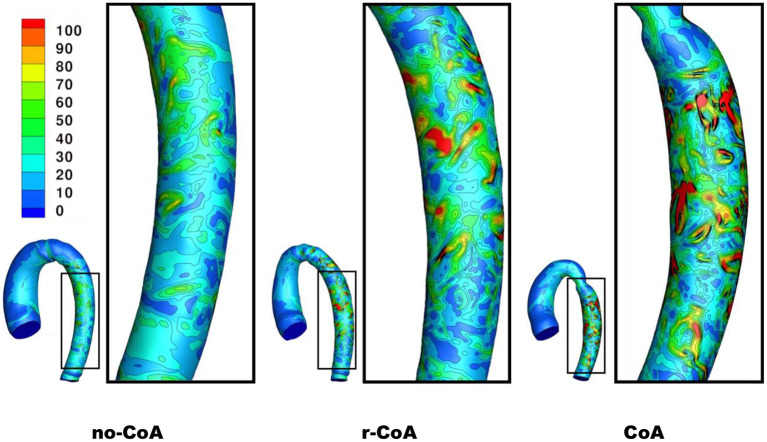
Computational simulations were run in three aortic models. MRI-derived aortic geometries were generated using a statistical shape modeling methodology. Starting from = 108 patients, the mean aortic configuration was derived in patients without CoA ( = 37, "no-CoA"), with surgically repaired CoA ( = 58, "r-CoA") and with unrepaired CoA ( = 13, "CoA"). As such, the aortic models represented average configurations for each scenario. Key hemodynamic parameters (i.e., pressure drop, aortic velocity, vorticity, wall shear stress WSS, and length and number of strong flow separations in the descending aorta) were measured in the three models at three time points (peak systole, end systole, end diastole).
Comparing no-CoA and CoA revealed substantial differences in all hemodynamic parameters. However, simulations revealed significant increases in vorticity at the site of CoA repair, higher WSS in the descending aorta and a 12% increase in power loss, in r-CoA compared to no-CoA, despite no clinically significant narrowing (CoA index >0.8) in the r-CoA model.
Small alterations in aortic morphology impact on key hemodynamic indices. This may contribute to explaining phenomena such as persistent hypertension in the absence of any clinically significant narrowing. Whilst cardiovascular events in these patients may be related to hypertension, the role of arch geometry may be a contributory factor.
主动脉缩窄(CoA)的有效管理会影响长期心血管结局。充分了解CoA血流动力学很重要。本研究旨在通过计算模拟分析主动脉形态与血流动力学参数之间的关系,特意分离出形态学变量。
在三个主动脉模型中进行计算模拟。使用统计形状建模方法生成源自MRI的主动脉几何形状。从108例患者开始,得出无CoA患者(n = 37,“无CoA”)、手术修复CoA患者(n = 58,“r-CoA”)和未修复CoA患者(n = 13,“CoA”)的平均主动脉构型。因此,主动脉模型代表了每种情况的平均构型。在三个时间点(收缩期峰值、收缩期末期、舒张期末期)测量三个模型中的关键血流动力学参数(即压降、主动脉速度、涡度、壁面剪应力WSS以及降主动脉中强血流分离的长度和数量)。
比较无CoA和CoA发现所有血流动力学参数存在显著差异。然而,模拟显示,与无CoA相比,r-CoA中CoA修复部位的涡度显著增加,降主动脉中的WSS更高,功率损失增加12%,尽管r-CoA模型中没有临床上显著的狭窄(CoA指数>0.8)。
主动脉形态的微小改变会影响关键血流动力学指标。这可能有助于解释在没有任何临床上显著狭窄的情况下持续高血压等现象。虽然这些患者的心血管事件可能与高血压有关,但主动脉弓几何形状的作用可能是一个促成因素。