Biophysics Division, Institute of Molecular Biosciences, University of Graz, NAWI Graz, Graz, Austria; BioTechMed Graz, Graz, Austria.
CEITEC-Central European Institute of Technology, Masaryk University, Brno, Czech Republic; National Centre for Biomolecular Research, Faculty of Science, Masaryk University, Brno, Czech Republic.
Biophys J. 2019 Nov 19;117(10):1858-1869. doi: 10.1016/j.bpj.2019.10.022. Epub 2019 Oct 24.
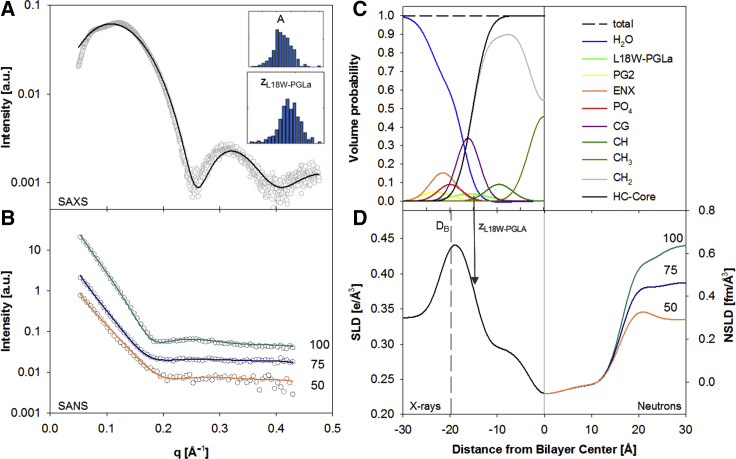
We addressed the onset of synergistic activity of the two well-studied antimicrobial peptides magainin 2 (MG2a) and PGLa using lipid-only mimics of Gram-negative cytoplasmic membranes. Specifically, we coupled a joint analysis of small-angle x-ray and neutron scattering experiments on fully hydrated lipid vesicles in the presence of MG2a and L18W-PGLa to all-atom and coarse-grained molecular dynamics simulations. In agreement with previous studies, both peptides, as well as their equimolar mixture, were found to remain upon adsorption in a surface-aligned topology and to induce significant membrane perturbation, as evidenced by membrane thinning and hydrocarbon order parameter changes in the vicinity of the inserted peptide. These effects were particularly pronounced for the so-called synergistic mixture of 1:1 (mol/mol) L18W-PGLa/MG2a and cannot be accounted for by a linear combination of the membrane perturbations of two peptides individually. Our data are consistent with the formation of parallel heterodimers at concentrations below a synergistic increase of dye leakage from vesicles. Our simulations further show that the heterodimers interact via salt bridges and hydrophobic forces, which apparently makes them more stable than putatively formed antiparallel L18W-PGLa and MG2a homodimers. Moreover, dimerization of L18W-PGLa and MG2a leads to a relocation of the peptides within the lipid headgroup region as compared to the individual peptides. The early onset of dimerization of L18W-PGLa and MG2a at low peptide concentrations consequently appears to be key to their synergistic dye-releasing activity from lipid vesicles at high concentrations.
我们使用革兰氏阴性细胞质膜的脂质模拟物来研究两种研究充分的抗菌肽magainin 2(MG2a)和 PGLa 的协同活性的起始。具体来说,我们将小角度 X 射线和中子散射实验的联合分析与全水合脂质囊泡在 MG2a 和 L18W-PGLa 存在下的全原子和粗粒度分子动力学模拟结合起来。与以前的研究一致,发现两种肽,以及它们的等摩尔混合物,在吸附时保持在表面对齐的拓扑结构,并诱导显著的膜扰动,这可以通过插入肽附近的膜变薄和烃序参数变化来证明。这些效应对于所谓的 1:1(摩尔/摩尔)L18W-PGLa/MG2a 协同混合物特别明显,并且不能通过两个肽各自的膜扰动的线性组合来解释。我们的数据与在协同增加囊泡染料泄漏浓度以下形成平行异二聚体一致。我们的模拟进一步表明,异二聚体通过盐桥和疏水相互作用相互作用,这显然使它们比假定形成的反平行 L18W-PGLa 和 MG2a 同二聚体更稳定。此外,L18W-PGLa 和 MG2a 的二聚化导致肽在脂质头部基团区域内的重新定位,与单独的肽相比。因此,L18W-PGLa 和 MG2a 的二聚化在低肽浓度下的早期起始似乎是它们在高浓度下从脂质囊泡中协同释放染料的关键。