Department of Biological Science, University of Ulsan, Ulsan, 44610, South Korea.
Department of Zoology, Comenius University in Bratislava, 842 15, Bratislava, Slovakia.
Sci Rep. 2019 Nov 8;9(1):16360. doi: 10.1038/s41598-019-52722-4.
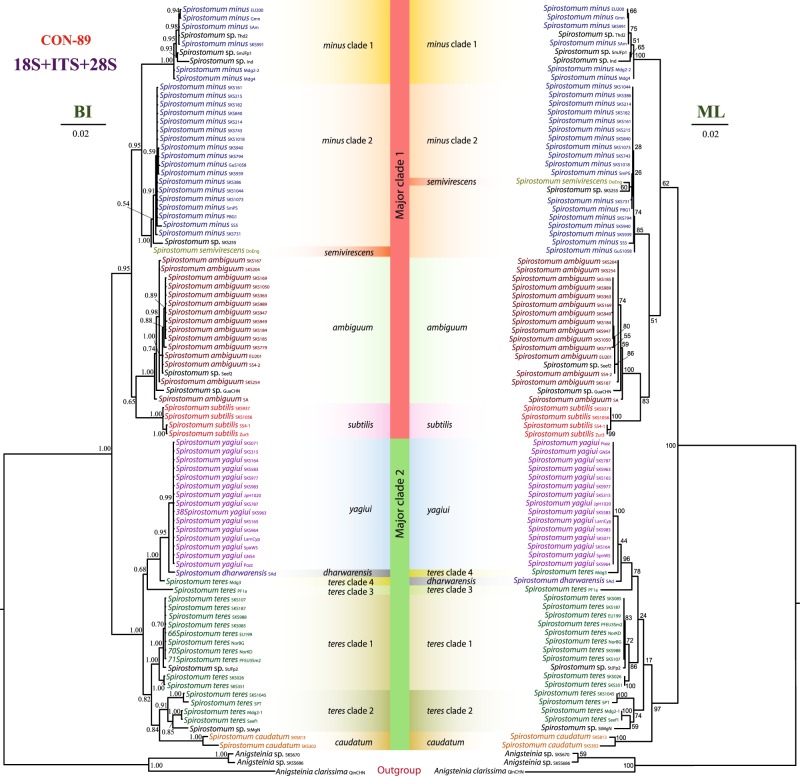
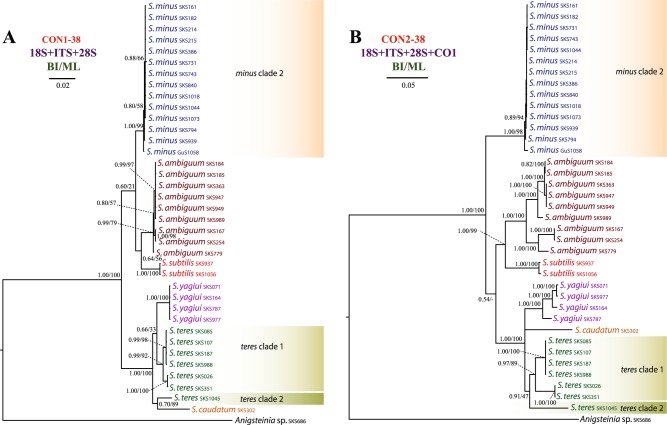
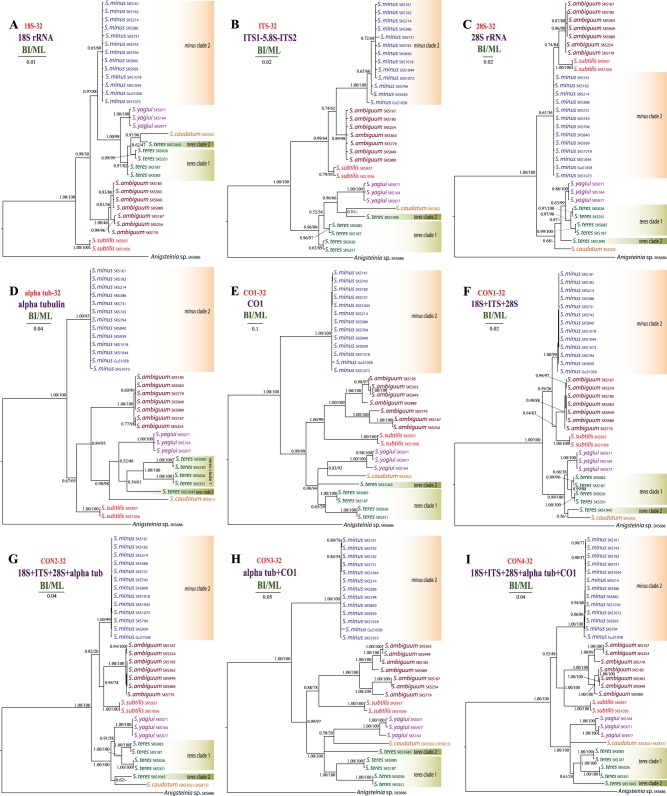
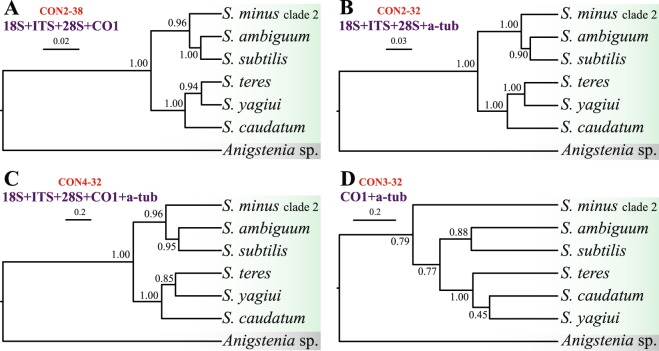
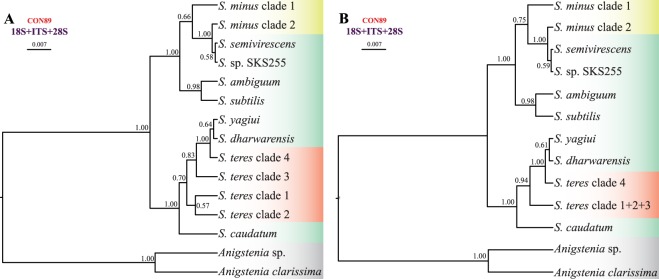
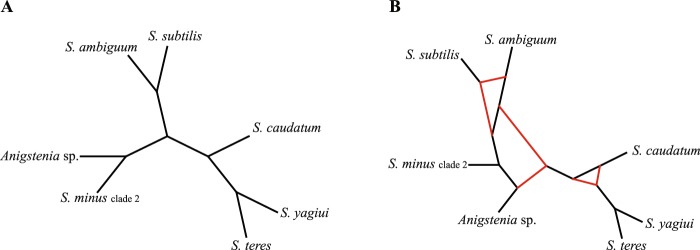
The ciliate genus Spirostomum comprises eight morphospecies, inhabiting diverse aquatic environments worldwide, where they can be used as water quality indicators. Although Spirostomum species are relatively easily identified using morphological methods, the previous nuclear rDNA-based phylogenies indicated several conflicts in morphospecies delineation. Moreover, the single locus phylogenies and previous analytical approaches could not unambiguously resolve phylogenetic relationships among Spirostomum morphospecies. Here, we attempt to investigate species boundaries and evolutionary history of Spirostomum taxa, using 166 new sequences from multiple populations employing one mitochondrial locus (CO1 gene) and two nuclear loci (rRNA operon and alpha-tubulin gene). In accordance with previous studies, relationships among the eight Spirostomum morphospecies were poorly supported statistically in individual gene trees. To overcome this problem, we utilised for the first time in ciliates the Bayesian coalescent approach, which accounts for ancestral polymorphisms, incomplete lineage sorting, and recombination. This strategy enabled us to robustly resolve deep relationships between Spirostomum species and to support the hypothesis that taxa with compact macronucleus and taxa with moniliform macronucleus each form a distinct lineage. Bayesian coalescent-based delimitation analyses strongly statistically supported the traditional morphospecies concept but also indicated that there are two S. minus-like cryptic species and S. teres is non-monophyletic. Spirostomum teres was very likely defined by a set of ancestral features of lineages that also gave rise to S. yagiui and S. dharwarensis. However, molecular data from type populations of the morphospecies S. minus and S. teres are required to unambiguously resolve the taxonomic problems.
纤毛门旋口虫属包含 8 个形态种,分布于世界各地的多种水生环境中,可作为水质指示生物。虽然旋口虫种可以通过形态学方法相对容易地识别,但之前基于核 rDNA 的系统发育研究表明,在形态种的划分上存在一些冲突。此外,单基因座系统发育和之前的分析方法不能明确解决旋口虫形态种之间的系统发育关系。在这里,我们试图利用来自多个种群的 166 个新序列,包括一个线粒体基因座(CO1 基因)和两个核基因座(rRNA 基因座和α-微管蛋白基因),来研究旋口虫分类单元的物种界限和进化历史。与之前的研究一致,在单独的基因树中,这 8 个旋口虫形态种之间的关系在统计学上支持度较低。为了克服这个问题,我们首次在纤毛动物中利用贝叶斯合并方法,该方法考虑了祖先多态性、不完全谱系分选和重组。这种策略使我们能够稳健地解决旋口虫种之间的深层关系,并支持以下假说:具有致密大核的类群和具有念珠状大核的类群各自形成一个独特的谱系。贝叶斯合并法种系发生界定分析强烈地支持了传统的形态种概念,但也表明存在两个类似 S. minus 的隐种,而 S. teres 是非单系的。Spirostomum teres 很可能是由一组祖先特征定义的,这些特征也导致了 S. yagiui 和 S. dharwarensis 的出现。然而,需要来自形态种 S. minus 和 S. teres 的模式种群的分子数据来明确解决分类问题。