Department of Sociology and Criminology, Pennsylvania State University, University Park, Pennsylvania.
Department of Human Development and Family Studies, Pennsylvania State University, University Park, Pennsylvania.
J Adolesc Health. 2020 Jan;66(1):39-47. doi: 10.1016/j.jadohealth.2019.08.030. Epub 2019 Nov 8.
The purpose of the study was to identify proximal links between electronic cigarette (e-cigarette) use and numerous indicators of adjustment, delinquency, and other substance use in adolescence, beyond prior levels and confounders.
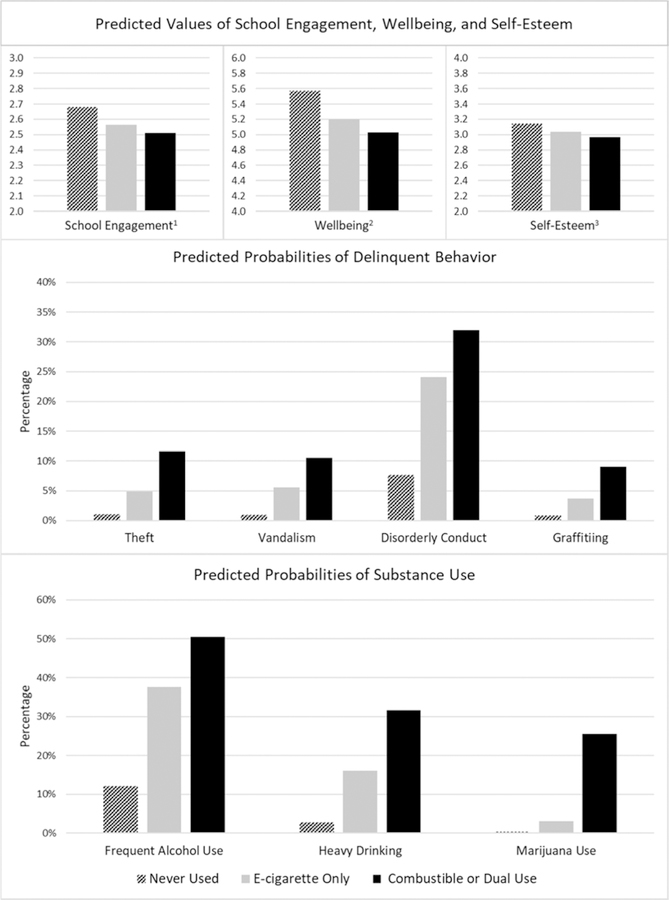
The ongoing Millennium Cohort Study is a nationally representative, intergenerational, longitudinal study of children born 2000-2001 in the United Kingdom followed from birth to age 14 years (n = 11,564 adolescents and their parents). A series of ordinary least squares and logistic regressions compared 14-year-old e-cigarette only users to never users and to combustible/dual users on 10 measures of adjustment (school engagement, well-being, and self-esteem), delinquency (theft, vandalism, disorderly conduct, and graffitiing), and other substance use (frequent alcohol use, heavy drinking, and marijuana use). Controls included each outcome variable measured at age 11 years and prospectively assessed parent and child confounders (e.g., parent education, child externalizing and internalizing behaviors, cognitive test scores, gender, and race/ethnicity).
At age 14 years, e-cigarette only users (approximately 7% of youth) had a higher risk of adolescent adjustment problems, delinquent behavior, and substance use relative to nonusers (75% of youth), but lower risk relative to combustible cigarette/dual users (18% of youth), even after controlling for a host of childhood confounders.
Positive links shown here between e-cigarette use and poor adjustment, delinquency, and other substance use in adolescence, coupled with accumulating evidence that e-cigarettes substantially increase youths' likelihood of combustible smoking, indicate that e-cigarettes are part of an emerging pattern of health-risk behaviors and poor adjustment for some youth.
本研究旨在确定电子烟(e-cigarette)使用与青少年众多调整、犯罪和其他物质使用指标之间的近端联系,这些联系超出了之前的水平和混杂因素。
正在进行的千禧年队列研究是一项具有全国代表性的、代际的、纵向研究,对 2000-2001 年在英国出生的儿童进行了研究,从出生到 14 岁(n=11564 名青少年及其父母)。一系列普通最小二乘法和逻辑回归比较了 14 岁只使用电子烟的青少年与从不使用电子烟的青少年和可燃/双重使用者在 10 项调整指标(学校参与度、幸福感和自尊)、犯罪(盗窃、破坏、行为不检和涂鸦)和其他物质使用(频繁饮酒、酗酒和大麻使用)上的差异。控制因素包括 11 岁时测量的每个结果变量以及前瞻性评估的父母和儿童混杂因素(例如,父母教育程度、儿童外化和内化行为、认知测试分数、性别和种族/族裔)。
在 14 岁时,电子烟只使用者(约占青少年的 7%)相对于非使用者(75%的青少年),青少年调整问题、犯罪行为和物质使用的风险更高,但相对于可燃香烟/双重使用者(18%的青少年),风险更低,即使在控制了一系列儿童混杂因素后也是如此。
这里显示的电子烟使用与青少年时期调整不良、犯罪和其他物质使用之间的正相关关系,加上越来越多的证据表明电子烟大大增加了青少年吸食可燃香烟的可能性,表明电子烟是一些青少年出现的健康风险行为和调整不良的一部分模式。