Department for Clinical and Movement Neurosciences, Institute of Neurology, University College London, United Kingdom; Department of Bioengineering, Imperial College, London, United Kingdom.
Department for Clinical and Movement Neurosciences, Institute of Neurology, University College London, United Kingdom.
Brain Stimul. 2020 Mar-Apr;13(2):353-356. doi: 10.1016/j.brs.2019.11.002. Epub 2019 Nov 4.
Short-latency intracortical inhibition (SICI) is extensively used to probe GABAergic inhibitory mechanisms in M1. Task-related changes in SICI are presumed to reflect changes in the central excitability of GABAergic pathways. Usually, the level of SICI is evaluated using a single intensity of conditioning stimulus so that inhibition can be compared in different brain states.
Here, we show that this approach may sometimes be inadequate since distinct conclusions can be drawn if a different CS intensity is used.
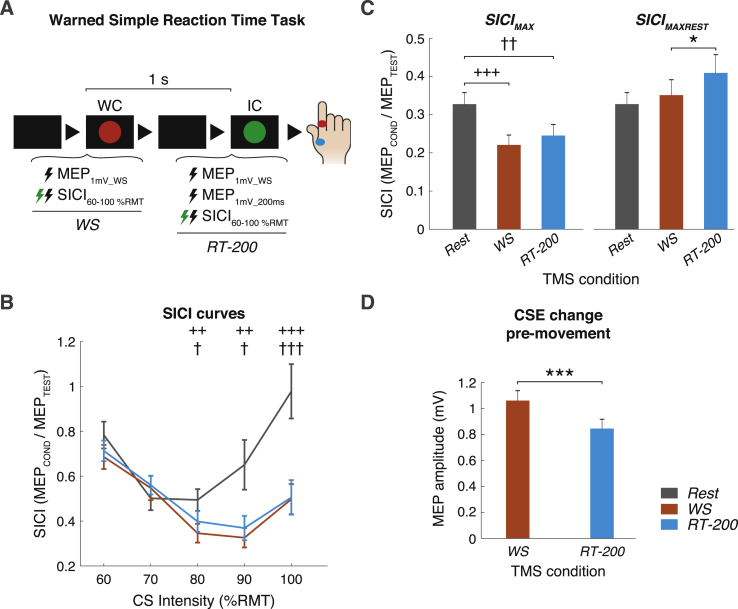
We measured SICI using a range of CS intensities at rest and during a warned simple reaction time task.
Our results show that SICI changes that occurred during the task could be either larger or smaller than at rest depending on the intensity of the CS. These findings indicate that careful interpretation of results are needed when a single intensity of CS is used to measure task-related physiological changes.
短潜伏期皮质内抑制(SICI)被广泛用于探测 M1 中的 GABA 能抑制机制。SICI 的任务相关变化被认为反映了 GABA 能通路的中枢兴奋性变化。通常,使用单个刺激强度来评估 SICI 的水平,以便在不同的大脑状态下比较抑制作用。
本文表明,这种方法有时可能不够充分,因为如果使用不同的 CS 强度,可能会得出不同的结论。
我们使用一系列 CS 强度在休息和预警简单反应时间任务期间测量 SICI。
我们的结果表明,取决于 CS 的强度,任务期间发生的 SICI 变化可能比休息时更大或更小。这些发现表明,当使用单个 CS 强度来测量与任务相关的生理变化时,需要仔细解释结果。