Peking University People's Hospital, Peking University Institute of Hematology, Beijing, China.
National Clinical Research Center for Hematologic Disease, Beijing, China.
Blood Adv. 2019 Nov 12;3(21):3406-3418. doi: 10.1182/bloodadvances.2019000564.
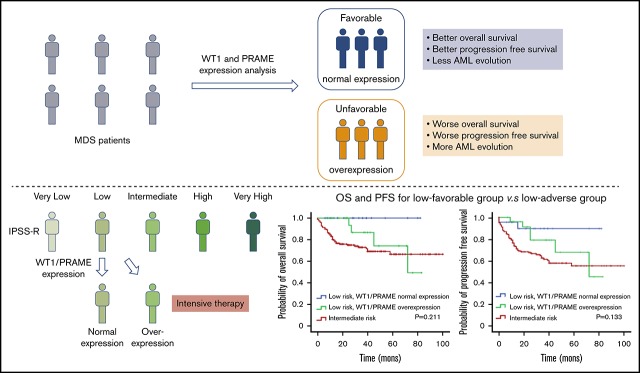
Thrombocytopenia is associated with life-threatening bleeding and is common in myelodysplastic syndromes (MDS). Robust molecular prognostic biomarkers need to be developed to improve clinical decision making for patients with MDS with thrombocytopenia. Wilms tumor 1 (WT1) and preferentially expressed antigen in melanoma (PRAME) are promising immunogenic antigen candidates for immunotherapy, and their clinical effects on patients with MDS with thrombocytopenia are still not well understood. We performed a multicenter observational study of adult patients with MDS with thrombocytopenia from 7 different tertiary medical centers in China. We examined bone marrow samples collected at diagnosis for WT1 and PRAME transcript levels and then analyzed their prognostic effect for patients with MDS with thrombocytopenia. In total, we enrolled 1110 patients diagnosed with MDS with thrombocytopenia. Overexpression of WT1 and PRAME was associated with elevated blast percentage, worse cytogenetics, and higher Revised International Prognostic Scoring System (IPSS-R) risk. Further, both WT1 and PRAME overexpression were independent poor prognostic factors for acute myeloid leukemia evolution, overall survival, and progression-free survival. Together, the 2 genes overexpression identified a population of patients with MDS with substantially worse survival. On the basis of WT1 and PRAME transcript levels, patients with MDS with IPSS-R low risk were classified into 2 significantly divergent prognostic risk groups: a low-favorable group and a low-adverse group. The low-adverse group had survival similar to that of patients in the intermediate-risk group. Our study demonstrates that the evaluation of WT1/PRAME transcript analysis may improve the prognostication precision and better risk-stratify the patients.
血小板减少症与危及生命的出血有关,并且在骨髓增生异常综合征(MDS)中很常见。需要开发强大的分子预后生物标志物,以改善血小板减少症 MDS 患者的临床决策。Wilms 肿瘤 1(WT1)和黑色素瘤优先表达抗原(PRAME)是免疫治疗有前途的免疫原性抗原候选物,但其对血小板减少症 MDS 患者的临床疗效尚不清楚。我们在中国 7 家不同的三级医疗中心对血小板减少症 MDS 成年患者进行了多中心观察性研究。我们检查了诊断时采集的骨髓样本中的 WT1 和 PRAME 转录水平,然后分析了它们对血小板减少症 MDS 患者的预后影响。我们共纳入了 1110 名诊断为血小板减少症 MDS 的患者。WT1 和 PRAME 的过度表达与原始细胞百分比升高、细胞遗传学恶化和更高的修订国际预后评分系统(IPSS-R)风险相关。此外,WT1 和 PRAME 的过度表达都是急性髓系白血病演变、总生存和无进展生存的独立不良预后因素。这两种基因的过度表达共同确定了一组生存情况明显较差的 MDS 患者。基于 WT1 和 PRAME 转录水平,IPSS-R 低危患者被分为 2 个明显不同的预后风险组:低有利组和低不利组。低不利组的生存与中危组患者相似。我们的研究表明,WT1/PRAME 转录分析的评估可能会提高预后的准确性,并更好地对患者进行风险分层。