Institute of Plant Science, Agricultural Research Organization - the Volcani Center, 7505101, Rishon LeZion, Israel.
BMC Genomics. 2019 Nov 12;20(1):843. doi: 10.1186/s12864-019-6217-9.
Intraspecific variations among induced responses might lead to understanding of adaptive variations in defense strategies against insects. We employed RNA-Seq transcriptome screening to elucidate the molecular basis for phenotypic differences between two populations of Eruca sativa (Brassicaceae), in defense against larvae of the generalist and specialist insects, Spodoptera littoralis and Pieris brassicae, respectively. The E. sativa populations originated from desert and Mediterranean sites, where the plants grow in distinct habitats.
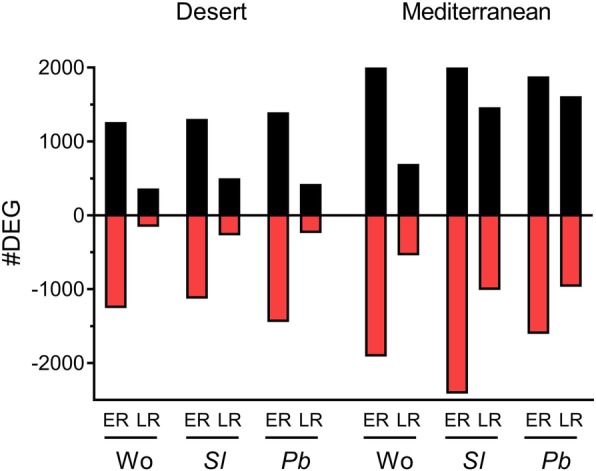
Responses to elicitation of the plants' defenses against wounding and insect herbivory resulted in more upregulated transcripts in plants of the Mediterranean population than in those of the desert. PCA analysis differentiated between the two populations and between the elicitation treatments. Comprehensive analysis indicated that defense responses involved induction of the salicylic acid and jasmonic acid pathways in plants of the desert and Mediterranean populations, respectively. In general, the defense response involved upregulation of the aliphatic glucosinolates pathway in plants of the Mediterranean population, whereas herbivory caused downregulation of this pathway in desert plants. Further quantitative RT-PCR analysis indicated that defense response in the desert plants involved higher expression of nitrile-specifier protein (NSP) than in the Mediterranean plants, suggesting that in the desert plants glucosinolates breakdown products are directed to simple-nitriles rather than to the more toxic isothiocyanates. In addition, the defense response in plants of the desert population involved upregulation of flavonoid synthesis and sclerophylly.
The results indicated that differing defense responses in plants of the two populations are governed by different signaling cascades. We suggest that adaptive ecotypic differentiation in defense strategies could result from generalist and specialist herbivore pressures in the Mediterranean and desert populations, respectively. Moreover, the defense responses in plants of the desert habitat, which include upregulation of mechanical defenses, also could be associated with their dual role in defense against both biotic and abiotic stresses.
诱导反应的种内变异可能有助于理解昆虫防御策略的适应性变化。我们采用 RNA-Seq 转录组筛选技术,阐明了两个芝麻菜(十字花科)种群在防御普通和专食性昆虫(分别为小地老虎和菜粉蝶)幼虫方面表型差异的分子基础。这两个芝麻菜种群起源于沙漠和地中海地区,植物生长在截然不同的生境中。
植物防御系统对创伤和昆虫取食的诱导反应导致地中海种群的转录本上调幅度大于沙漠种群。主成分分析(PCA)将两个种群和两种处理区分开来。综合分析表明,防御反应涉及沙漠和地中海种群中水杨酸和茉莉酸途径的诱导。一般来说,防御反应涉及地中海种群中脂肪族硫代葡萄糖苷途径的上调,而取食则导致沙漠种群中该途径的下调。进一步的定量 RT-PCR 分析表明,沙漠植物的防御反应涉及更高的腈特异性蛋白(NSP)表达,表明在沙漠植物中,硫代葡萄糖苷分解产物被引导到简单腈类,而不是更有毒的异硫氰酸盐。此外,沙漠种群植物的防御反应涉及类黄酮合成和木质化的上调。
结果表明,两个种群植物的不同防御反应受不同信号级联的控制。我们认为,分别在中温和沙漠种群中,专食性和广食性昆虫的压力导致了防御策略的适应性生态型分化。此外,沙漠生境植物的防御反应,包括机械防御的上调,也可能与其在生物和非生物胁迫下的双重防御作用有关。