Department of Radiation Oncology, the Second Affiliated Hospital, Zhejiang University School of Medicine, Jiefang Road 88, Hangzhou, 310009, People's Republic of China.
Cancer Institute (Ministry of Education Key Laboratory of Cancer Prevention and Intervention), Zhejiang University Cancer Institute, Hangzhou, 310009, People's Republic of China.
BMC Cancer. 2019 Nov 12;19(1):1087. doi: 10.1186/s12885-019-6292-y.
SOX2 is regarded as an important marker in stem cell. The change of SOX2 expression after adjuvant therapy in high grade glioma (HGG) remains unknown so far. Few patients with recurrent glioma have opportunity to undergo operation once again, so the recurrent glioma samples are scarce. This study tries to analyze SOX2 expression in paired primary and recurrent HGG, aims to better understand the transformation law of SOX2 after adjuvant therapy in HGG.
Twenty-four recurrent HGG patients who undergone a second resection were included. 16 patients received adjuvant therapy, the remaining 8 patients didn't receive any adjuvant therapy at all. The protein expression of SOX2 in paired primary and recurrent HGG was tested by immunohistochemistry. The statistical analysis was conducted by IBM SPSS Statistics 19.0.
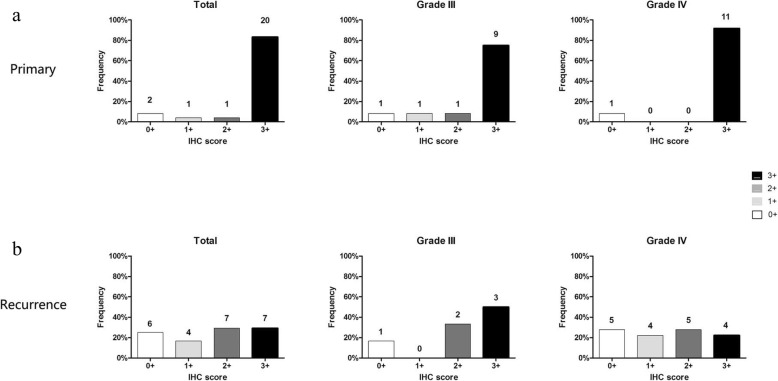
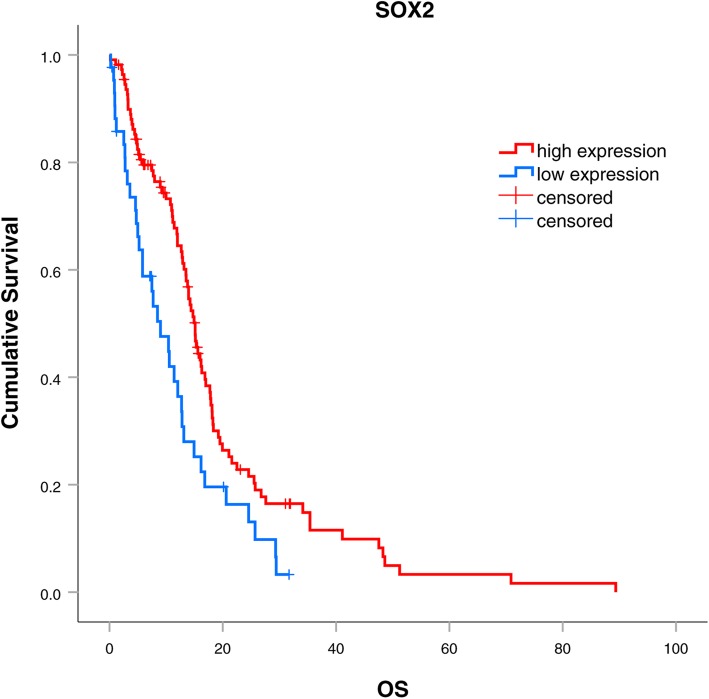
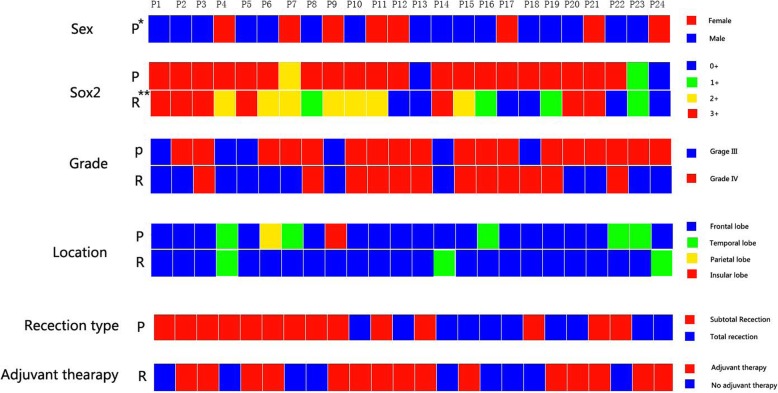
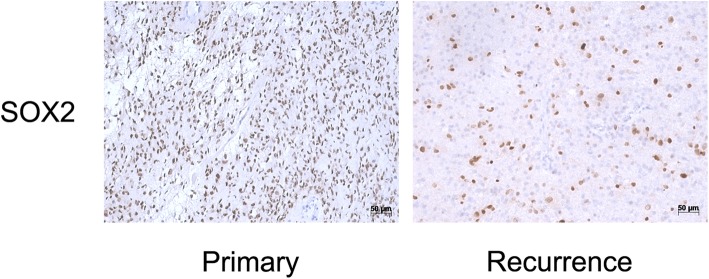
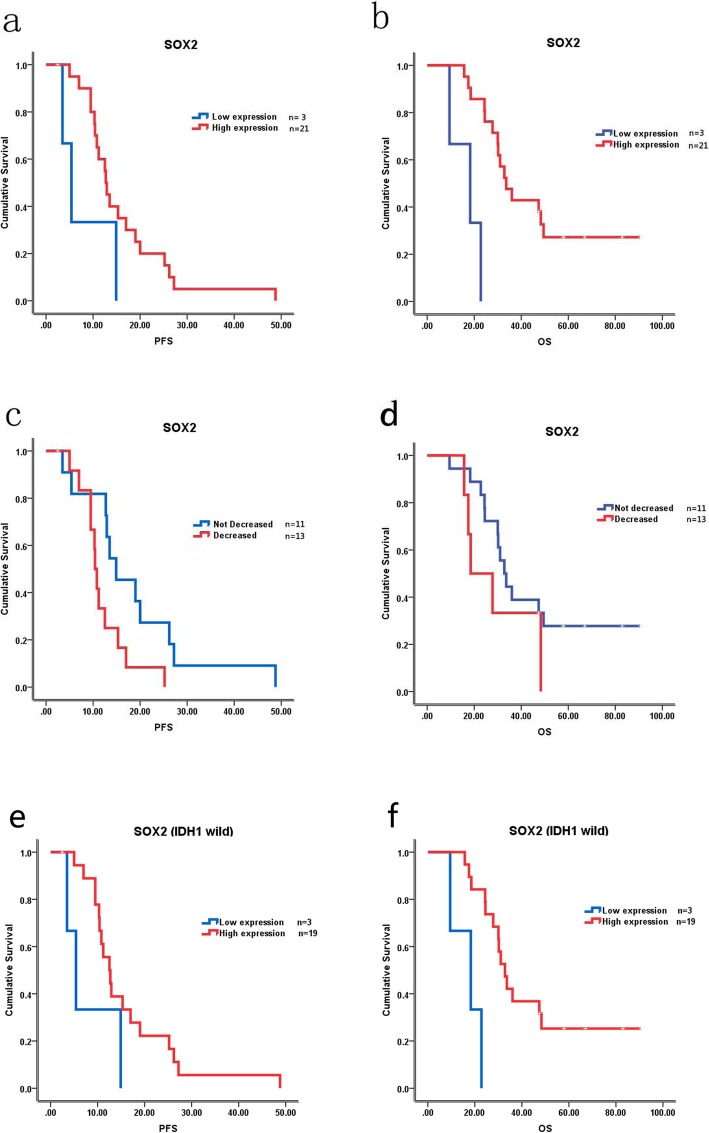
In primary HGG, SOX2 expression of 3 + , 2 + , 1+ and 0+ were seen in 20 (83.3%), 1 (4.2%), 1 (4.2%) and 2 cases (8.3%), respectively. The expression of SOX2 was decreased in recurrent HGG compared to the paired primary sample (p = 0.001). The decrease of SOX2 was often seen in patients received chemotherapy, radiotherapy or both (p = 0.003). Patients with SOX2 high expression in primary glioma had a longer median PFS than those with SOX2 low expression with marginal statistic significance (12.7 vs. 5.4 months, p = 0.083). For cases with SOX2 high expression in the primary glioma, those had SOX2 low expression after recurrence seemed to have worse prognosis as compared to patients with stable SOX2 high expression (PFS: 10.4 vs. 14.9 months, p = 0.036; OS: 27.0 vs 49.5 months, p = 0.005).
This is the first study comparing the protein expression of SOX2 in recurrent HGG and its paired primary tumor. SOX2 high expression is common in brain HGG, a tendency of decreased SOX2 expression in recurrent gliomas was evidenced. Lower SOX2 expression was seen in those patients who received adjuvant chemotherapy and/or radiotherapy. Patients with low SOX2 expression in primary HGG usually have poorer prognosis, those with SOX2 expression decreased in recurrent HGG had worse outcome.
SOX2 被认为是干细胞中的一个重要标志物。目前尚不清楚高级别胶质瘤(HGG)辅助治疗后 SOX2 表达的变化。很少有复发性胶质瘤患者有机会再次接受手术,因此复发性胶质瘤样本稀缺。本研究试图分析配对原发性和复发性 HGG 中 SOX2 的表达,旨在更好地了解 HGG 辅助治疗后 SOX2 的转化规律。
纳入 24 例接受二次切除术的复发性 HGG 患者。其中 16 例患者接受辅助治疗,其余 8 例患者未接受任何辅助治疗。采用免疫组织化学法检测配对原发性和复发性 HGG 中 SOX2 的蛋白表达。采用 IBM SPSS Statistics 19.0 进行统计学分析。
在原发性 HGG 中,SOX2 表达为 3+、2+、1+和 0+的分别为 20 例(83.3%)、1 例(4.2%)、1 例(4.2%)和 2 例(8.3%)。与配对原发性样本相比,复发性 HGG 中 SOX2 的表达降低(p=0.001)。SOX2 降低常见于接受化疗、放疗或两者联合治疗的患者(p=0.003)。原发性胶质瘤中 SOX2 高表达的患者无进展生存期(PFS)长于 SOX2 低表达的患者,差异具有统计学意义(12.7 个月 vs. 5.4 个月,p=0.083)。对于原发性胶质瘤中 SOX2 高表达的病例,与稳定的 SOX2 高表达患者相比,复发后 SOX2 低表达的患者预后更差(PFS:10.4 个月 vs. 14.9 个月,p=0.036;OS:27.0 个月 vs. 49.5 个月,p=0.005)。
这是第一项比较复发性 HGG 及其配对原发性肿瘤中 SOX2 蛋白表达的研究。SOX2 高表达常见于脑 HGG,复发性胶质瘤中存在 SOX2 表达降低的趋势。接受辅助化疗和/或放疗的患者中 SOX2 表达较低。原发性 HGG 中 SOX2 表达较低的患者通常预后较差,复发性 HGG 中 SOX2 表达降低的患者预后更差。