Division of Community Health, Tohoku University Graduate School of Medicine, Sendai, Miyagi, Japan.
Division of Cancer Epidemiology and Prevention, Miyagi Cancer Center Research Institute, Natori, Miyagi, Japan.
PLoS One. 2019 Nov 13;14(11):e0224797. doi: 10.1371/journal.pone.0224797. eCollection 2019.
It is unclear whether alcohol consumption may impact survival after breast cancer diagnosis. To clarify the association between pretreatment alcohol consumption and survival in breast cancer patients, a prospective patient cohort study was conducted.
The cohort comprised 1,420 breast cancer patients diagnosed during 1997-2013 at a single institute in Japan. Alcohol drinking and other lifestyle factors were assessed by questionnaire survey at the initial admission. The patients were followed until December 31, 2016. The crude associations of pretreatment alcohol intake with survival were evaluated by Kaplan-Meier analysis. The Cox proportional hazards model was used to estimate hazard ratios (HRs) and 95% confidence intervals (CIs) controlled by confounders.
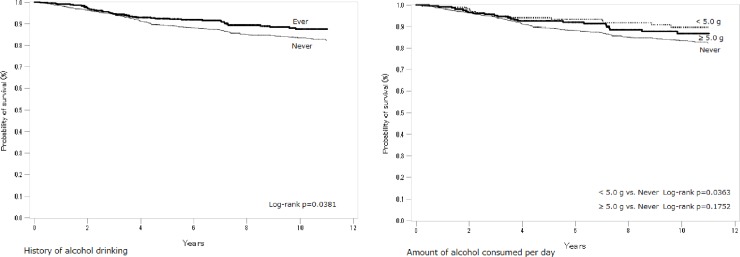
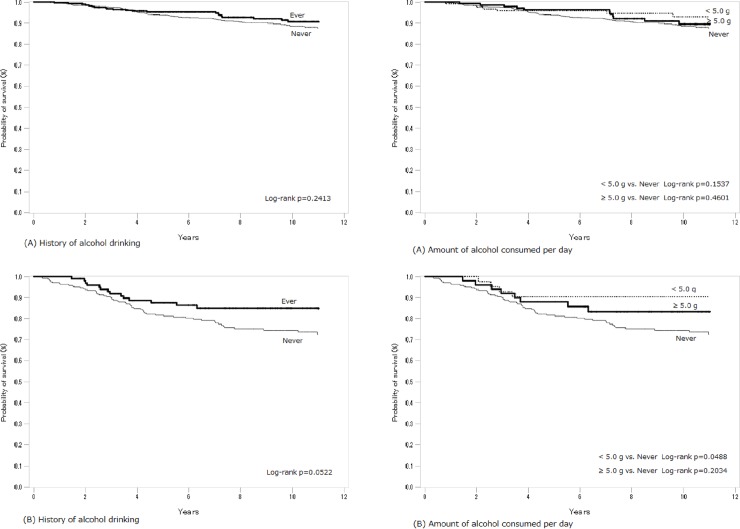
During a median follow-up period of 8.6 years, 261 all-cause and 193 breast cancer-specific deaths were documented. Survival curves showed that ever-drinkers tended to have better survival than never-drinkers (breast cancer-specific survival, log-rank p = 0.0381). Better survival was also observed for light drinkers with an intake of <5.0 g per day. In the Cox model, ever-drinking was associated with a decreased risk of all-cause (HR: 0.75; 95% CI: 0.54-1.05) and breast cancer-specific death (HR: 0.68; 95% CI: 0.46-0.99). Light drinkers had a lower risk of breast cancer-specific death (frequency of drinking, HR = 0.57 for occasional or 1-2 times per week and 0.72 for 3-7 times per week; amount of alcohol consumed per day, HR = 0.57 for <5.0 g and 0.68 for ≥5.0 g compared with never-drinking). In terms of hormone receptor status, a significantly decreased risk of death associated with ever-drinking was observed among women with receptor-negative cancer (ER-/PR-, HR = 0.41; 95% CI: 0.20-0.84 for breast cancer-specific death).
Pretreatment, i.e., pre-diagnosis alcohol consumption is unlikely to have an adverse effect on survival after breast cancer diagnosis. Light alcohol consumption may have a beneficial effect on patient survival.
目前尚不清楚饮酒是否会影响乳腺癌诊断后的生存。为了阐明乳腺癌患者治疗前饮酒与生存之间的关系,进行了一项前瞻性患者队列研究。
该队列包括 1997 年至 2013 年在日本一家医院诊断的 1420 名乳腺癌患者。在初次入院时通过问卷调查评估饮酒和其他生活方式因素。患者随访至 2016 年 12 月 31 日。通过 Kaplan-Meier 分析评估治疗前饮酒与生存的粗关联。使用 Cox 比例风险模型估计风险比 (HR) 和 95%置信区间 (CI),并通过混杂因素进行控制。
在中位随访 8.6 年期间,记录了 261 例全因和 193 例乳腺癌特异性死亡。生存曲线显示,曾经饮酒者的生存状况好于从不饮酒者(乳腺癌特异性生存,对数秩检验 p=0.0381)。每天摄入<5.0 克的轻度饮酒者也观察到更好的生存。在 Cox 模型中,曾经饮酒与全因死亡风险降低相关(HR:0.75;95%CI:0.54-1.05)和乳腺癌特异性死亡风险降低相关(HR:0.68;95%CI:0.46-0.99)。轻度饮酒者乳腺癌特异性死亡风险较低(饮酒频率,每周偶尔或 1-2 次 HR=0.57,每周 3-7 次 HR=0.72;每天饮酒量,HR=0.57,<5.0 g 和 HR=0.68,≥5.0 g 与从不饮酒相比)。就激素受体状态而言,在受体阴性癌症(ER-/PR-)的女性中,与曾经饮酒相关的死亡风险显著降低(HR=0.41;95%CI:乳腺癌特异性死亡 0.20-0.84)。
治疗前,即诊断前饮酒不太可能对乳腺癌诊断后的生存产生不利影响。轻度饮酒可能对患者生存有益。