Department of Psychosis Studies, Institute of Psychiatry, Psychology & Neuroscience, King's College London, London, United Kingdom.
Department of Neuroimaging, Institute of Psychiatry, Psychology & Neuroscience, King's College London, London, United Kingdom.
JAMA Psychiatry. 2020 Feb 1;77(2):190-200. doi: 10.1001/jamapsychiatry.2019.3501.
The development of adverse clinical outcomes in patients with psychosis has been associated with behavioral and neuroanatomical deficits related to emotion processing. However, the association between alterations in brain regions subserving emotion processing and clinical outcomes remains unclear.
To examine the association between alterations in emotion processing and regional gray matter volumes in individuals at clinical high risk (CHR) for psychosis, and the association with subsequent clinical outcomes.
DESIGN, SETTING, AND PARTICIPANTS: This naturalistic case-control study with clinical follow-up at 12 months was conducted from July 1, 2010, to August 31, 2016, and collected data from 9 psychosis early detection centers (Amsterdam, Basel, Cologne, Copenhagen, London, Melbourne, Paris, The Hague, and Vienna). Participants (213 individuals at CHR and 52 healthy controls) were enrolled in the European Network of National Schizophrenia Networks Studying Gene-Environment Interactions (EU-GEI) project. Data were analyzed from October 1, 2018, to April 24, 2019.
Emotion recognition was assessed with the Degraded Facial Affect Recognition Task. Three-Tesla magnetic resonance imaging scans were acquired from all participants, and gray matter volume was measured in regions of interest (medial prefrontal cortex, amygdala, hippocampus, and insula). Clinical outcomes at 12 months were evaluated for transition to psychosis using the Comprehensive Assessment of At-Risk Mental States criteria, and the level of overall functioning was measured through the Global Assessment of Functioning [GAF] scale.
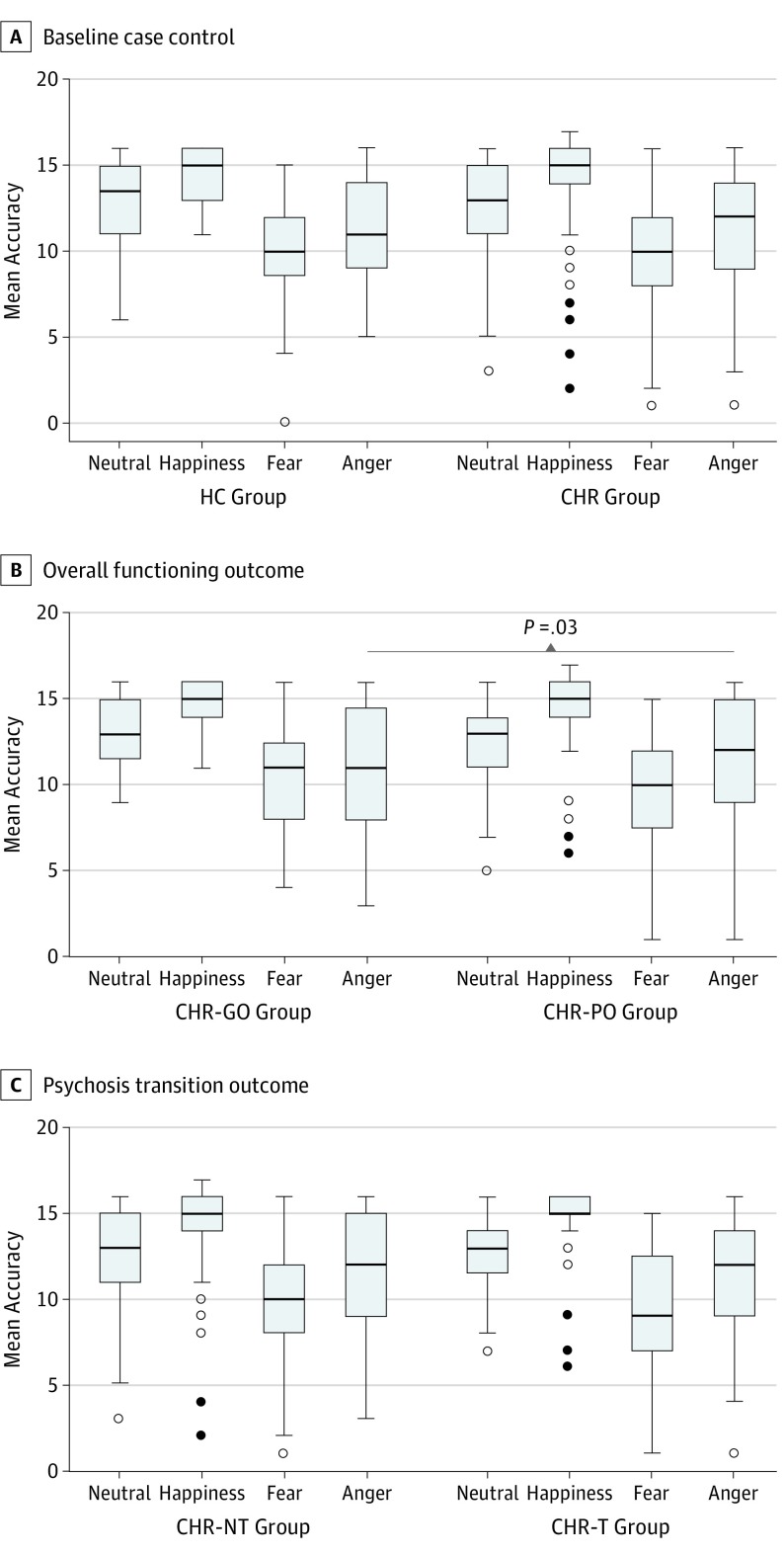
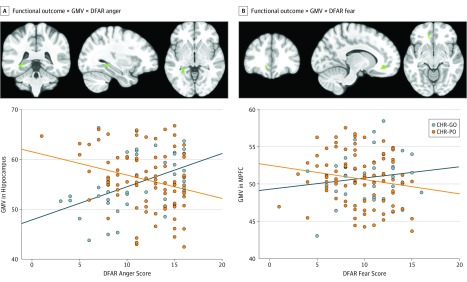
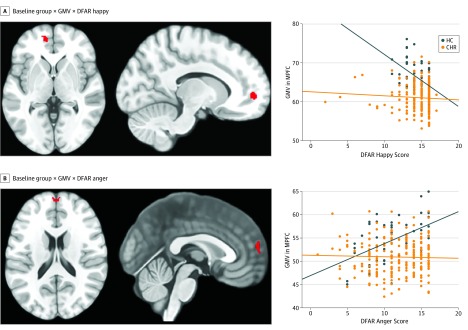
A total of 213 individuals at CHR (105 women [49.3%]; mean [SD] age, 22.9 [4.7] years) and 52 healthy controls (25 women [48.1%]; mean [SD] age, 23.3 [4.0] years) were included in the study at baseline. At the follow-up within 2 years of baseline, 44 individuals at CHR (20.7%) had developed psychosis and 169 (79.3%) had not. Of the individuals at CHR reinterviewed with the GAF, 39 (30.0%) showed good overall functioning (GAF score, ≥65), whereas 91 (70.0%) had poor overall functioning (GAF score, <65). Within the CHR sample, better anger recognition at baseline was associated with worse functional outcome (odds ratio [OR], 0.88; 95% CI, 0.78-0.99; P = .03). In individuals at CHR with a good functional outcome, positive associations were found between anger recognition and hippocampal volume (ze = 3.91; familywise error [FWE] P = .02) and between fear recognition and medial prefrontal cortex volume (z = 3.60; FWE P = .02), compared with participants with a poor outcome. The onset of psychosis was not associated with baseline emotion recognition performance (neutral OR, 0.93; 95% CI, 0.79-1.09; P = .37; happy OR, 1.03; 95% CI, 0.84-1.25; P = .81; fear OR, 0.98; 95% CI, 0.85-1.13; P = .77; anger OR, 1.00; 95% CI, 0.89-1.12; P = .96). No difference was observed in the association between performance and regional gray matter volumes in individuals at CHR who developed or did not develop psychosis (FWE P < .05).
In this study, poor functional outcome in individuals at CHR was found to be associated with baseline abnormalities in recognizing negative emotion. This finding has potential implications for the stratification of individuals at CHR and suggests that interventions that target socioemotional processing may improve functional outcomes.
精神病患者的不良临床结局与情绪处理相关的行为和神经解剖学缺陷有关。然而,与情绪处理相关的脑区变化和临床结局之间的关联仍不清楚。
研究精神分裂症高危个体(CHR)中情绪处理变化与脑区灰质体积的关系,以及与随后的临床结局的关系。
设计、地点和参与者:这是一项自然对照研究,有临床随访 12 个月,于 2010 年 7 月 1 日至 2016 年 8 月 31 日进行,收集了来自 9 个精神病早期检测中心(阿姆斯特丹、巴塞尔、科隆、哥本哈根、伦敦、墨尔本、巴黎、海牙和维也纳)的数据。参与者(213 名 CHR 和 52 名健康对照组)被纳入欧洲精神分裂症网络研究基因-环境相互作用(EU-GEI)项目。数据于 2018 年 10 月 1 日至 2019 年 4 月 24 日进行分析。
采用面部表情识别任务评估情绪识别。所有参与者均进行了 3T 磁共振成像扫描,在感兴趣的区域(内侧前额叶皮质、杏仁核、海马体和脑岛)测量灰质体积。使用风险精神状态综合评估标准评估 12 个月时的临床转归,使用总体功能评估(GAF)量表评估总体功能水平。
共纳入 213 名 CHR(105 名女性[49.3%];平均[SD]年龄 22.9[4.7]岁)和 52 名健康对照组(25 名女性[48.1%];平均[SD]年龄 23.3[4.0]岁)作为研究的基线。在基线后 2 年内的随访中,44 名 CHR(20.7%)发展为精神病,169 名(79.3%)未发展为精神病。在重新进行 GAF 评估的 CHR 中,39 名(30.0%)的总体功能良好(GAF 评分,≥65),91 名(70.0%)的总体功能较差(GAF 评分,<65)。在 CHR 样本中,基线时愤怒识别能力较好与较差的功能结果相关(优势比[OR],0.88;95%置信区间[CI],0.78-0.99;P=0.03)。在功能结果良好的 CHR 中,愤怒识别与海马体体积之间存在正相关(z=3.91;家族错误率[FWE]P=0.02),恐惧识别与内侧前额叶皮质体积之间存在正相关(z=3.60;FWE P=0.02),与功能结果较差的参与者相比。精神病的发病与基线时的情绪识别表现无关(中性 OR,0.93;95%CI,0.79-1.09;P=0.37;开心 OR,1.03;95%CI,0.84-1.25;P=0.81;恐惧 OR,0.98;95%CI,0.85-1.13;P=0.77;愤怒 OR,1.00;95%CI,0.89-1.12;P=0.96)。在发展或未发展为精神病的 CHR 中,表现与脑区灰质体积之间的关联无差异(FWE P<0.05)。
本研究发现,CHR 个体的功能结果较差与识别负性情绪的基线异常有关。这一发现对 CHR 个体的分层具有潜在意义,并表明针对社会情感处理的干预措施可能改善功能结果。