Muffly Matthew, Scheinker David, Muffly Tyler, Singleton Mark, Agarwal Rita, Honkanen Anita
Anesthesiology, Stanford University, Stanford, USA.
Department of Management Science and Engineering, Stanford University, Stanford, USA.
Cureus. 2019 Sep 24;11(9):e5745. doi: 10.7759/cureus.5745.
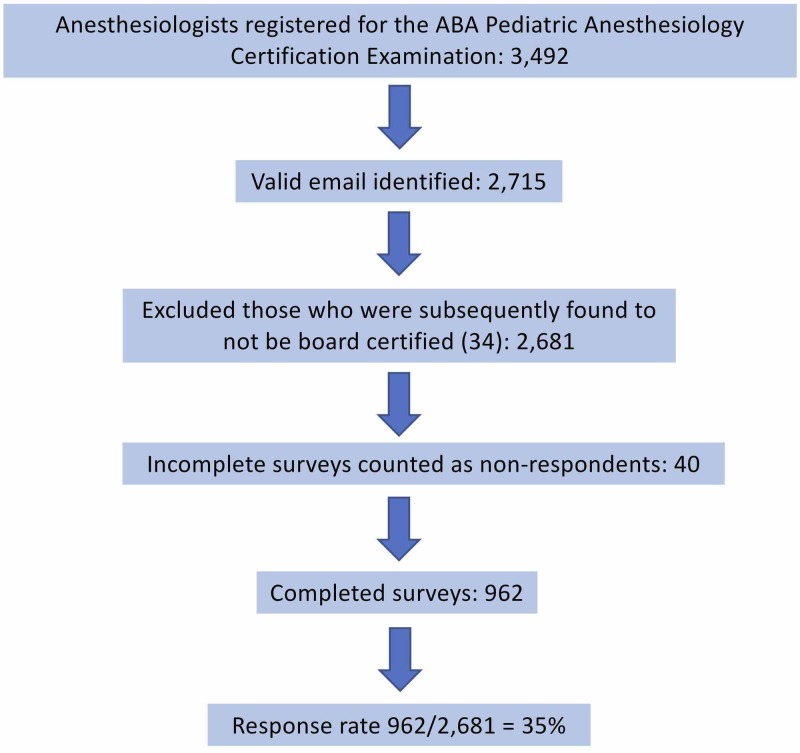
Introduction We conducted a survey to describe the practice characteristics of anesthesiologists who have passed the American Board of Anesthesiology (ABA) Pediatric Anesthesiology Certification Examination. Methods In July 2017, a list of anesthesiologists who had taken the ABA Pediatric Anesthesiology Certification Examination (hereafter referred to as "pediatric anesthesiologists") was obtained from the American Board of Anesthesiologists (theaba.org). Email contact information for these individuals was collected from departmental rosters, email distribution lists, hospital or anesthesia group profiles, manuscript author contact information, website source code, and other publicly available online sources. The survey was designed using Qualtrics (Qualtrics, Provo, Utah; Seattle, Washington), a web-based tool, to ascertain residency/fellowship training history and current practice characteristics that includes: years in practice, clinical work hours per week, primary hospital setting, practice type, supervision model, estimated percentage of cases by patient age group, and percentage of respondents who cared for any patient undergoing a fellowship-level index cases within the previous year. The invitation to complete the survey included a financial incentive - the chance to win one of twenty $50 Amazon gift cards. Results There were 3,492 anesthesiologists who had taken the Pediatric Anesthesiology Certification Examination since 2013. Surveys were sent to those whom an email address was identified (2,681) and 962 complete survey responses were received (35.9%, 962/2,681). Over 80% (785) of respondents completed a pediatric anesthesiology fellowship. Of these, 485 respondents (50.4%) work in academic practice, 212 (22.0%) in private practice, 233 (24.2%) in private practice and have academic affiliations, and 32 (3.3%) as locum tenens or in other practice settings. The majority of respondents (64.3%) in academic practice work in freestanding children's hospitals. Pediatric anesthesiologists in academic practice and private practice with academic affiliations reported caring for a greater number of younger children and doing a wider variety of index cases than respondents in private practice. Conclusion The extent to which pediatric anesthesiologists care for pediatric patients - particularly young children and those undergoing complex cases - varies. The variability in practice characteristics is likely a result of differences in hospital type, anesthesia practice type, geographic location, and other factors.
引言 我们开展了一项调查,以描述通过美国麻醉学委员会(ABA)儿科麻醉学认证考试的麻醉医生的执业特征。方法 2017年7月,从美国麻醉学委员会(theaba.org)获取了参加ABA儿科麻醉学认证考试的麻醉医生名单(以下简称“儿科麻醉医生”)。通过科室花名册、邮件列表、医院或麻醉小组简介、稿件作者联系信息、网站源代码及其他公开的在线资源收集这些人员的电子邮件联系方式。该调查使用基于网络的工具Qualtrics(Qualtrics,普罗沃,犹他州;西雅图,华盛顿州)进行设计,以确定住院医师/专科培训经历及当前的执业特征,包括:执业年限、每周临床工作时长、主要医院环境、执业类型、监督模式、按患者年龄组估算的病例百分比,以及在前一年中护理过任何接受专科水平索引病例患者的受访者百分比。完成调查的邀请包括一项经济激励——有机会赢得20张价值50美元的亚马逊礼品卡中的一张。结果 自2013年以来,有3492名麻醉医生参加了儿科麻醉学认证考试。向确定了电子邮件地址的人员发送了调查问卷(2681人),共收到962份完整的调查问卷回复(35.9%,962/2681)。超过80%(785人)的受访者完成了儿科麻醉学专科培训。其中,485名受访者(50.4%)从事学术性执业,212名(22.0%)从事私人执业,233名(24.2%)从事私人执业并具有学术附属关系,32名(3.3%)为临时执业医生或在其他执业环境中工作。在学术性执业的受访者中,大多数(64.3%)就职于独立的儿童医院。与私人执业的受访者相比,从事学术性执业以及具有学术附属关系的私人执业的儿科麻醉医生报告称护理的年幼儿童数量更多,且索引病例种类更多。结论 儿科麻醉医生护理儿科患者(尤其是年幼儿童和接受复杂病例的患者)的程度存在差异。执业特征的差异可能是医院类型、麻醉执业类型、地理位置及其他因素不同所致。