Department of Molecular Oncology, Moffitt Cancer Center and Research Institute, Tampa, FL.
Incyte Corporation, Wilmington, DE; and.
Blood Adv. 2019 Nov 26;3(22):3503-3514. doi: 10.1182/bloodadvances.2019000260.
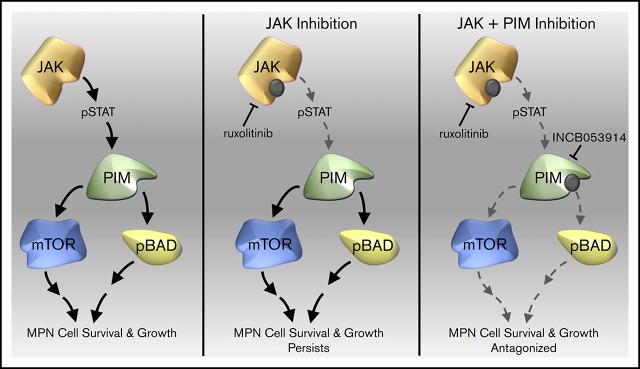
Aberrant JAK2 tyrosine kinase signaling drives the development of Philadelphia chromosome-negative myeloproliferative neoplasms (MPNs), including polycythemia vera, essential thrombocythemia, and primary myelofibrosis. However, JAK2 kinase inhibitors have failed to significantly reduce allele burden in MPN patients, underscoring the need for improved therapeutic strategies. Members of the PIM family of serine/threonine kinases promote cellular proliferation by regulating a variety of cellular processes, including protein synthesis and the balance of signaling that regulates apoptosis. Overexpression of PIM family members is oncogenic, exemplified by their ability to induce lymphomas in collaboration with c-Myc. Thus, PIM kinases are potential therapeutic targets for several malignancies such as solid tumors and blood cancers. We and others have shown that PIM inhibitors augment the efficacy of JAK2 inhibitors by using in vitro models of MPNs. Here we report that the recently developed pan-PIM inhibitor INCB053914 augments the efficacy of the US Food and Drug Administration-approved JAK1/2 inhibitor ruxolitinib in both in vitro and in vivo MPN models. INCB053914 synergizes with ruxolitinib to inhibit cell growth in JAK2-driven MPN models and induce apoptosis. Significantly, low nanomolar INCB053914 enhances the efficacy of ruxolitinib to inhibit the neoplastic growth of primary MPN patient cells, and INCB053914 antagonizes ruxolitinib persistent myeloproliferation in vivo. These findings support the notion that INCB053914, which is currently in clinical trials in patients with advanced hematologic malignancies, in combination with ruxolitinib may be effective in MPN patients, and they support the clinical testing of this combination in MPN patients.
异常的 JAK2 酪氨酸激酶信号驱动费城染色体阴性骨髓增殖性肿瘤(MPN)的发展,包括真性红细胞增多症、原发性血小板增多症和原发性骨髓纤维化。然而,JAK2 激酶抑制剂未能显著降低 MPN 患者的等位基因负担,这突显了需要改进治疗策略。丝氨酸/苏氨酸激酶 PIM 家族成员通过调节多种细胞过程,包括蛋白质合成和调节细胞凋亡的信号平衡,促进细胞增殖。PIM 家族成员的过表达是致癌的,例如它们与 c-Myc 协同诱导淋巴瘤的能力。因此,PIM 激酶是几种恶性肿瘤(如实体瘤和血液癌)的潜在治疗靶点。我们和其他人已经表明,PIM 抑制剂通过使用 MPN 的体外模型增强 JAK2 抑制剂的疗效。在这里,我们报告最近开发的泛 PIM 抑制剂 INCB053914 增强了美国食品和药物管理局批准的 JAK1/2 抑制剂鲁索利替尼在体外和体内 MPN 模型中的疗效。INCB053914 与鲁索利替尼协同抑制 JAK2 驱动的 MPN 模型中的细胞生长并诱导细胞凋亡。重要的是,低纳摩尔浓度的 INCB053914 增强了鲁索利替尼抑制原发性 MPN 患者细胞肿瘤生长的疗效,并且 INCB053914 在体内拮抗鲁索利替尼的持续骨髓增殖。这些发现支持这样的观点,即 INCB053914 目前正在接受晚期血液恶性肿瘤患者的临床试验,与鲁索利替尼联合使用可能对 MPN 患者有效,并且支持在 MPN 患者中测试这种联合用药。