Department of Child and Adolescent Psychiatry, Erasmus Medical Center, PO-Box 2040, 3000 CA Rotterdam, the Netherlands; The Generation R Study Group, Erasmus Medical Center, PO-Box 2040, 3000 CA Rotterdam, the Netherlands.
Department of Child and Adolescent Psychiatry, Erasmus Medical Center, PO-Box 2040, 3000 CA Rotterdam, the Netherlands; Department of Epidemiology, Erasmus Medical Center, PO-Box 2040, 3000 CA Rotterdam, the Netherlands.
Dev Cogn Neurosci. 2019 Dec;40:100724. doi: 10.1016/j.dcn.2019.100724. Epub 2019 Oct 25.
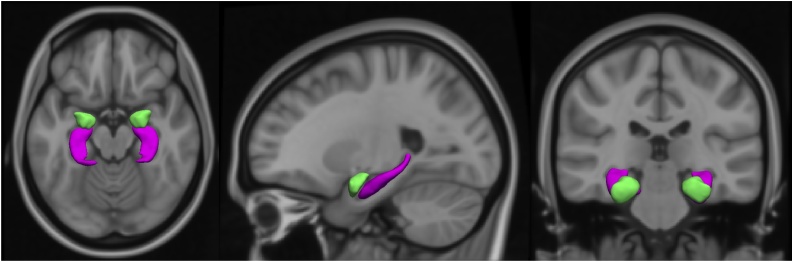
Poor quality of the early infant-parent bond predicts later child problems. Infant-parent attachment has been suggested to influence brain development, but this association has hardly been examined. In adults, larger amygdala volumes have been described in relation to early attachment disorganization; neuroimaging studies of attachment in children, however, are lacking. We examined the association between infant-parent attachment and brain morphology in 551 children from a population-based cohort in the Netherlands. Infant-parent attachment was observed with the Strange-Situation Procedure at age 14 months and different brain measures were collected with magnetic resonance imaging at mean age 10 years. Children with disorganized infant attachment had larger hippocampal volumes than those with organized attachment patterns. This finding was robust to the adjustment for confounders and consistent across hemispheres. The association was not explained by cognitive or emotional and behavioral problems. Disorganized attachment did not predict any other difference in brain morphology. Moreover, children with insecure organized infant attachment patterns did not differ from those who were securely attached in any brain outcome. Causality cannot be inferred, but our findings in this large population-based study provide novel evidence for a long-term association between the quality of infant-parent attachment and specific brain differences in childhood.
早期母婴关系质量差预示着日后儿童问题。母婴依恋关系被认为会影响大脑发育,但这一关联几乎没有被研究过。在成年人中,较大的杏仁核体积与早期依恋失调有关;然而,儿童依恋的神经影像学研究却很少。我们在荷兰的一个基于人群的队列中检查了 551 名儿童的母婴依恋与大脑形态之间的关系。在婴儿 14 个月大时,通过陌生情境程序观察母婴依恋关系,在平均年龄为 10 岁时使用磁共振成像采集不同的大脑测量值。与有组织的依恋模式相比,依恋关系紊乱的婴儿的海马体体积较大。这一发现经得起混杂因素的调整,在两个半球都是一致的。该关联不能用认知、情感和行为问题来解释。依恋关系紊乱也没有预测到大脑形态的任何其他差异。此外,与那些有安全依恋模式的婴儿相比,不安全的组织性依恋婴儿在任何大脑结果上都没有差异。不能推断因果关系,但我们在这项大型基于人群的研究中的发现为母婴依恋质量与儿童期特定大脑差异之间的长期关联提供了新的证据。