Clinic of Gastroenterology, University Hospital "Tsaritsa Yoanna - ISUL", Sofia, Bulgaria.
Department of Medical Sciences, University of Ferrara, Ferrara, Italy.
BMC Gastroenterol. 2019 Nov 14;19(1):185. doi: 10.1186/s12876-019-1102-1.
Bile acid malabsorption (BAM) and bile acid-related diarrhea represent an under-recognized cause of chronic diarrhea mainly because of limited guidance on appropriate diagnostic and laboratory tests. We aimed to perform a systematic review of the literature in order to identify and compare the diagnostic accuracy of different diagnostic methods for patients with BAM, despite a proven gold standard test is still lacking.
A PubMed literature review and a manual search were carried out. Relevant full papers, evaluating the diagnostic accuracy of different methods for BAM, were assessed. Available data were analyzed to estimate the sensitivity and specificity of each published test.
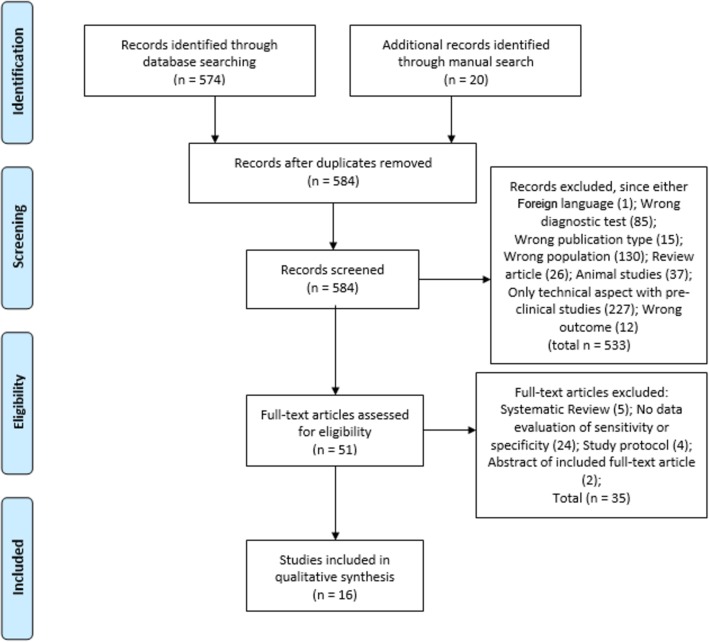
Overall, more than one test was considered in published papers on BAM. The search strategy retrieved 574 articles; of these, only 16 were full papers (with a total of 2.332 patients) included in the final review. Specifically, n = 8 studies used Selenium-homotaurocholic-acid-test (SeHCAT) with a < 10% retention threshold; n = 8 studies evaluated fasting serum 7-α-hydroxy-4-cholesten-3-one (C4); n = 3 studies involved total fecal bile acid (BA) excretion over 48 h; n = 4 studies assessed fibroblast growth factor 19 (FGF19). SeHCAT showed an average sensitivity and specificity of 87.32 and 93.2%, respectively, followed by serum C4 (85.2 and 71.1%) and total fecal BA (66.6 and 79.3%). Fasting serum FGF19 had the lowest sensitivity and specificity (63.8 and 72.3%). All the extracted data were associated with substantial heterogeneity.
Our systematic review indicates that SeHCAT has the highest diagnostic accuracy for BAM, followed by serum C4 assay. The diagnostic yield of fecal BA and FGF19 assays is still under investigation. Our review reinforces the need for novel biomarkers aimed to an objective detection of BAM and therefore improving the management of this condition.
胆酸吸收不良(BAM)和胆酸相关腹泻是慢性腹泻的一个未被充分认识的原因,主要是因为缺乏适当的诊断和实验室检测的指导。我们旨在进行系统的文献回顾,以确定和比较不同诊断方法对 BAM 患者的诊断准确性,尽管目前仍然缺乏一种经过验证的金标准检测方法。
进行了 PubMed 文献回顾和手动搜索。评估了不同方法对 BAM 诊断准确性的相关全文论文。分析了可用数据,以估计每个已发表测试的敏感性和特异性。
总体而言,在关于 BAM 的已发表论文中考虑了一种以上的检测方法。搜索策略检索到 574 篇文章;其中只有 16 篇是全文(共 2332 例患者)被纳入最终综述。具体而言,n=8 项研究使用硒-牛磺胆酸试验(SeHCAT),保留阈值<10%;n=8 项研究评估空腹血清 7-α-羟基-4-胆甾烷-3-酮(C4);n=3 项研究涉及 48 小时内总粪便胆酸(BA)排泄;n=4 项研究评估成纤维细胞生长因子 19(FGF19)。SeHCAT 的平均敏感性和特异性分别为 87.32%和 93.2%,其次是血清 C4(85.2%和 71.1%)和总粪便 BA(66.6%和 79.3%)。空腹血清 FGF19 的敏感性和特异性最低(63.8%和 72.3%)。所有提取的数据均与显著的异质性相关。
我们的系统综述表明,SeHCAT 对 BAM 的诊断准确性最高,其次是血清 C4 检测。粪便 BA 和 FGF19 检测的诊断效果仍在研究中。我们的综述强调需要新的生物标志物,旨在客观检测 BAM,从而改善这种情况的管理。