Department of Personality, Evaluation and Psychological Treatment, University of Granada, 18071 Granada, Spain.
Department of Physical Activity and Sports, University of Murcia, Santiago de la Ribera, 30720 Murcia, Spain.
Int J Environ Res Public Health. 2019 Nov 15;16(22):4525. doi: 10.3390/ijerph16224525.
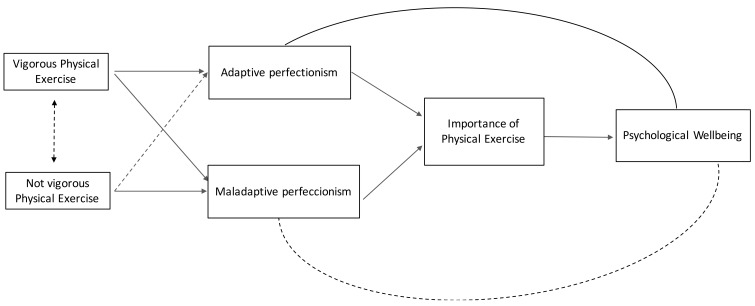
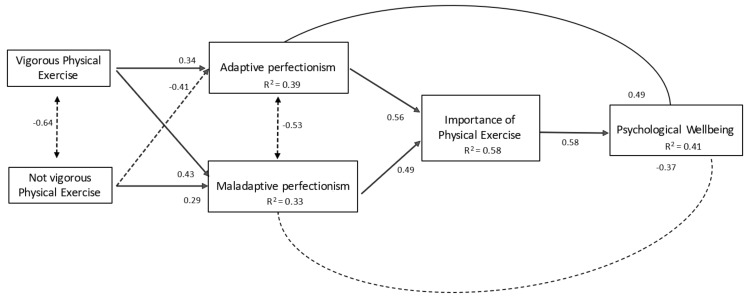
In the context of physical activity and sport, perfectionism and the regular practice of physical activity are related to psychological well-being and the regulation of psychological resources necessary for adaptation to effort and satisfaction. At the same time, the most active students are also those who show greater appetites for physical education classes. The goal of this work was to identify the influence of perfectionist beliefs and the regularity of the practice of physical exercise on psychological well-being. The participants were adolescents ( = 436) aged between 14 and 19 years (M = 16.80, SD = .77). They were administered the Multidimensional Perfection Scale, the Psychological Wellbeing Scale, the Global Physical Activity Questionnaire (GPAQv2), and a sociodemographic questionnaire. The results showed, under a non-random and transversal design, that the participants gave important value to physical exercise because they feel both active and vigorous. Regarding perfectionism, the functional aspects of perfectionism (expectations of achievement and organization) correlated positively, while the dysfunctional aspects (fear of committing errors and external expectations) did so negatively with the importance given to physical exercise performed by adolescents; this in turn positively predicted psychological well-being. In this way, the hypothesized model contemplated the relevance of the included variables and reflected the mediation of the degree of importance given to the practice of physical exercise on perfectionist beliefs and psychological well-being. Currently, most physical activity practice proposals for adolescents focus on federated and structured environments for competition, and those that deal with recreational and health-oriented sports are far less common. Hence, "the perfect way of doing sports" for a teenager should be accompanied by cognitive schemes aimed at strengthening psychological resources that allow the regulation of beliefs, attitudes, and behaviors.
在体育活动的背景下,完美主义和体育活动的定期实践与心理健康以及适应努力和满足感所需的心理资源的调节有关。同时,最活跃的学生也是那些对体育课表现出更大兴趣的学生。这项工作的目的是确定完美主义信念和体育锻炼的规律性对心理健康的影响。参与者为青少年(n=436),年龄在 14 至 19 岁之间(M=16.80,SD=.77)。他们接受了多维完美主义量表、心理幸福感量表、全球体育活动问卷(GPAQv2)和社会人口学问卷的测试。结果表明,在非随机和横断设计下,参与者非常重视体育锻炼,因为他们感到活跃和充满活力。关于完美主义,完美主义的功能方面(成就和组织的期望)呈正相关,而功能失调方面(对犯错误的恐惧和外部期望)则呈负相关,与青少年进行体育锻炼的重要性相关;这反过来又积极预测了心理健康。这样,假设模型考虑了包含变量的相关性,并反映了对完美主义信念和心理幸福感的重视程度对体育锻炼实践的中介作用。目前,大多数针对青少年的体育活动实践建议都侧重于联盟和结构化的竞争环境,而涉及娱乐和健康导向的体育活动的建议则要少得多。因此,青少年“完美的运动方式”应该伴随着认知模式,旨在增强心理资源,以调节信念、态度和行为。