Department of Radiology and Nuclear Medicine, University Medical Center Utrecht, Utrecht University, Heidelberglaan 100, 3584 CX, Utrecht, The Netherlands.
Clin Exp Metastasis. 2020 Feb;37(1):95-105. doi: 10.1007/s10585-019-10006-1. Epub 2019 Nov 15.
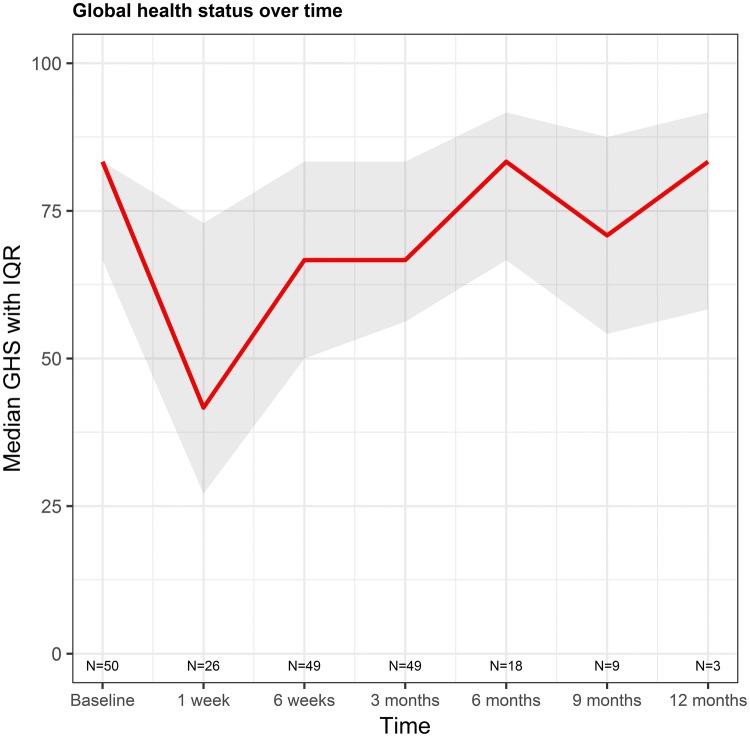
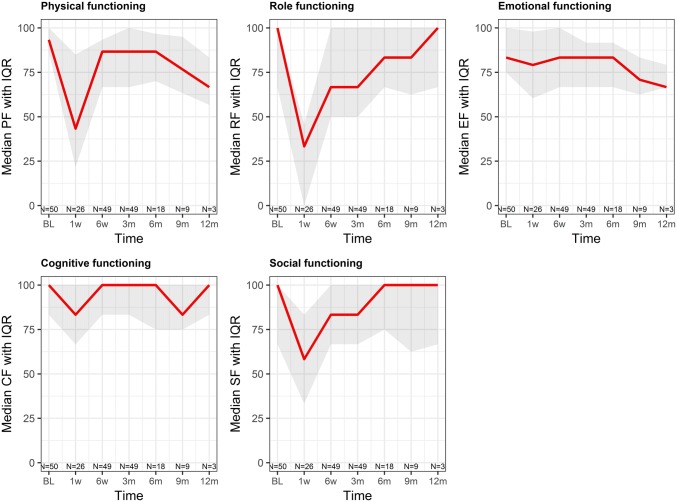
Holmium-166 radioembolization is a palliative treatment option for patients with unresectable hepatic malignancies. Its influence on quality of life has not been evaluated yet. Since quality of life is very important in the final stages of disease, the aim of this study was to evaluate the effect of holmium-166 radioembolization on quality of life. Patients with hepatic malignancies were treated with holmium-166 radioembolization in the HEPAR I and II studies. The European Organization for Research and Treatment of Cancer QLQ-C30 and LMC21 questionnaires were used to evaluate quality of life at baseline, 1 week, 6 weeks and at 6, 9 and 12 months after treatment. The course of the global health status and symptom and functioning scales were analyzed using a linear mixed model. Quality of life was studied in a total of 53 patients with a compliance of 94%. Role functioning was the most affected functioning scale. Fatigue and pain were the most affected symptom scales. Changes in almost all categories were most notable at 1 week after treatment. A higher WHO performance score at baseline decreased global health status, physical functioning, role functioning and social functioning and it increased symptoms of fatigue, dyspnea and diarrhea. Quality of life in salvage patients with liver metastases treated with holmium-166 radioembolization was not significantly affected over time, although a striking decline was seen during the first week post-treatment. A WHO performance score > 0 at baseline significantly influenced quality of life.
钬 166 放射性栓塞是一种不可切除的肝恶性肿瘤的姑息治疗选择。其对生活质量的影响尚未得到评估。由于生活质量在疾病的终末期非常重要,本研究旨在评估钬 166 放射性栓塞对生活质量的影响。在 HEPAR I 和 II 研究中,用钬 166 放射性栓塞治疗肝恶性肿瘤患者。采用欧洲癌症研究和治疗组织 EORTC QLQ-C30 和 LMC21 问卷在治疗前、治疗后 1 周、6 周以及治疗后 6、9 和 12 个月评估生活质量。采用线性混合模型分析全球健康状况以及症状和功能量表的进程。对 53 例患者进行了生活质量研究,其依从性为 94%。角色功能是受影响最严重的功能量表。疲劳和疼痛是受影响最严重的症状量表。治疗后 1 周,几乎所有类别的变化最为显著。治疗前 WHO 表现评分越高,全球健康状况、身体功能、角色功能和社会功能越差,疲劳、呼吸困难和腹泻症状越严重。接受钬 166 放射性栓塞治疗肝转移的挽救性患者的生活质量随时间推移并未显著受到影响,尽管治疗后第一周生活质量显著下降。治疗前 WHO 表现评分>0 显著影响生活质量。