Department of Orthopaedics and Rehabilitation, New York Presbyterian Queens, Weill Medical College of Cornell University, New York, NY, USA.
Ferring Pharmaceuticals, Parsippany, NJ, USA.
Adv Ther. 2020 Jan;37(1):344-352. doi: 10.1007/s12325-019-01142-x. Epub 2019 Nov 18.
Evidence has demonstrated greater benefit of intra-articular hyaluronic acid (IA-HA) within earlier stages of knee osteoarthritis (OA) rather than waiting for patients to have progressed to later stages of disease progression. High molecular weight (HMW) HA has also been shown to be more effective than low molecular weight (LMW) HA products in mild to moderate knee OA, providing an important distinction to make within the class of IA-HA therapies. The purpose of this study is to evaluate the cost-effectiveness of treating patients with knee OA with HMW HA compared to LMW and conservative treatment, while taking into account disease stage.
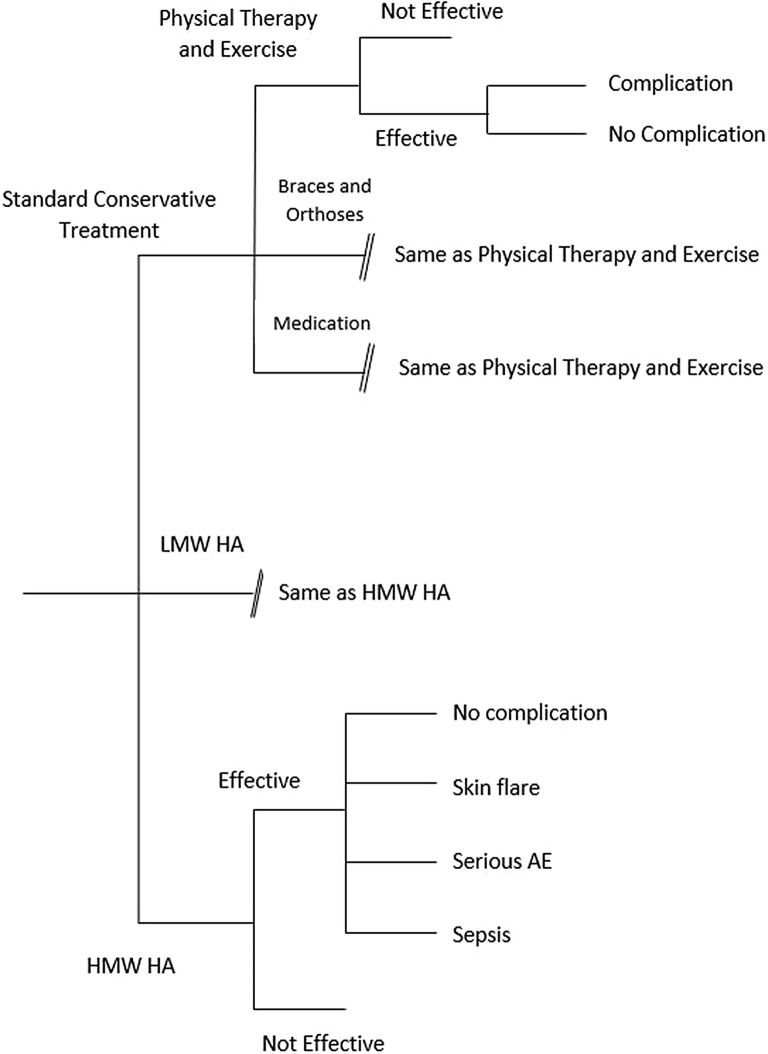
Decision analytic models were created for early/moderate, as well as late stage knee OA. Models for late stage knee OA were created by assuming a range of response rates to IA-HA treatments from 10% to 50%. These models included conservative treatment using physical therapy/exercise, braces/orthosis, and medications such as non-steroidal anti-inflammatory drugs (NSAIDs) and analgesics. The models compared the cost per quality adjusted life year (QALY) gained for these treatments to the use of either LMW or HMW HA. Incremental cost-effectiveness ratios (ICERs) were calculated for each treatment in relation to HMW HA.
When evaluating treatment in early to moderate knee OA, HMW HA was dominant over LMW HA and physical therapy/exercise, as it was less expensive and provided greater benefit. HMW HA was cost-effective versus braces/orthosis and NSAID/analgesic medications based on a willingness to pay threshold of $50,000. In the model of 50% response rate to IA-HA for late stage OA, HMW HA remained cost-effective in comparison to physical therapy/exercise and braces/orthosis at a willingness to pay threshold of $50,000; but not NSAID/analgesic medications. In the worst-case scenario of a 10% responder rate to IA-HA, HMW HA was no longer cost-effective in any circumstance.
IA-HA, particularly HMW formulations, demonstrate cost-effectiveness when compared to conservative treatment options and LMW HA in patients with early/mid stage knee OA. The cost-effectiveness of HMW HA in patients with later stage knee OA was not as apparent, particularly because of the uncertainty in the proportion of patients with late stage OA who have a meaningful improvement after receiving IA-HA. This cost-effectiveness finding supports the use of IA-HA in patients with early and moderate knee OA, as the benefits of IA-HA are apparent within the patient population with mild to moderate knee OA. The findings of this study suggest that there is a potential cost savings benefit as a result of utilizing HMW HA in earlier stages of knee OA as opposed to later stages.
Ferring Pharmaceuticals Inc.
有证据表明,在膝关节骨关节炎(OA)的早期阶段,关节内透明质酸(IA-HA)的益处大于等待患者进展到疾病进展的后期阶段。高分子量(HMW)HA 也已被证明比低分子量(LMW)HA 产品在轻度至中度膝关节 OA 中更有效,这在 IA-HA 治疗类别中是一个重要的区别。本研究的目的是评估与 LMW 和保守治疗相比,用 HMW HA 治疗膝关节 OA 患者的成本效益,同时考虑疾病阶段。
为早期/中期以及晚期膝关节 OA 建立了决策分析模型。晚期膝关节 OA 模型通过假设 IA-HA 治疗的反应率从 10%到 50%不等来创建。这些模型包括使用物理治疗/运动、支具/矫形器以及非甾体抗炎药(NSAIDs)和镇痛药等药物的保守治疗。这些模型比较了这些治疗方法相对于使用 LMW 或 HMW HA 的成本效益。对于每种治疗方法,相对于 HMW HA 计算了增量成本效益比(ICER)。
在评估早期至中期膝关节 OA 的治疗时,HMW HA 优于 LMW HA 和物理治疗/运动,因为它更便宜且提供了更大的益处。HMW HA 在经济上优于支具/矫形器和 NSAID/镇痛药,因为支付意愿阈值为 50,000 美元。在对晚期 OA 进行 50%IA-HA 反应率的模型中,HMW HA 在支付意愿阈值为 50,000 美元的情况下,与物理治疗/运动和支具/矫形器相比仍然具有成本效益;但不包括 NSAID/镇痛药。在对 IA-HA 的反应率为 10%的最坏情况下,在任何情况下,HMW HA 都不再具有成本效益。
与保守治疗选择和 LMW HA 相比,IA-HA,特别是 HMW 制剂,在早期/中期膝关节 OA 患者中具有成本效益。在晚期膝关节 OA 患者中,HMW HA 的成本效益并不明显,特别是因为接受 IA-HA 治疗后有明显改善的晚期 OA 患者比例存在不确定性。这一成本效益发现支持在早期和中期膝关节 OA 患者中使用 IA-HA,因为 IA-HA 的益处在轻度至中度膝关节 OA 患者中显而易见。本研究的结果表明,由于在膝关节 OA 的早期阶段使用 HMW HA 而不是在晚期阶段使用,可能会节省成本。
辉凌制药公司。
