Luo Xin, Hayes Lauren
College of Health Solutions, Arizona State University, Tempe, AZ, United States.
School of Arts, Media and Engineering, Arizona State University, Tempe, AZ, United States.
Front Neurosci. 2019 Oct 29;13:1145. doi: 10.3389/fnins.2019.01145. eCollection 2019.
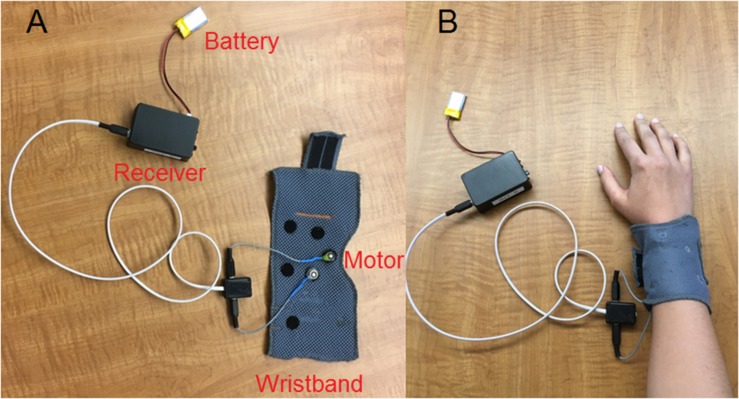
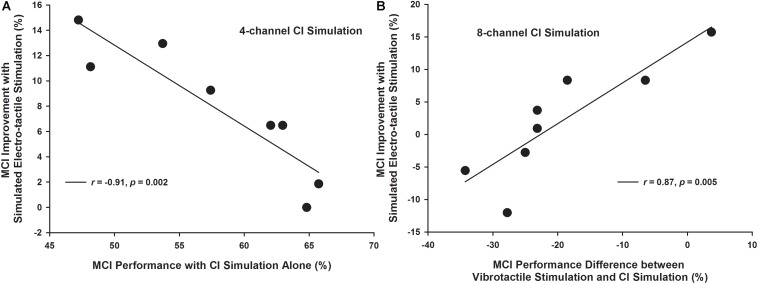
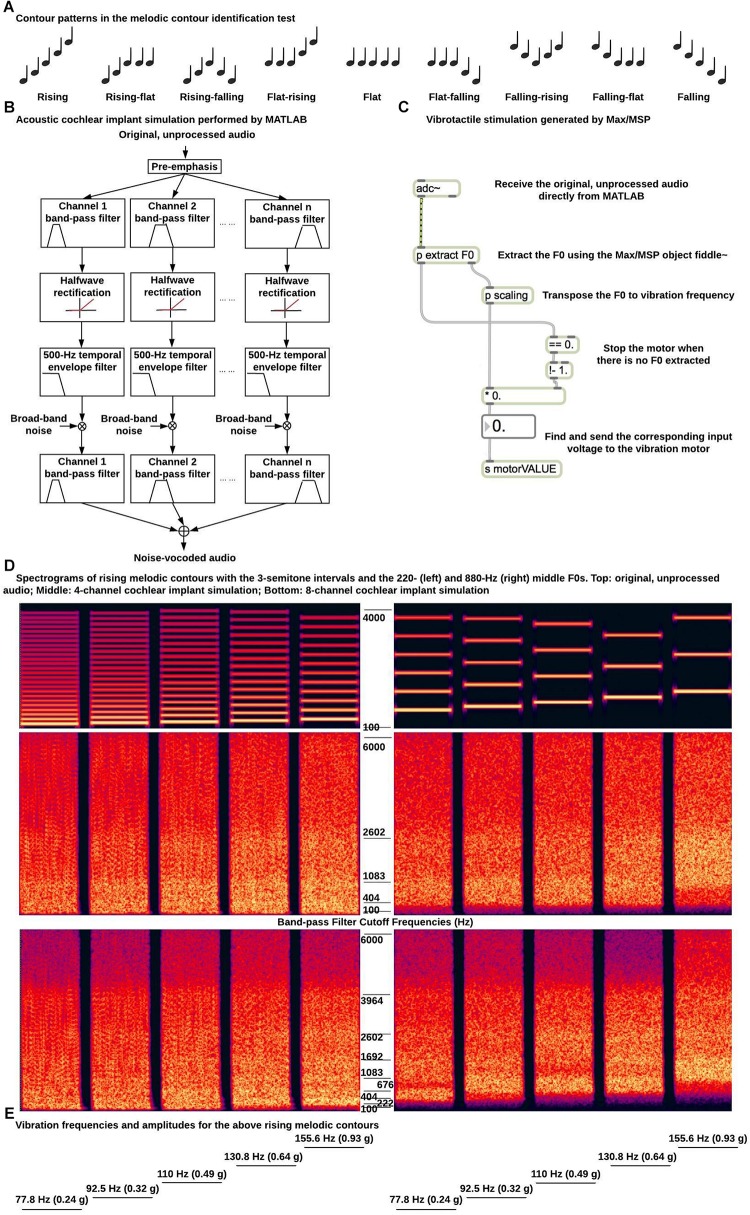
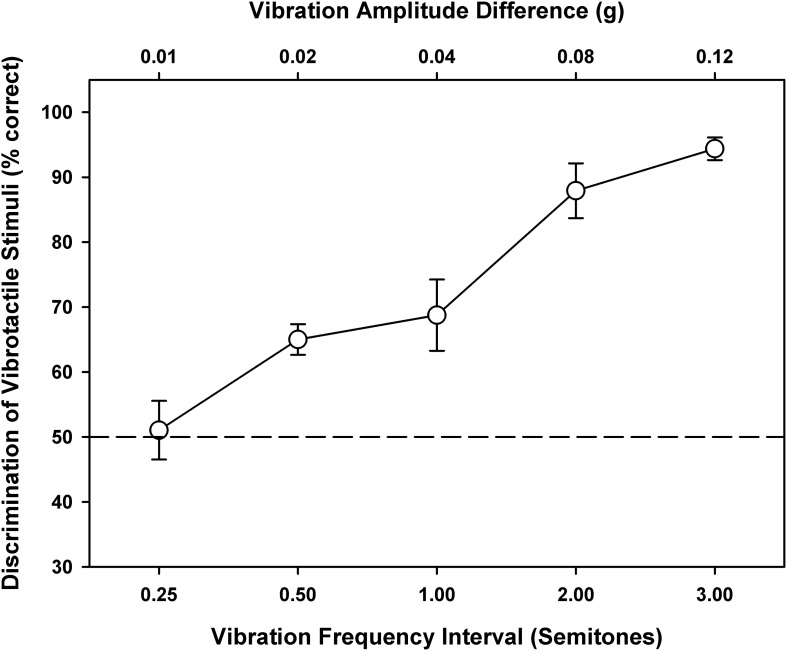
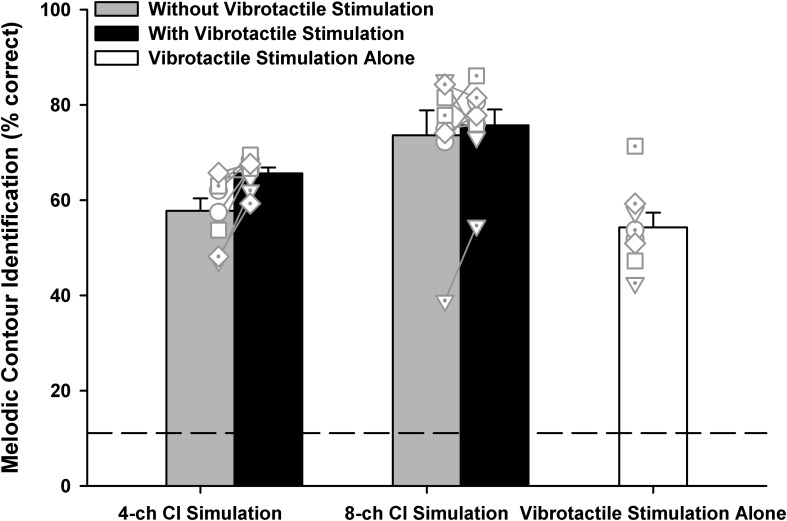
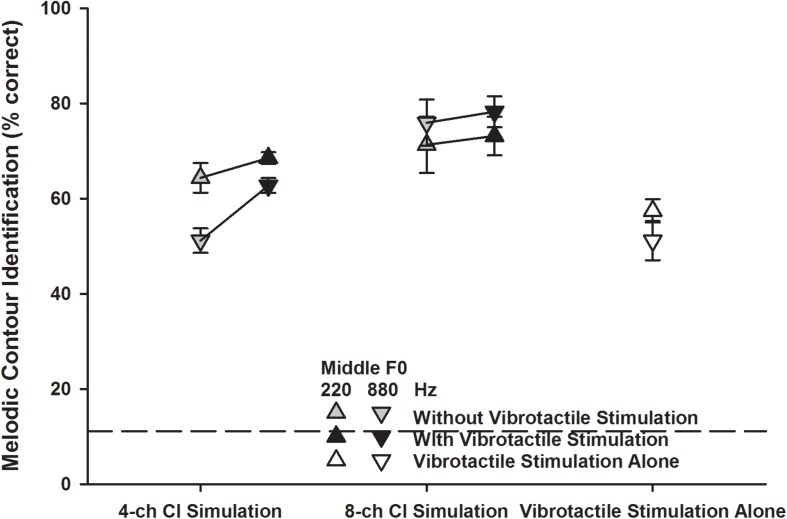
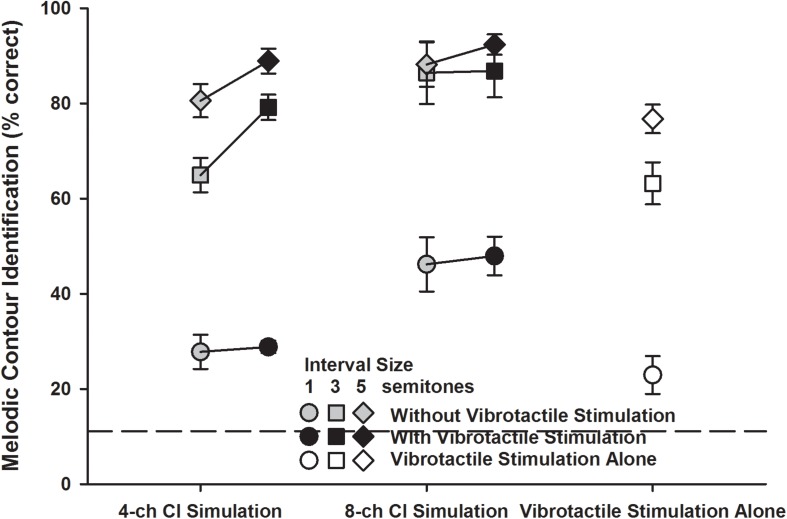
Cochlear implant (CI) users' poor speech recognition in noise and music perception may be both due to their limited access to pitch cues such as the fundamental frequency (F0). Recent studies showed that similar to residual low-frequency acoustic hearing, vibrotactile presentation of the F0 significantly improved speech recognition in noise of CI users. The present study tested whether F0-based vibrotactile stimulation can improve melodic contour identification (MCI) of normal-hearing listeners with acoustically simulated CI processing. Each melodic contour consisted of five musical notes with one of nine contour patterns (rising, falling, or flat in each half of the contour). The F0 of the middle note was 220 or 880 Hz, and the frequency intervals between adjacent notes were 1, 3, or 5 semitones. The F0 of each note was extracted in real time and transposed to a vibration frequency centered around 110 Hz at the right forearm top. MCI was tested in five experimental conditions (with a 4- or 8-channel CI simulation alone, vibrotactile stimulation alone, and 4- or 8-channel CI simulation plus vibrotactile stimulation), each after the same amount of brief training was provided. Results showed that discrimination of vibrotactile stimuli significantly improved from chance to near perfect as the vibration frequency interval increased from 0.25 to 3 semitones. The MCI performance with vibrotactile stimulation alone was similar to that with the 4-channel CI simulation alone, but was significantly worse than that with the 8-channel CI simulation alone. Significant improvement in MCI performance with the addition of vibrotactile stimulation was only found with the 4-channel CI simulation when the middle F0 was 880 Hz and when the frequency intervals were 3 or 5 semitones. The improvement in MCI performance with than without vibrotactile stimulation was significantly correlated with the baseline MCI performance with 4-channel CI simulation alone or with the MCI performance difference between vibrotactile stimulation and 8-channel CI simulation. Therefore, when the simulated or real CI performance is relatively poor, vibrotactile stimulation based on the F0 may improve MCI with acoustic CI simulations and perhaps in real CI users as well.
人工耳蜗(CI)使用者在噪声环境中的言语识别能力欠佳以及音乐感知能力较差,这可能都归因于他们获取诸如基频(F0)等音高线索的机会有限。近期研究表明,与残余低频听觉类似,F0的振动触觉呈现显著改善了CI使用者在噪声环境中的言语识别能力。本研究测试了基于F0的振动触觉刺激能否改善正常听力的聆听者在声学模拟CI处理情况下的旋律轮廓识别(MCI)。每个旋律轮廓由五个音符组成,共有九种轮廓模式之一(轮廓的每一半为上升、下降或水平)。中间音符的F0为220或880赫兹,相邻音符之间的频率间隔为1、3或5个半音。每个音符的F0实时提取并转换为围绕右前臂上方110赫兹的振动频率。在五种实验条件下测试MCI(单独进行4通道或8通道CI模拟、单独进行振动触觉刺激以及4通道或8通道CI模拟加振动触觉刺激),每种条件在提供相同量的简短训练后进行。结果表明,随着振动频率间隔从0.25增加到3个半音,振动触觉刺激的辨别能力从随机水平显著提高到接近完美。单独进行振动触觉刺激时的MCI表现与单独进行4通道CI模拟时相似,但显著差于单独进行8通道CI模拟时的表现。仅在中间F0为880赫兹且频率间隔为3或5个半音时,4通道CI模拟加上振动触觉刺激后MCI表现有显著改善。与没有振动触觉刺激相比,MCI表现的改善与单独进行4通道CI模拟时的基线MCI表现或振动触觉刺激与八通道CI模拟之间的MCI表现差异显著相关。因此,当模拟或实际的CI表现相对较差时,基于F0的振动触觉刺激可能会改善声学CI模拟情况下的MCI,或许对实际的CI使用者也有帮助。