Talwar Puneet, Kushwaha Suman, Gupta Renu, Agarwal Rachna
Department of Neurology, Institute of Human Behaviour and Allied Sciences (IHBAS), University of Delhi, Delhi, India.
Department of Microbiology, Institute of Human Behaviour and Allied Sciences (IHBAS), University of Delhi, Delhi, India.
Front Aging Neurosci. 2019 Oct 23;11:290. doi: 10.3389/fnagi.2019.00290. eCollection 2019.
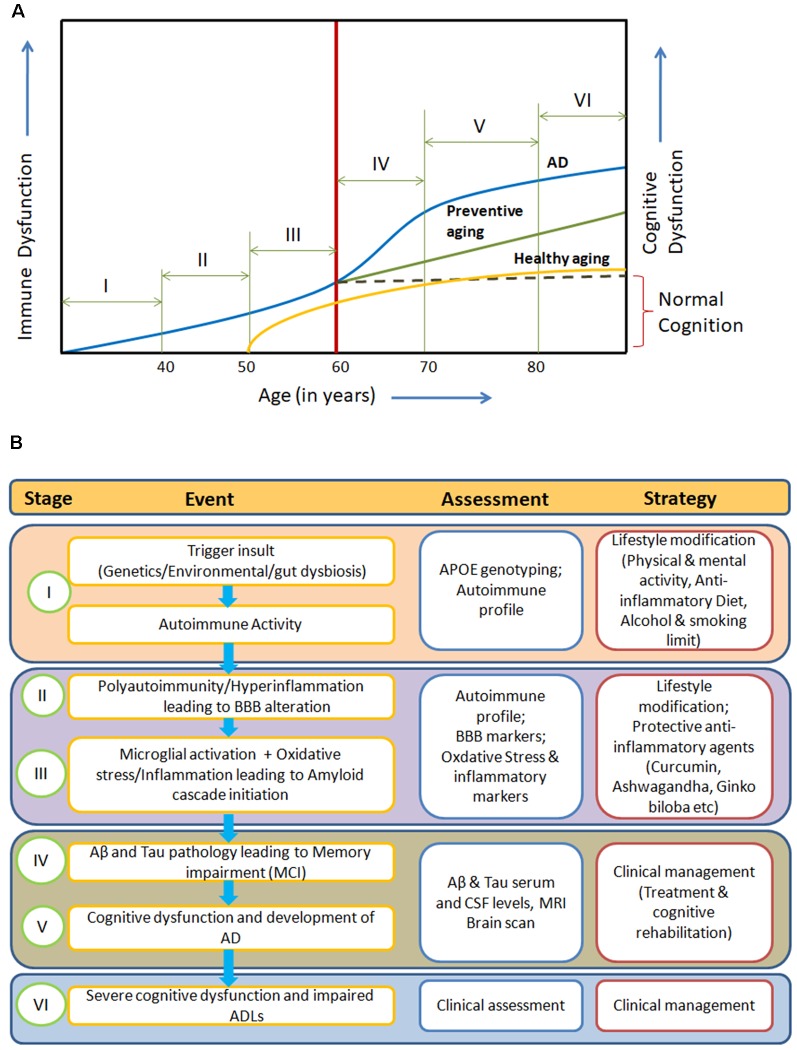
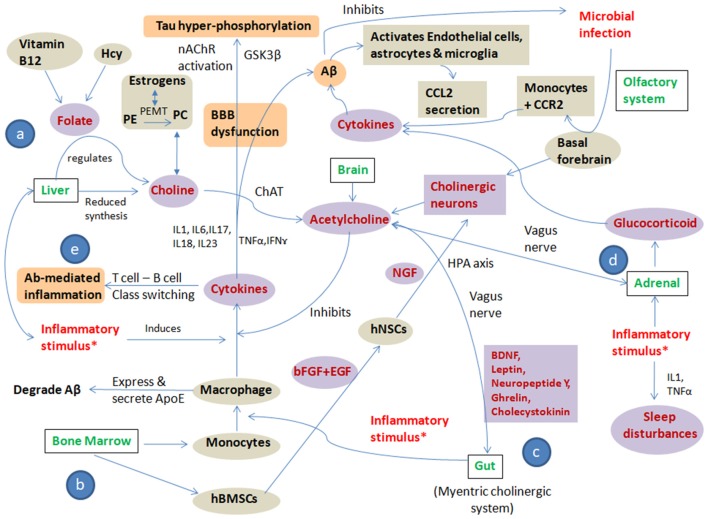
Alzheimer's disease (AD) still remains an enigma for researchers and clinicians. The onset of AD is insidious, gradually progressive and multifactorial. The recent accumulated scientific evidences suggests that the pathological changes resemble the autoimmune-driven self-sustaining inflammatory process as a result of prolonged oxidative stress and immune dyshomeostasis. Apart from aging, during life span various other factors-mainly environmental, lifestyle, chronic stress, polymicrobial infections and neuroendocrine functions-affect the immune system. Here, we provide crosstalk among "trigger insults/inflammatory stimulus" i.e., polymicrobial infection, chronic stress, pro-inflammatory diet and cholinergic signaling to put forward a "Systemic Immune Dyshomeostasis" model as to connect the events leading to AD development and progression. Our model implicates altered cholinergic signaling and suggests pathological stages with various modifiable risk factors and triggers at different chronological age and stage of cognitive decline. The search of specific autoantibodies for AD which may serve as the suitable blood/CSF biomarkers should be actively pursued for the early diagnosis of AD. The preventive and therapeutic strategies should be directed towards maintaining the normal functioning of the immune system throughout the life span and specific modulation of the immune responses in the brain depending on the stage of changes in brain.
阿尔茨海默病(AD)对研究人员和临床医生来说仍然是一个谜。AD的发病隐匿、逐渐进展且具有多因素性。最近积累的科学证据表明,由于长期氧化应激和免疫失调,其病理变化类似于自身免疫驱动的自我维持炎症过程。除衰老外,在生命周期中,各种其他因素——主要是环境、生活方式、慢性应激、多种微生物感染和神经内分泌功能——都会影响免疫系统。在此,我们阐述了“触发损伤/炎症刺激”(即多种微生物感染、慢性应激、促炎饮食和胆碱能信号)之间的相互作用,以提出一个“系统性免疫失调”模型,从而将导致AD发生和进展的事件联系起来。我们的模型涉及胆碱能信号改变,并提出了不同病理阶段,以及在认知衰退的不同时间年龄和阶段存在的各种可改变的风险因素和触发因素。应积极寻找可作为合适血液/脑脊液生物标志物的AD特异性自身抗体,用于AD的早期诊断。预防和治疗策略应旨在维持整个生命周期免疫系统的正常功能,并根据大脑变化阶段对大脑中的免疫反应进行特异性调节。