Hung Yu-Han, Kanke Matt, Kurtz Catherine Lisa, Cubitt Rebecca L, Bunaciu Rodica P, Zhou Liye, White Phillip J, Vickers Kasey C, Hussain Mohammed Mahmood, Li Xiaoling, Sethupathy Praveen
Department of Biomedical Sciences, Cornell University, Ithaca, NY, United States.
Department of Genetics, The University of North Carolina at Chapel Hill, Chapel Hill, NC, United States.
Front Physiol. 2019 Oct 29;10:1367. doi: 10.3389/fphys.2019.01367. eCollection 2019.
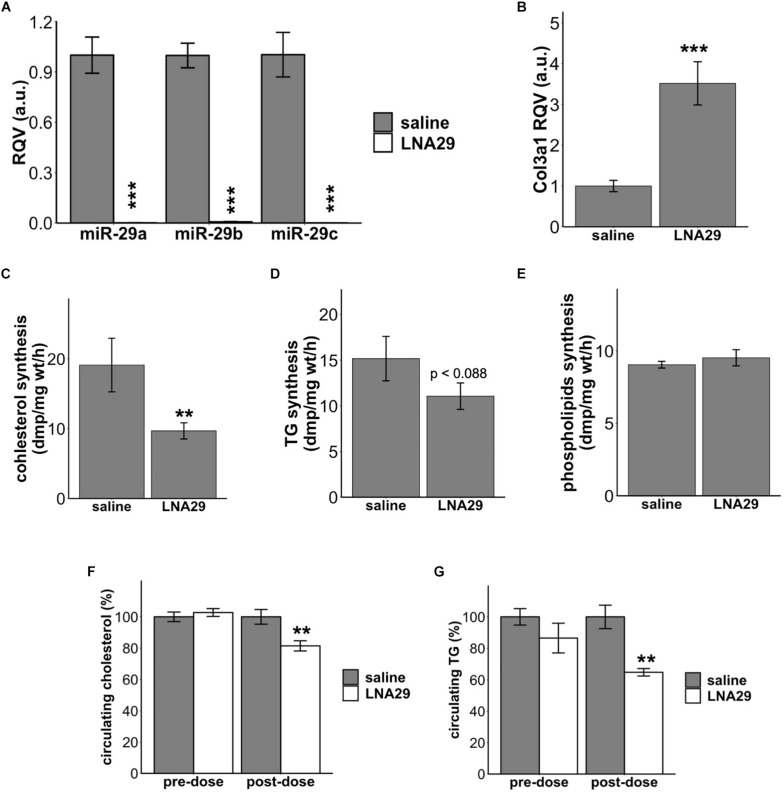
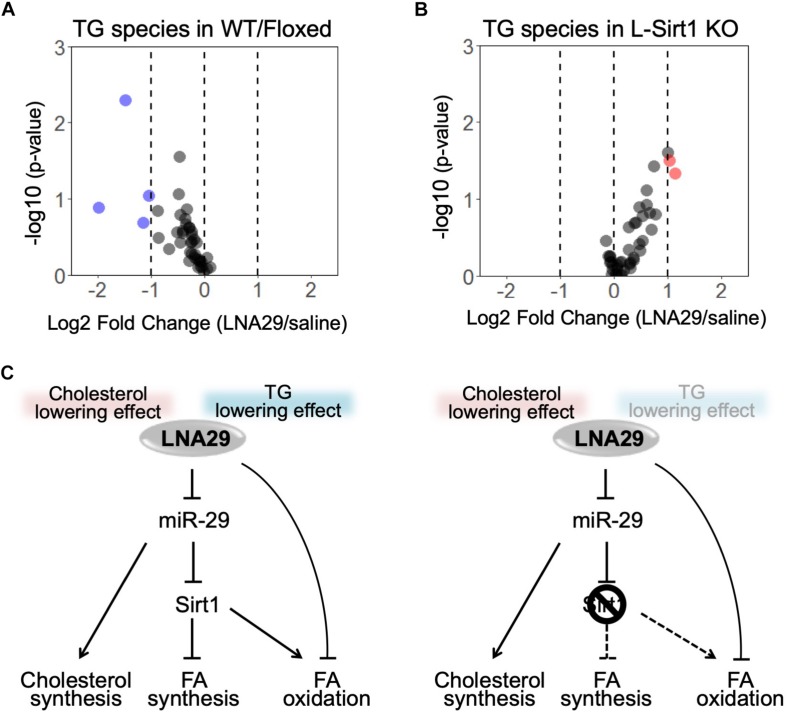
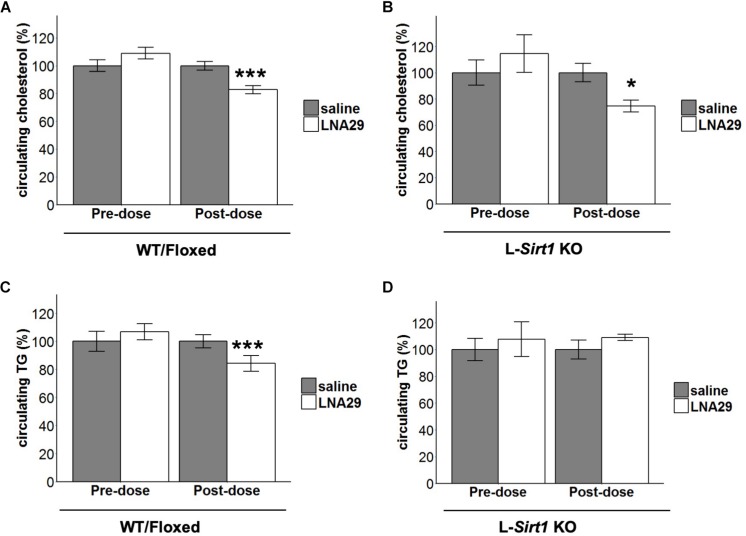
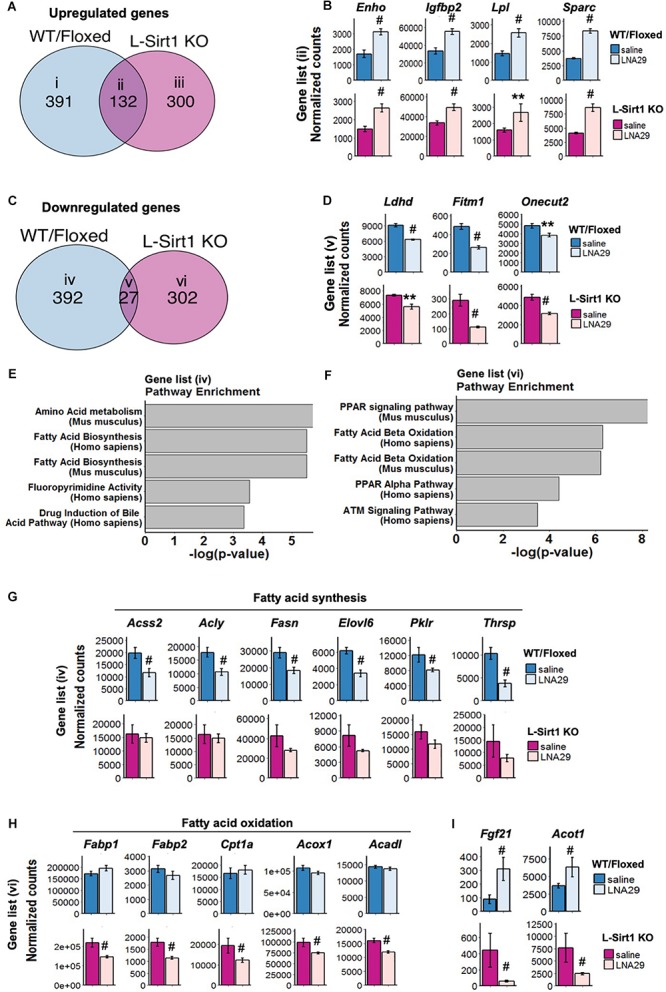
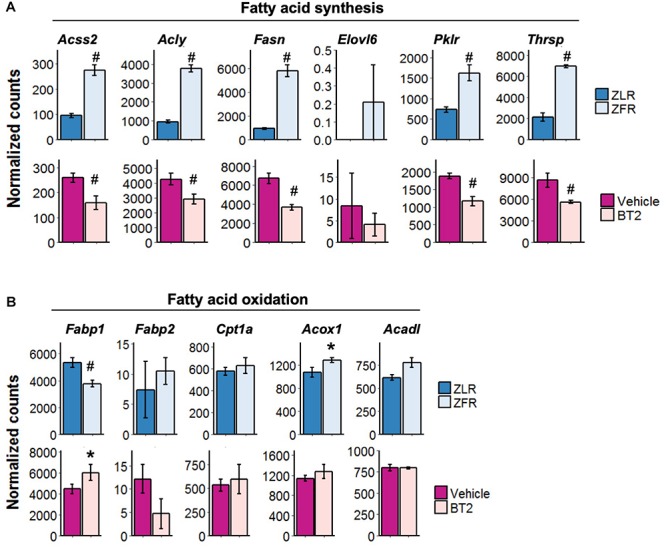
MicroRNAs (miRNAs) are known regulators of lipid homeostasis. We recently demonstrated that miR-29 controls the levels of circulating cholesterol and triglycerides, but the mechanisms remained unknown. In the present study, we demonstrated that systemic delivery of locked nucleic acid inhibitor of miR-29 (LNA29) through subcutaneous injection effectively suppresses hepatic expression of miR-29 and dampens lipogenesis (DNL) in the liver of chow-fed mice. Next, we used mice with liver-specific deletion of Sirtuin 1 (L- KO), a validated target of miR-29, and demonstrated that the LNA29-induced reduction of circulating triglycerides, but not cholesterol, is dependent on hepatic Sirt1. Moreover, lipidomics analysis revealed that LNA29 suppresses hepatic triglyceride levels in a liver-Sirt1 dependent manner. A comparative transcriptomic study of liver tissue from LNA29-treated wild-type/floxed and L- KO mice identified the top candidate lipogenic genes and hepatokines through which LNA29 may confer its effects on triglyceride levels. The transcriptomic analysis also showed that fatty acid oxidation (FAO) genes respond differently to LNA29 depending on the presence of hepatic Sirt1. Overall, this study demonstrates the beneficial effects of LNA29 on DNL and circulating lipid levels. In addition, it provides mechanistic insight that decouples the effect of LNA29 on circulating triglycerides from that of circulating cholesterol.
微小RNA(miRNA)是脂质稳态的已知调节因子。我们最近证明miR-29控制循环中胆固醇和甘油三酯的水平,但其机制仍不清楚。在本研究中,我们证明通过皮下注射系统性递送miR-29的锁核酸抑制剂(LNA29)可有效抑制正常饮食小鼠肝脏中miR-29的表达,并抑制肝脏中的脂肪生成(DNL)。接下来,我们使用肝脏特异性缺失沉默调节蛋白1(L-KO)的小鼠(miR-29的一个已验证靶点),并证明LNA29诱导的循环甘油三酯而非胆固醇的降低依赖于肝脏中的Sirt1。此外,脂质组学分析表明LNA29以肝脏Sirt1依赖的方式抑制肝脏甘油三酯水平。对LNA29处理的野生型/ floxed和L-KO小鼠肝脏组织进行的比较转录组学研究确定了LNA29可能通过其对甘油三酯水平产生影响的顶级候选脂肪生成基因和肝因子。转录组学分析还表明,脂肪酸氧化(FAO)基因对LNA29的反应因肝脏Sirt1的存在与否而有所不同。总体而言,本研究证明了LNA29对DNL和循环脂质水平的有益作用。此外,它提供了机制上的见解,将LNA29对循环甘油三酯的影响与对循环胆固醇的影响区分开来。