Lee Il-Ho, Kim Young-Ki, Kang Dong-Mug, Kim Se-Yeong, Kim In-Ah, Kim Eun-Mi
Department of Occupational & Environmental Medicine, Pusan National University Yangsan Hospital, Yangsan, Korea.
Department of Preventive and Occupational Medicine, School of Medicine, Pusan National University, Busan, Korea.
Ann Occup Environ Med. 2019 Nov 7;31:e31. doi: 10.35371/aoem.2019.31.e31. eCollection 2019.
The present study aimed to investigate the basic characteristics of carpal tunnel syndrome (CTS) and its differences between occupations using Korea's National Health Insurance (NHI) and National Employment Insurance (NEI).
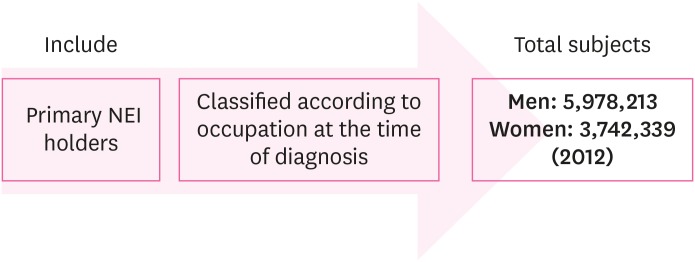
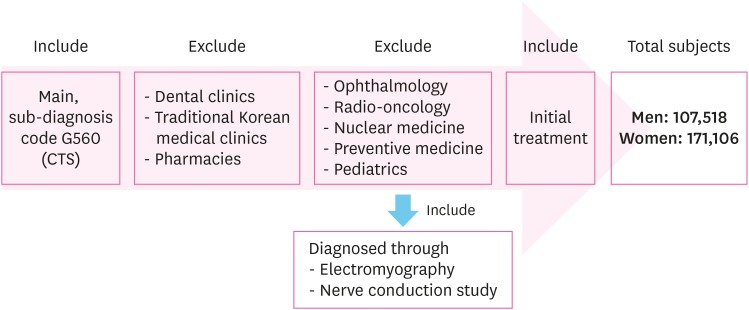
The study participants were obtained from the NEI and NHI data from 2008 to 2015, with a diagnosis code of G560 (CTS) as the main or sub-diagnosis. Data about gender, age, diabetes mellitus, smoking, drinking, and length of employment, information about type of occupation, and number of employees according to age and occupation were obtained from NHI and NEI data. In total, 240 occupations were classified into blue-collar (BC) and white-collar (WC) work. In addition, each occupation was classified as high-risk and low-risk groups depending on the degree of wrist usage.
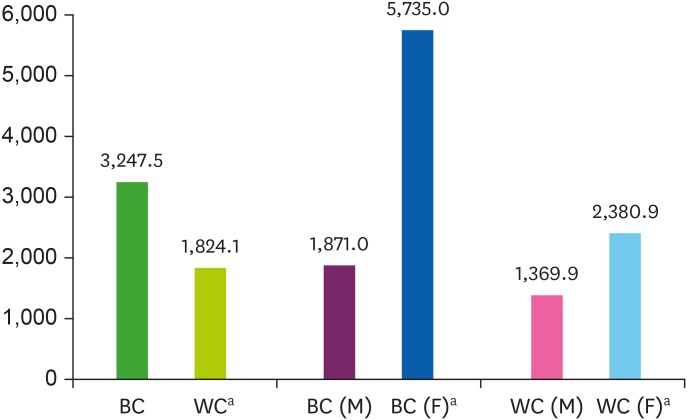
The number of patients with CTS per 100,000 individuals increased with advancing age, and it was higher in women (4,572.2) than in men (1,798.5). Furthermore, the number was higher in BC workers (3,247.5) than in WC workers (1,824.1) as well as in the high-risk group than in the low-risk group in both BC workers (3,527.8 vs. 1,908.2) and WC workers (1,829.9 vs. 1,754.4). The number of patients with CTS was higher in the high-risk group than in the low-risk group among male and female BC workers and female WC workers. However, the number was higher in the low-risk group among male WC workers. In the BC category, the number of patients with CTS was highest among food processing-related workers (19,984.5). In the WC category, the number of patients with CTS was highest among social workers and counselors (7,444.1).
The results of this study are expected to help identify occupational differences in patterns of CTS. High number of patients with CTS was seen in new jobs, as well as in previous studies.
本研究旨在利用韩国国民健康保险(NHI)和国民就业保险(NEI)调查腕管综合征(CTS)的基本特征及其职业差异。
研究参与者来自2008年至2015年的NEI和NHI数据,以诊断代码G560(CTS)作为主要或次要诊断。从NHI和NEI数据中获取有关性别、年龄、糖尿病、吸烟、饮酒和就业时长、职业类型信息以及按年龄和职业划分的员工数量。总共240种职业被分为蓝领(BC)和白领(WC)工作。此外,根据手腕使用程度,每种职业被分为高风险和低风险组。
每10万人中CTS患者数量随年龄增长而增加,女性(4572.2)高于男性(1798.5)。此外,BC工人(3247.5)中的患者数量高于WC工人(1824.1),并且在BC工人(3527.8对1908.2)和WC工人(1829.9对1754.4)中,高风险组的患者数量均高于低风险组。在男性和女性BC工人以及女性WC工人中,高风险组的CTS患者数量高于低风险组。然而,男性WC工人中低风险组的患者数量更高。在BC类别中,食品加工相关工人中的CTS患者数量最高(19984.5)。在WC类别中,社会工作者和顾问中的CTS患者数量最高(7444.1)。
本研究结果有望有助于识别CTS模式中的职业差异。在新工作以及先前的研究中都发现了大量CTS患者。