de la Cruz-López Karen G, Castro-Muñoz Leonardo Josué, Reyes-Hernández Diego O, García-Carrancá Alejandro, Manzo-Merino Joaquín
Programa de Doctorado en Ciencias Biomédicas, Instituto de Investigaciones Biomédicas, Universidad Nacional Autónoma de México, Ciudad Universitaria, Mexico City, Mexico.
Unidad de Investigación Biomédica en Cáncer, Instituto Nacional de Cancerología, México/Instituto de Investigaciones Biomédicas, Universidad Nacional Autónoma de México, Mexico City, Mexico.
Front Oncol. 2019 Nov 1;9:1143. doi: 10.3389/fonc.2019.01143. eCollection 2019.
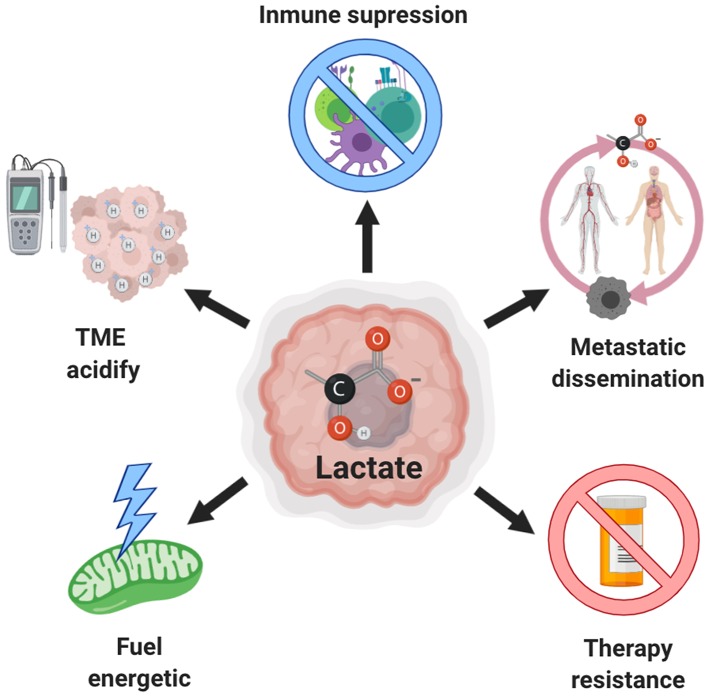
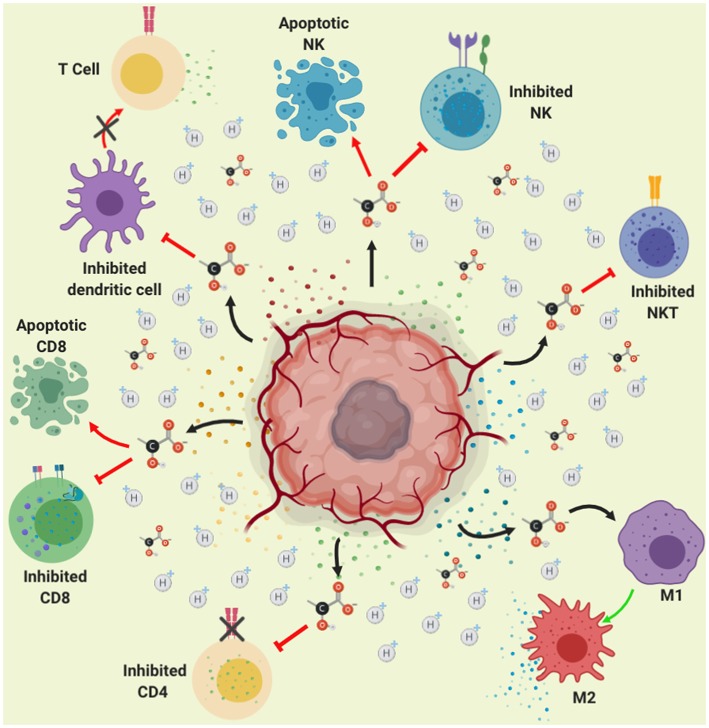
Tumor cells must generate sufficient ATP and biosynthetic precursors in order to maintain cell proliferation requirements. Otto Warburg showed that tumor cells uptake high amounts of glucose producing large volumes of lactate even in the presence of oxygen, this process is known as "Warburg effect or aerobic glycolysis." As a consequence of such amounts of lactate there is an acidification of the extracellular pH in tumor microenvironment, ranging between 6.0 and 6.5. This acidosis favors processes such as metastasis, angiogenesis and more importantly, immunosuppression, which has been associated to a worse clinical prognosis. Thus, lactate should be thought as an important oncometabolite in the metabolic reprogramming of cancer. In this review, we summarized the role of lactate in regulating metabolic microenvironment of cancer and discuss its relevance in the up-regulation of the enzymes lactate dehydrogenase (LDH) and monocarboxilate transporters (MCTs) in tumors. The goal of this review is to expose that lactate is not only a secondary product of cellular metabolic waste of tumor cells, but also a key molecule involved in carcinogenesis as well as in tumor immune evasion. Finally, the possible targeting of lactate production in cancer treatment is discussed.
肿瘤细胞必须产生足够的三磷酸腺苷(ATP)和生物合成前体,以维持细胞增殖的需求。奥托·瓦尔堡发现,肿瘤细胞即使在有氧的情况下也会摄取大量葡萄糖,产生大量乳酸,这一过程被称为“瓦尔堡效应或有氧糖酵解”。由于产生了如此大量的乳酸,肿瘤微环境中的细胞外pH值会酸化,范围在6.0至6.5之间。这种酸中毒有利于转移、血管生成等过程,更重要的是有利于免疫抑制,而免疫抑制与更差的临床预后相关。因此,乳酸应被视为癌症代谢重编程中的一种重要的肿瘤代谢物。在这篇综述中,我们总结了乳酸在调节癌症代谢微环境中的作用,并讨论了其与肿瘤中乳酸脱氢酶(LDH)和单羧酸转运蛋白(MCTs)上调的相关性。这篇综述的目的是揭示乳酸不仅是肿瘤细胞细胞代谢废物的次要产物,而且是参与致癌作用以及肿瘤免疫逃逸的关键分子。最后,讨论了癌症治疗中针对乳酸产生的可能靶点。