Division of Infectious Diseases and Geographic Medicine, Department of Medicine.
Department of Pathology, and.
Blood Adv. 2019 Nov 26;3(22):3602-3612. doi: 10.1182/bloodadvances.2019000634.
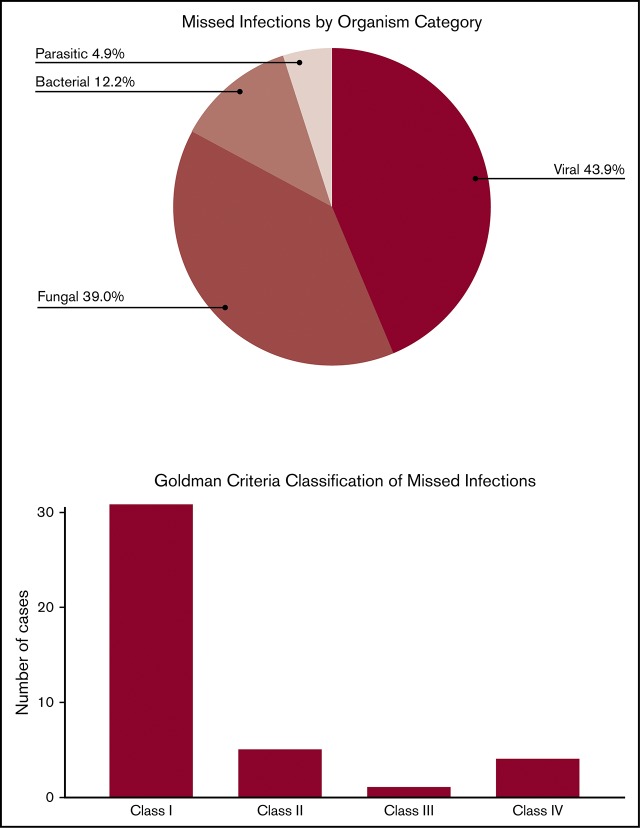
Hematopoietic cell transplantation (HCT) is potentially curative for patients with hematologic disorders, but carries significant risks of infection-related morbidity and mortality. Infectious diseases are the second most common cause of death in HCT recipients, surpassed only by progression of underlying disease. Many infectious diseases are difficult to diagnose and treat, and may only be first identified by autopsy. However, autopsy rates are decreasing despite their value. The clinical and autopsy records of adult HCT recipients at our center who underwent autopsy between 1 January 2000 and 31 December 2017 were reviewed. Discrepancies between premortem clinical diagnoses and postmortem autopsy diagnoses were evaluated. Of 185 patients who underwent autopsy, 35 patients (18.8%) had a total of 41 missed infections. Five patients (2.7%) had >1 missed infection. Of the 41 missed infections, 18 (43.9%) were viral, 16 (39.0%) were fungal, 5 (12.2%) were bacterial, and 2 (4.9%) were parasitic. According to the Goldman criteria, 31 discrepancies (75.6%) were class I, 5 (12.2%) were class II, 1 (2.4%) was class III, and 4 (9.8%) were class IV. Autopsies of HCT recipients frequently identify clinically significant infectious diseases that were not suspected premortem. Had these infections been suspected, a change in management might have improved patient survival in many of these cases. Autopsy is underutilized and should be performed regularly to help improve infection-related morbidity and mortality. Illustrative cases are presented and the lessons learned from them are also discussed.
造血细胞移植(HCT)对血液系统疾病患者具有潜在的治愈作用,但也存在严重的感染相关发病率和死亡率风险。传染病是 HCT 受者的第二大死亡原因,仅次于基础疾病的进展。许多传染病难以诊断和治疗,只有通过尸检才能首次发现。然而,尽管尸检具有重要价值,但尸检率却在下降。对 2000 年 1 月 1 日至 2017 年 12 月 31 日期间在我们中心接受 HCT 的成年受者的临床和尸检记录进行了回顾。评估了生前临床诊断与死后尸检诊断之间的差异。在接受尸检的 185 名患者中,有 35 名(18.8%)患者共有 41 例感染被漏诊。5 名(2.7%)患者有 1 例以上漏诊。在 41 例漏诊感染中,18 例(43.9%)为病毒感染,16 例(39.0%)为真菌感染,5 例(12.2%)为细菌感染,2 例(4.9%)为寄生虫感染。根据 Goldman 标准,31 个差异(75.6%)为 I 类,5 个(12.2%)为 II 类,1 个(2.4%)为 III 类,4 个(9.8%)为 IV 类。HCT 受者的尸检经常发现临床上有意义的感染性疾病,这些疾病生前并未被怀疑。如果这些感染被怀疑,在许多情况下,治疗方法的改变可能会提高患者的生存率。尸检的应用不足,应定期进行,以帮助降低感染相关的发病率和死亡率。文中提供了一些说明性病例,并讨论了从这些病例中吸取的教训。