Cell Biology & Epigenetics, Department of Biology, Technische Universität Darmstadt, Darmstadt, Germany.
Institute of Cytology, Russian Academy of Sciences, St. Petersburg, Russia.
Nucleus. 2019 Dec;10(1):231-253. doi: 10.1080/19491034.2019.1688932.
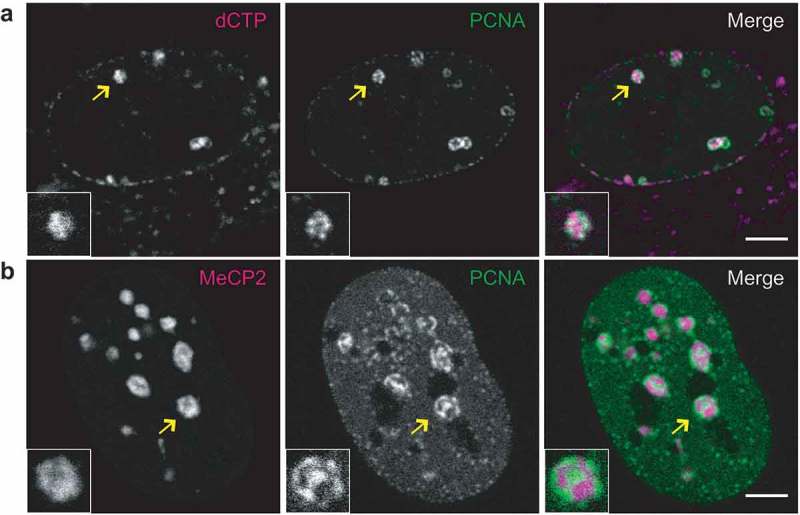
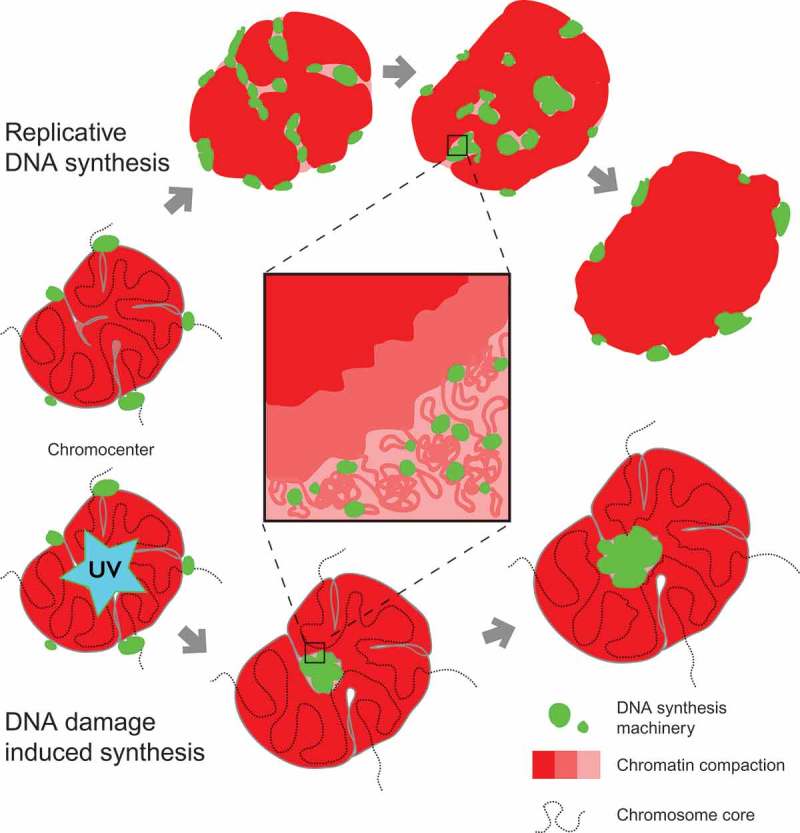
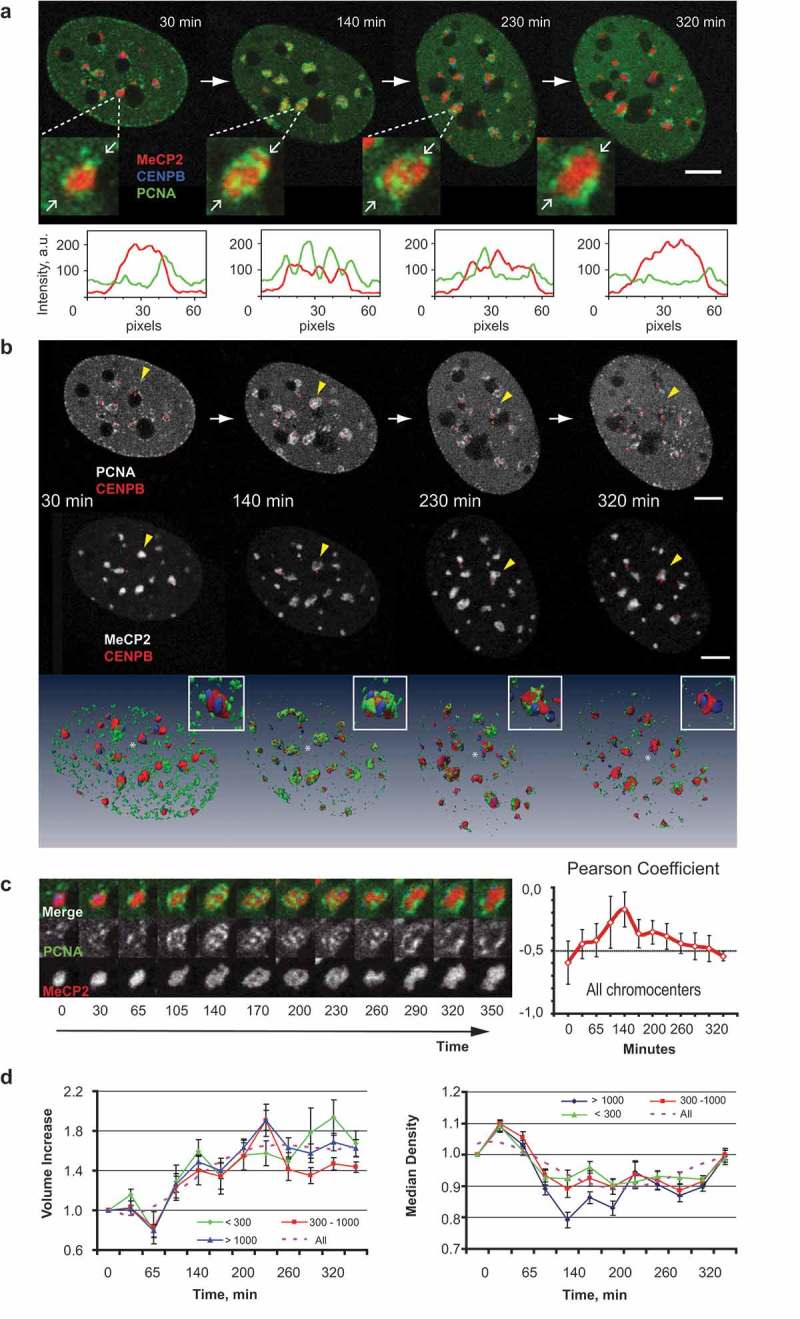
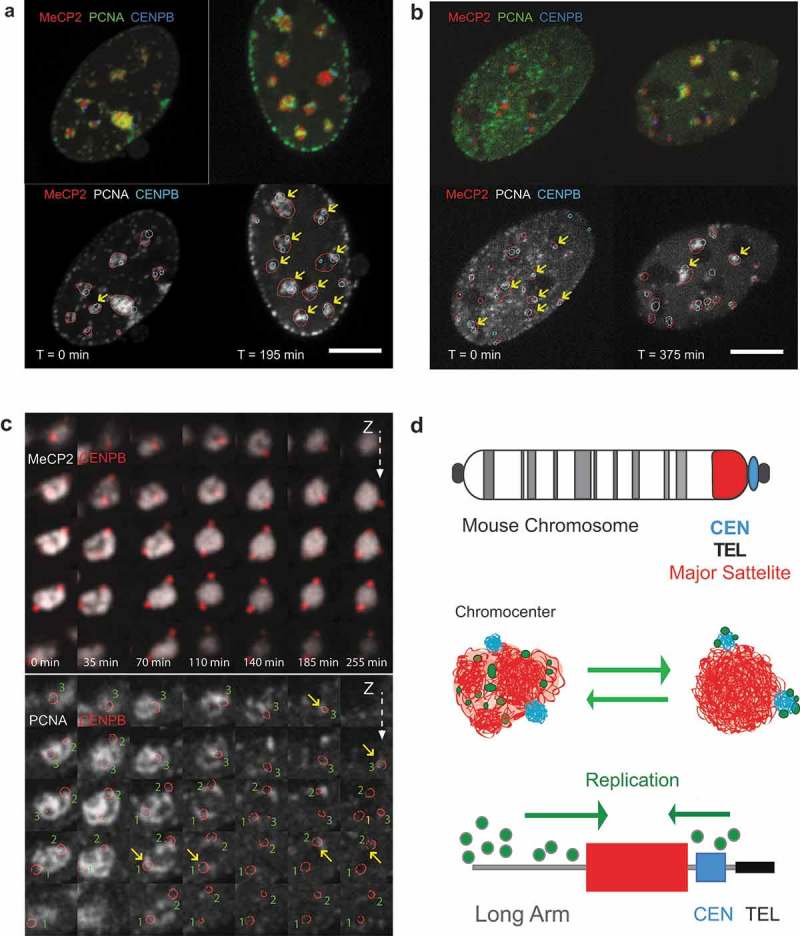
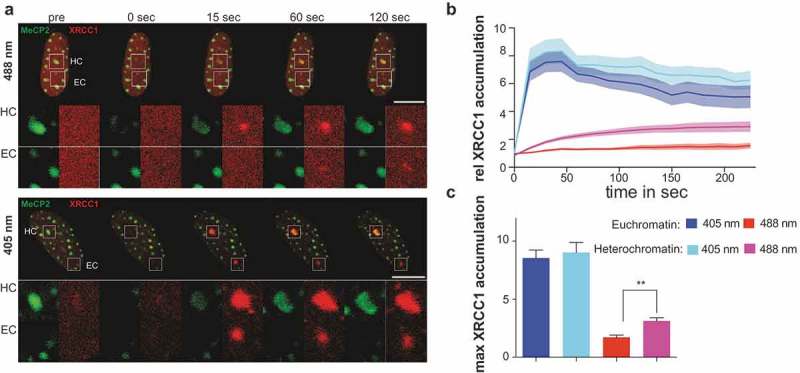
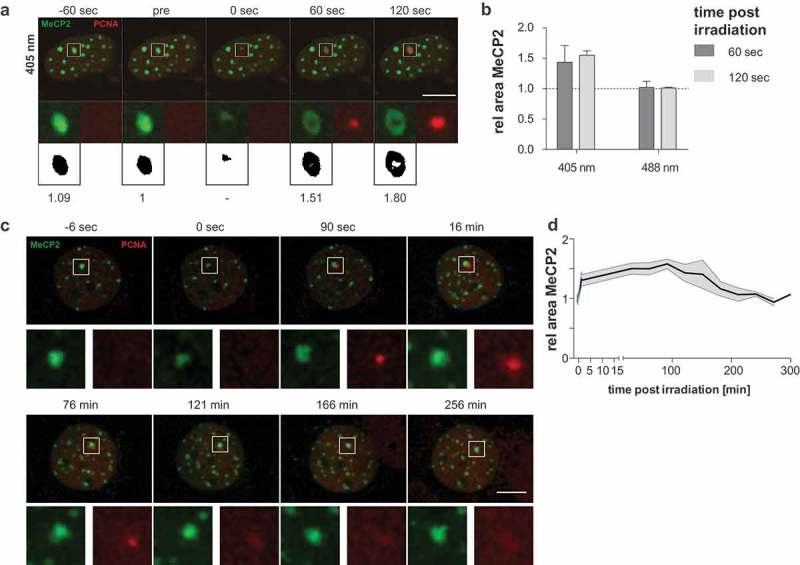
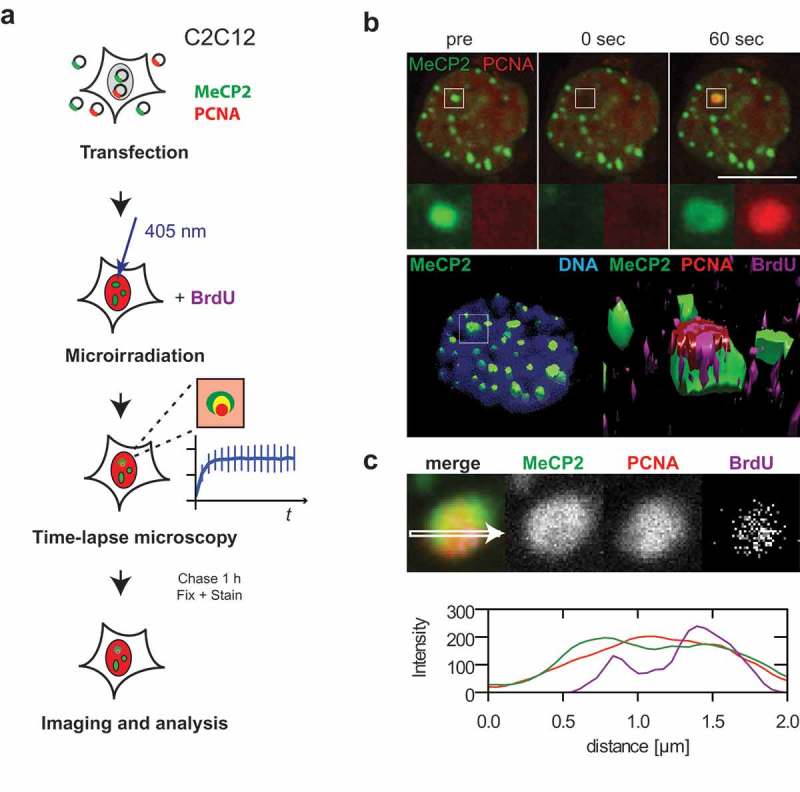
Constitutive heterochromatin is considered as a functionally inert genome compartment, important for its architecture and stability. How such stable structure is maintained is not well understood. Here, we apply four different visualization schemes to label it and investigate its dynamics during DNA replication and repair. We show that replisomes assemble over the heterochromatin in a temporally ordered manner. Furthermore, heterochromatin undergoes transient decompaction locally at the active sites of DNA synthesis. Using selective laser microirradiation conditions that lead to damage repaired via processive DNA synthesis, we measured similarly local decompaction of heterochromatin. In both cases, we could not observe large-scale movement of heterochromatin to the domain surface. Instead, the processive DNA synthesis machinery assembled at the replication/repair sites. Altogether, our data are compatible with a progression of DNA replication/repair along the chromatin in a dynamic mode with localized and transient decompaction that does not globally remodels the whole heterochromatin compartment.
组成性异染色质被认为是一种功能上无活性的基因组区室,对于其结构和稳定性很重要。然而,人们对于这种稳定结构是如何维持的还不太了解。在这里,我们应用了四种不同的可视化方案来标记它,并研究了它在 DNA 复制和修复过程中的动态变化。我们发现,复制体以时间顺序的方式在异染色质上组装。此外,异染色质在 DNA 合成的活性位点处局部经历短暂的解压缩。使用选择性激光微照射条件,导致通过连续的 DNA 合成修复损伤,我们测量到异染色质的局部解压缩也类似。在这两种情况下,我们都没有观察到异染色质大规模地移动到域表面。相反,连续的 DNA 合成机制在复制/修复位点组装。总的来说,我们的数据与 DNA 复制/修复沿着染色质以动态方式进行的模式是一致的,这种模式伴随着局部和短暂的解压缩,但不会全局重塑整个异染色质区室。