Martin-Luther-University Halle-Wittenberg, Institute of Medical Epidemiology, Biometrics and Informatics, Halle (Saale), Germany.
Public Health Department, City of Halle (Saale), Germany.
BMC Pediatr. 2019 Nov 19;19(1):448. doi: 10.1186/s12887-019-1825-8.
In Germany, all preschoolers undergo a school entry examination (SEE). While most children are sufficiently served with standardized developmental tests only, for a small group of otherwise underserved children, the SEE should also include a subsidiary health checkup. The aim of the study was to validate selection criteria to differentiate these two groups of children.
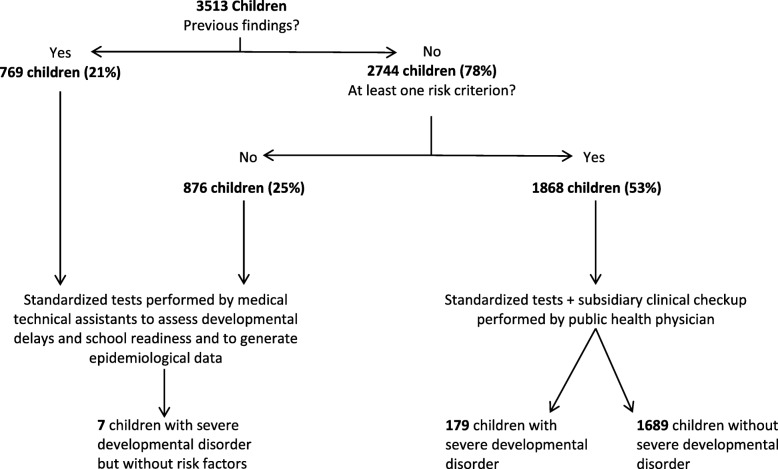
Secondary data from the SEEs of 2016 and 2017 that contained information on 3513 children were analyzed. Of these children, a subset was selected in which no severe developmental disorders were diagnosed prior to the SEE (n = 2744). The selection criteria identified in an earlier study (low or medium social status, missed the last pediatric routine check-up, migration background, three or more siblings, and raised by a single mother) were then applied to this subset to estimate their effectiveness in finding children at risk for a newly diagnosed severe developmental disorder. The sensitivity, specificity and positive and negative predictive values of the selection criteria were calculated.
The tested selection criteria identified children who would likely benefit from a subsidiary checkup in the context of SEEs with a sensitivity of 96% (95% CI: 94.5-98.9%). The negative predictive value and specificity of the criteria were 99% (98.6-99.7%) and 34% (32.1-35.8%), respectively. By using this approach, the number of children seen by a physician could be reduced to 53% of the age cohorts.
The tested selection criteria are a viable way to differentiate children for whom SEEs should include a subsidiary health checkup from those who do not need it. Therefore, the time that physicians spend with SEEs could be reduced. Using the selection criteria to establish a stepped procedure in SEEs therefore offers a valid way to focus physicians' resources on the children who need them most.
在德国,所有学龄前儿童都要接受入学考试(SEE)。虽然大多数儿童只需接受标准化发展测试即可,但对于一小部分服务不足的儿童,SEE 还应包括辅助健康检查。本研究的目的是验证区分这两组儿童的选择标准。
分析了 2016 年和 2017 年 SEE 的二次数据,其中包含 3513 名儿童的信息。在这些儿童中,选择了一组在 SEE 之前未被诊断出严重发育障碍的儿童(n=2744)。然后将早期研究中确定的选择标准(社会地位低或中等、错过最近的儿科常规检查、移民背景、有三个或更多兄弟姐妹以及由单身母亲抚养)应用于该子集,以估计这些标准在发现新诊断的严重发育障碍风险儿童方面的有效性。计算了选择标准的灵敏度、特异性、阳性和阴性预测值。
测试的选择标准确定了在 SEE 背景下可能受益于辅助检查的儿童,其灵敏度为 96%(95%CI:94.5-98.9%)。该标准的阴性预测值和特异性分别为 99%(98.6-99.7%)和 34%(32.1-35.8%)。通过这种方法,可以将接受医生检查的儿童人数减少到年龄组的 53%。
测试的选择标准是区分需要进行 SEE 辅助健康检查的儿童和不需要进行检查的儿童的一种可行方法。因此,可以减少医生在 SEE 上花费的时间。使用选择标准在 SEE 中建立一个阶梯式程序可以有效地将医生的资源集中在最需要的儿童身上。