Fortunato Michael, Harrison Joseph, Oon Ai Leen, Small Dylan, Hilbert Victoria, Rareshide Charles, Patel Mitesh
University of Pennsylvania, Philadelphia, PA, United States.
Penn Medicine Nudge Unit, Philadelphia, PA, United States.
JMIR Res Protoc. 2019 Nov 20;8(11):e14180. doi: 10.2196/14180.
Type 2 diabetes is a significant cause of morbidity and mortality in the United States. Lifestyle modifications including increasing physical activity and losing weight have been demonstrated to improve glycemic control. However, most patients struggle to make these changes. Many stakeholders are interested in using gamification and social incentives to increase engagement in healthy behaviors. However, these approaches often do not appropriately leverage insights from behavioral economics that could be used to address predictable barriers to behavior change.
This study aimed to describe the protocol for the Influencing DIabetics to Adapt Behaviors related to Exercise and weighT by Enhancing Social incentives (iDiabetes) trial, which aimed to evaluate the effectiveness of gamification interventions that leverage insights from behavioral economics to enhance supportive, competitive, or collaborative social incentives to improve glycemic control, promote weight loss, and increase physical activity among overweight and obese adults with type 2 diabetes.
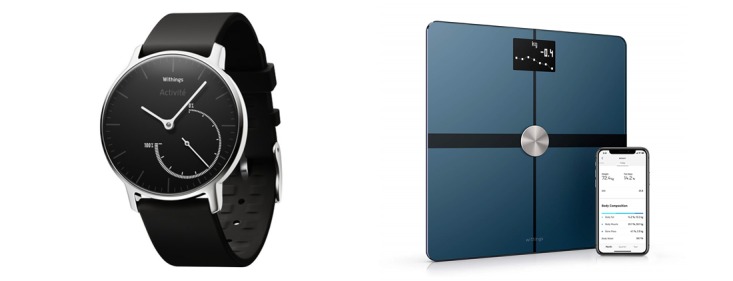
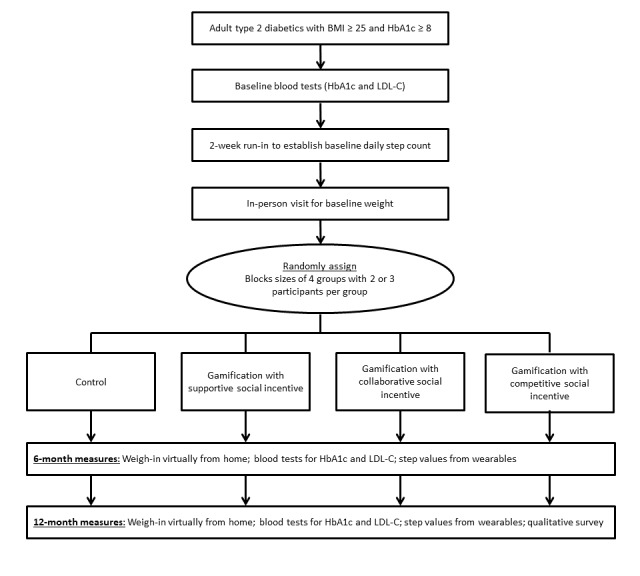
We are conducting a one-year four-arm randomized controlled trial of 361 overweight and obese patients with type 2 diabetes and a glycated hemoglobin (HbA) level ≥8.0. Wireless weight scales and wearable devices are provided to remotely monitor weight and physical activity and transmit data to the study team. Patients are recruited by email, following which they establish a baseline measure of weight, daily step count, HbA level, and low-density lipoprotein cholesterol level and then repeat these measures at 6 and 12 months. The control arm receives no other interventions. Patients randomized to one of the three intervention arms are entered into a game designed using insights from behavioral economics to enhance supportive, competitive, or collaborative social incentives. To examine predictors of strong or poor performance, participants completed validated questionnaires on a range of areas including their personality, risk preferences, and social network.
Enrollment of 361 patients was completed in January 2019. Results are expected in 2020.
The iDiabetes trial represents a scalable model to remotely monitor the daily health behaviors of adults with type 2 diabetes. Results from this trial will help provide insights into how to improve management of patients with type 2 diabetes.
ClinicalTrials.gov NCT02961192; https://clinicaltrials.gov/ct2/show/NCT02961192.
INTERNATIONAL REGISTERED REPORT IDENTIFIER (IRRID): DERR1-10.2196/14180.
2型糖尿病是美国发病和死亡的重要原因。包括增加体育活动和减肥在内的生活方式改变已被证明可改善血糖控制。然而,大多数患者难以做出这些改变。许多利益相关者有兴趣利用游戏化和社会激励措施来提高对健康行为的参与度。然而,这些方法往往没有适当地利用行为经济学的见解,而这些见解可用于解决行为改变中可预测的障碍。
本研究旨在描述“通过增强社会激励措施影响糖尿病患者适应与运动和体重相关行为(iDiabetes)”试验的方案,该试验旨在评估利用行为经济学见解的游戏化干预措施的有效性,以增强支持性、竞争性或协作性社会激励措施,从而改善血糖控制、促进体重减轻并增加超重和肥胖的2型糖尿病成年人的身体活动。
我们正在对361名超重和肥胖的2型糖尿病患者以及糖化血红蛋白(HbA)水平≥8.0的患者进行为期一年的四臂随机对照试验。提供无线体重秤和可穿戴设备以远程监测体重和身体活动,并将数据传输给研究团队。通过电子邮件招募患者,之后他们建立体重、每日步数、HbA水平和低密度脂蛋白胆固醇水平的基线测量值,然后在6个月和12个月时重复这些测量。对照组不接受其他干预。随机分配到三个干预组之一的患者将参与一个使用行为经济学见解设计的游戏,以增强支持性、竞争性或协作性社会激励措施。为了检查表现优劣的预测因素,参与者完成了一系列领域的有效问卷,包括他们的个性、风险偏好和社交网络。
2019年1月完成了361名患者的入组。预计2020年得出结果。
iDiabetes试验代表了一种可扩展的模型,用于远程监测2型糖尿病成年人的日常健康行为。该试验的结果将有助于深入了解如何改善2型糖尿病患者的管理。
ClinicalTrials.gov NCT02961192;https://clinicaltrials.gov/ct2/show/NCT02961192。
国际注册报告识别码(IRRID):DERR1-10.2196/14180。