Department of Neurosciences, University of New Mexico School of Medicine, Albuquerque, NM 87131.
Department of Neurosciences, University of New Mexico School of Medicine, Albuquerque, NM 87131
eNeuro. 2019 Dec 4;6(6). doi: 10.1523/ENEURO.0070-19.2019. Print 2019 Nov/Dec.
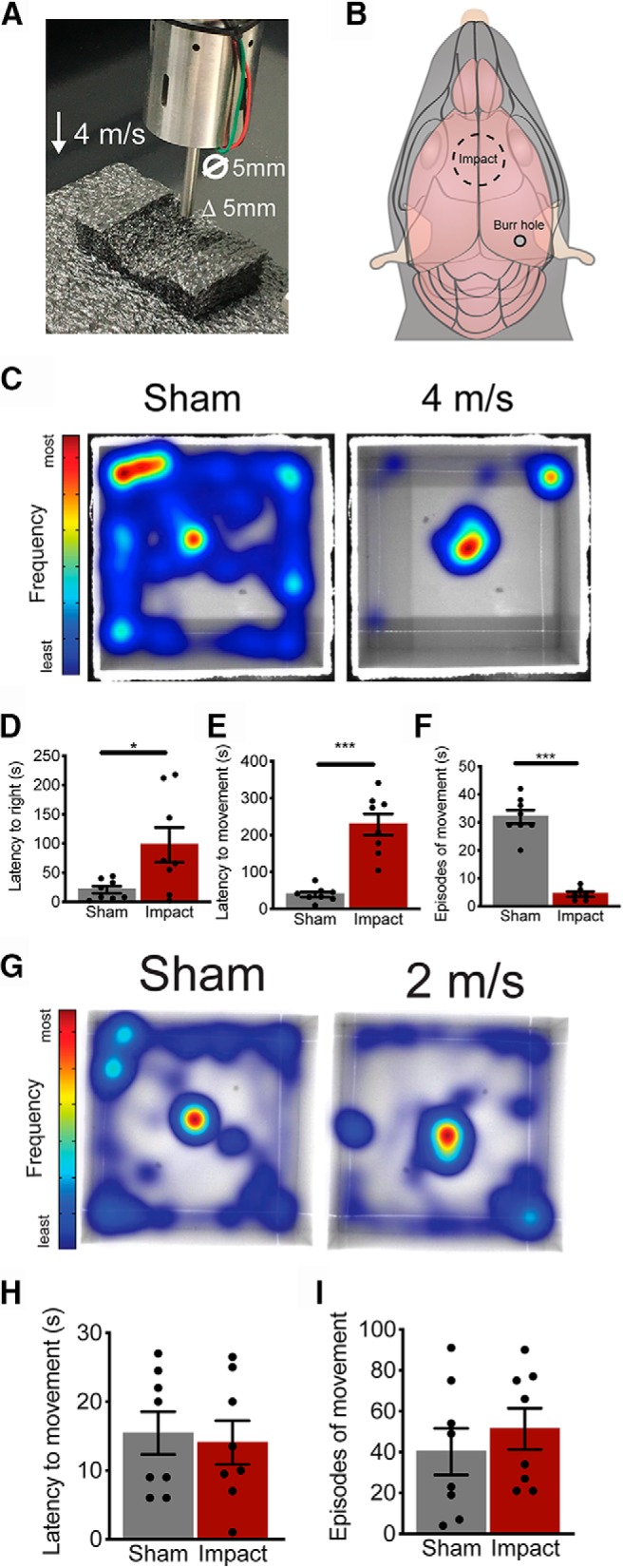
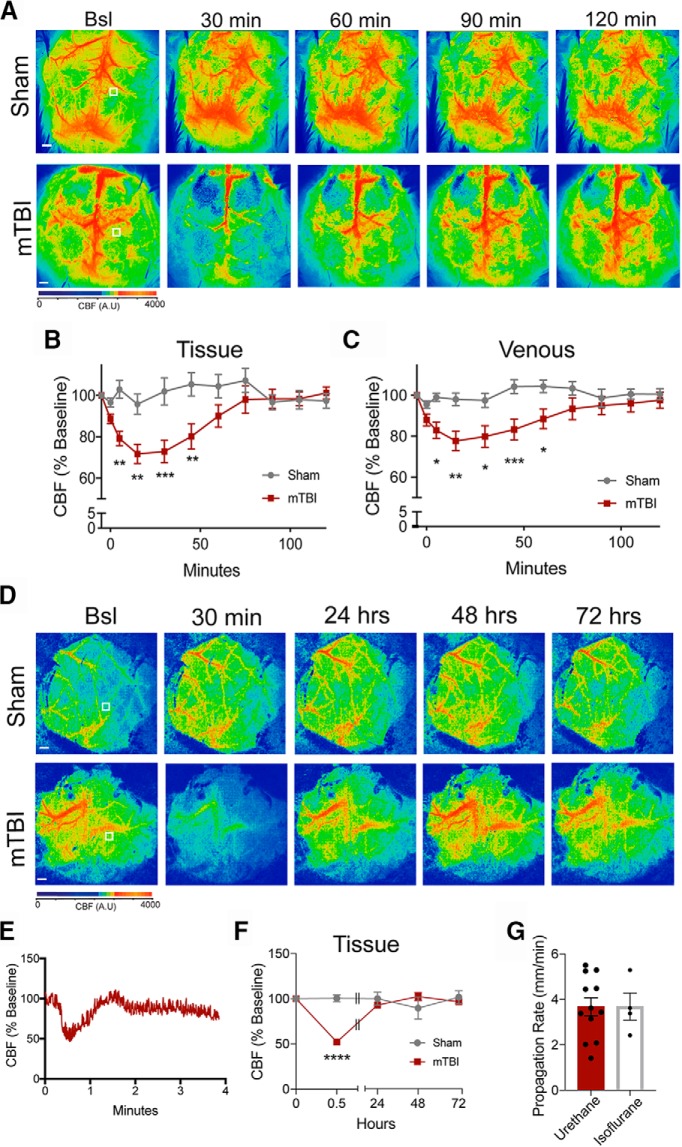
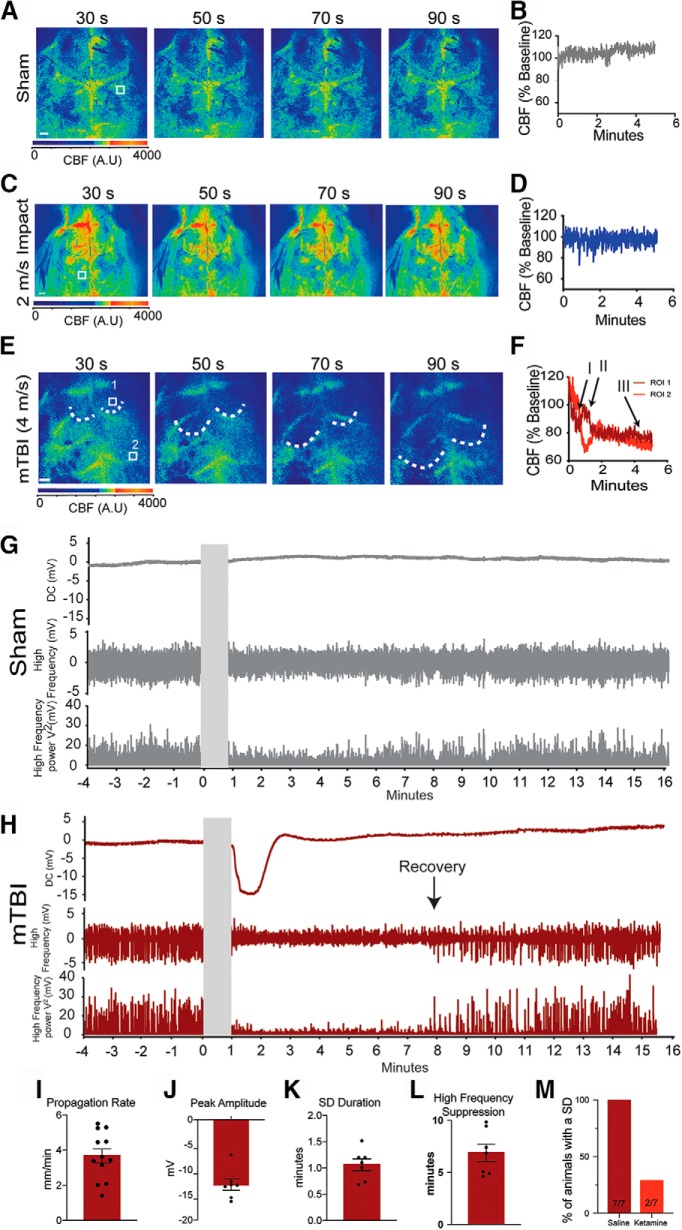
Millions of people suffer mild traumatic brain injuries (mTBIs) every year, and there is growing evidence that repeated injuries can result in long-term pathology. The acute symptoms of these injuries may or may not include the loss of consciousness but do include disorientation, confusion, and/or the inability to concentrate. Most of these acute symptoms spontaneously resolve within a few hours or days. However, the underlying physiological and cellular mechanisms remain unclear. Spreading depolarizations (SDs) are known to occur in rodents and humans following moderate and severe TBIs, and SDs have long been hypothesized to occur in more mild injuries. Using a closed skull impact model, we investigated the presence of SDs immediately following a mTBI. Animals remained motionless for multiple minutes following an impact and once recovered had fewer episodes of movement. We recorded the defining electrophysiological properties of SDs, including the large extracellular field potential shifts and suppression of high-frequency cortical activity. Impact-induced SDs were also associated with a propagating wave of reduced cerebral blood flow (CBF). In the wake of the SD, there was a prolonged period of reduced CBF that recovered in approximately 90 min. Similar to SDs in more severe injuries, the impact-induced SDs could be blocked with ketamine. Interestingly, impacts at a slower velocity did not produce the prolonged immobility and did not initiate SDs. Our data suggest that SDs play a significant role in mTBIs and SDs may contribute to the acute symptoms of mTBIs.
每年都有数以百万计的人遭受轻度创伤性脑损伤(mTBI),越来越多的证据表明,反复受伤会导致长期的病理变化。这些损伤的急性症状可能包括或不包括意识丧失,但包括定向障碍、混乱和/或注意力不集中。大多数这些急性症状会在数小时或数天内自发缓解。然而,其潜在的生理和细胞机制尚不清楚。众所周知,中度和重度 TBI 后会在啮齿动物和人类中发生扩散性去极化(SD),并且长期以来一直假设在更轻微的损伤中也会发生 SD。我们使用闭合颅骨撞击模型,研究了 mTBI 后 SD 的发生情况。动物在撞击后会一动不动地持续数分钟,一旦恢复,其运动发作的次数会减少。我们记录了 SD 的定义性电生理特性,包括大的细胞外场电位变化和高频皮质活动的抑制。撞击引起的 SD 还与脑血流(CBF)的传播性降低波有关。在 SD 之后,存在约 90 分钟恢复的延长的 CBF 降低期。与更严重的损伤中的 SD 类似,可以用氯胺酮阻断撞击引起的 SD。有趣的是,速度较慢的撞击不会产生长时间的不动性,也不会引发 SD。我们的数据表明,SD 在 mTBI 中起重要作用,SD 可能导致 mTBI 的急性症状。