
在自主通气的麻醉健康受试者中进行区域应变映射。
Mapping regional strain in anesthetised healthy subjects during spontaneous ventilation.
机构信息
Escuela de Medicina Veterinaria, Facultad de Ciencias de la Vida, Universidad Andres Bello, Santiago, Chile.
Pediatric Intensive Care Unit, Hospital El Carmen de Maipú, Santiago, Chile.
出版信息
BMJ Open Respir Res. 2019 Oct 28;6(1):e000423. doi: 10.1136/bmjresp-2019-000423. eCollection 2019.
INTRODUCTION
Breathing produces a phenomenon of cyclic deformation throughout life. Biomechanically, deformation of the lung is measured as strain. Regional strain recently started to be recognised as a tool in the study of lung pathophysiology, but regional lung strain has not been studied in healthy subjects breathing spontaneously without voluntary or pharmacological control of ventilation. Our aim is to generate three-dimensional (3D) regional strain and heterogeneity maps of healthy rat lungs and describe their changes over time.
METHODS
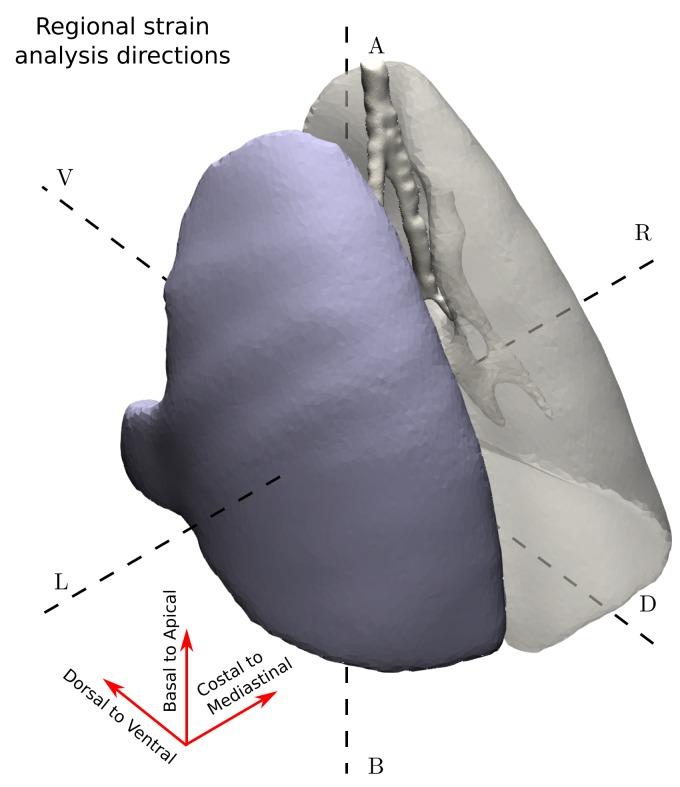
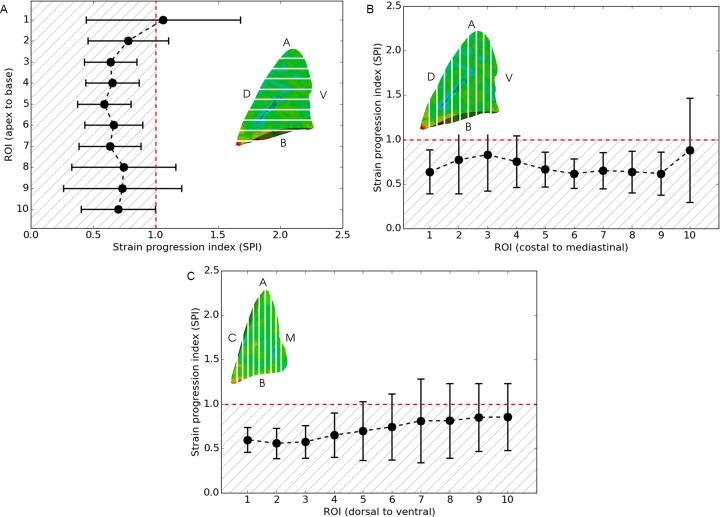
Micro-CT and image-based biomechanical analysis by finite element approach were carried out in six anaesthetised rats under spontaneous breathing in two different states, at the beginning of the experiment and after 3 hours of observation. 3D regional strain maps were constructed and divided into 10 isovolumetric region-of-interest (ROI) in three directions (apex to base, dorsal to ventral and costal to mediastinal), allowing to regionally analyse the volumetric strain, the strain progression and the strain heterogeneity. To describe in depth these parameters, and systematise their report, we defined [1+strain SD ROI(x)]/[1+strain mean ROI(x)] and [ROI(x)-mean of final strain/ROI(x)-mean of initial strain].
RESULTS
We were able to generate 3D regional strain maps of the lung in subjects without respiratory support, showing significant differences among the three analysed axes. We observed a significantly lower regional volumetric strain in the apex sector compared with the base, with no significant anatomical systematic differences in the other directions. This heterogeneity could not be identified with physiological or standard CT methods. There was no progression of the analysed regional volumetric strain when the two time-points were compared.
DISCUSSION
It is possible to map the regional volumetric strain in the lung for healthy subjects during spontaneous breathing. Regional strain heterogeneity and changes over time can be measured using a CT image-based numerical analysis applying a finite element approach. These results support that healthy lung might have significant regional strain and its spatial distribution is highly heterogeneous. This protocol for CT image acquisition and analysis could be a useful tool for helping to understand the mechanobiology of the lung in many diseases.
简介
呼吸在整个生命周期中都会产生循环变形现象。从生物力学的角度来看,肺部的变形是通过应变来测量的。最近,区域性应变开始被认为是研究肺部病理生理学的一种工具,但在没有自主或药物控制通气的情况下,健康受试者自发性呼吸时,尚未对区域性肺应变进行研究。我们的目标是生成健康大鼠肺部的三维(3D)区域性应变和异质性图谱,并描述其随时间的变化。
方法
在实验开始时和观察 3 小时后,对六只麻醉大鼠在自发性呼吸下进行微 CT 和基于图像的有限元方法生物力学分析。构建了 3D 区域性应变图,并将其分为三个方向(从顶部到底部、从背部到腹部和从肋部到纵隔)的 10 个等容感兴趣区(ROI),从而能够对体积应变、应变进展和应变异质性进行区域性分析。为了深入描述这些参数并对其报告进行系统分类,我们定义了[应变 ROI(x)的平均值+应变标准差]/[应变 ROI(x)的平均值+1]和[ROI(x)的最终应变-ROI(x)的初始应变平均值]/[ROI(x)的初始应变平均值-1]。
结果
我们能够为没有呼吸支持的受试者生成肺部的 3D 区域性应变图,显示出三个分析轴之间的显著差异。我们观察到与底部相比,顶部区域的体积应变明显较低,而在其他方向上没有明显的解剖系统差异。这种异质性无法通过生理或标准 CT 方法识别。当比较两个时间点时,分析的区域性体积应变没有进展。
讨论
在自发性呼吸期间,有可能为健康受试者绘制肺部的区域性体积应变图。使用基于 CT 图像的数值分析和有限元方法可以测量区域性应变异质性及其随时间的变化。这些结果表明,健康的肺部可能具有显著的区域性应变,其空间分布高度异质。这种 CT 图像采集和分析的方案可能是一种有用的工具,可以帮助理解许多疾病中肺部的力学生物学。


 Zotero 插件