John Aparna, Newton-Lewis Thomas, Srinivasan Shuchi
Institute of Development Studies, University of Sussex, Brighton, UK.
Oxford Policy Management, New Delhi, India.
BMJ Glob Health. 2019 Oct 23;4(5):e001790. doi: 10.1136/bmjgh-2019-001790. eCollection 2019.
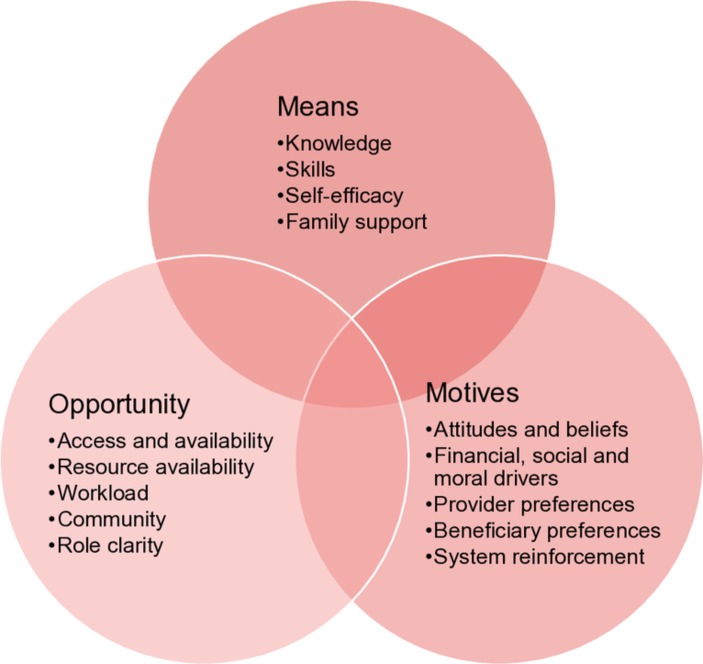
The performance of community health workers (CHWs) typically depends on the interaction between their motivation (their intent to achieve personal and organisational goals) and the constraints that they face in doing so. These constraints can be both at the individual level, for example, whether the worker has the skills and knowledge required to deliver on their job role, and the organisational level, for example, whether the worker is provided with the resources required to perform. Designing interventions to improve the performance of CHWs requires identifying the constraints to performance in a particular context. Existing frameworks on CHW performance tend to be derived empirically, identifying a broad range of intervention design and contextual factors that have been shown to influence CHW performance. These may not always be able to guide policy makers to identify the precise cause of a specific performance problem in a particular context and develop an appropriate policy response. This article presents a framework to help practitioners and researchers diagnose the constraints to performance of CHWs and guide programmatic and policy responses. The Means, Motives and Opportunity (MMO) framework has been adapted from the SaniFOAM framework used to identify the determinants of sanitation behaviours. It is based on three interdependent and interacting domains: means (whether an individual is capable of performing), motives (whether an individual wants to perform) and opportunity (whether the individual has the chance to perform). A wide range of data sources are expected to be used when applying the MMO framework, especially qualitative research that captures the perspectives and lived realities of CHWs and their communities. In this article, we demonstrate how the MMO framework can be applied to identify the constraints to CHW performance using the case study of Anganwadi Workers (village nutrition workers) in Bihar, India.
社区卫生工作者(CHW)的工作表现通常取决于其动机(实现个人和组织目标的意图)与工作中所面临的限制因素之间的相互作用。这些限制因素既可能存在于个人层面,例如,工作人员是否具备履行工作职责所需的技能和知识;也可能存在于组织层面,例如,是否为工作人员提供了履行职责所需的资源。设计旨在提高社区卫生工作者绩效的干预措施,需要确定特定背景下影响绩效的限制因素。现有的关于社区卫生工作者绩效的框架往往是基于实证得出的,确定了一系列已被证明会影响社区卫生工作者绩效的干预设计和背景因素。但这些框架可能并不总能指导政策制定者确定特定背景下具体绩效问题的精确原因,并制定适当的政策应对措施。本文提出了一个框架,以帮助从业者和研究人员诊断社区卫生工作者绩效的限制因素,并指导规划和政策应对。手段、动机和机会(MMO)框架改编自用于确定卫生行为决定因素的SaniFOAM框架。它基于三个相互依存且相互作用的领域:手段(个人是否有能力履行职责)、动机(个人是否想要履行职责)和机会(个人是否有机会履行职责)。在应用MMO框架时,预计会使用广泛的数据来源,特别是能够捕捉社区卫生工作者及其社区的观点和生活现实的定性研究。在本文中,我们通过印度比哈尔邦的anganwadi工人(乡村营养工作者)的案例研究,展示了如何应用MMO框架来确定社区卫生工作者绩效的限制因素。