Medical Research Council Centre for Neuropsychiatric Genetics and Genomics, Institute of Psychological Medicine and Clinical Neurosciences, School of Medicine, Cardiff University, Cardiff, United Kingdom.
Department of Medical Epidemiology and Biostatistics, Karolinska Institutet, Stockholm, Sweden.
JAMA Psychiatry. 2020 Mar 1;77(3):303-310. doi: 10.1001/jamapsychiatry.2019.4079.
Insomnia, hypersomnia, and an evening chronotype are common in individuals with bipolar disorder (BD), but whether this reflects shared genetic liability is unclear. Stratifying by BD subtypes could elucidate this association and inform sleep and BD research.
To assess whether polygenic risk scores (PRSs) for sleep traits are associated with BD subtypes I and II.
DESIGN, SETTING, AND PARTICIPANTS: This case-control study was conducted in the United Kingdom and Sweden with participants with BD and control participants. Multinomial regression was used to assess whether PRSs for insomnia, daytime sleepiness, sleep duration, and chronotype are associated with BD subtypes compared with control participants. Affected individuals were recruited from the Bipolar Disorder Research Network. Control participants were recruited from the 1958 British Birth Cohort and the UK Blood Service. Analyses were repeated in an independent Swedish sample from August 2018 to July 2019. All participants were of European ancestry.
Standardized PRSs derived using alleles from genome-wide association studies of insomnia, sleep duration, daytime sleepiness, and chronotype. These were adjusted for the first 10 population principal components, genotyping platforms, and sex.
Association of PRSs with BD subtypes, determined by semistructured psychiatric interview and case notes.
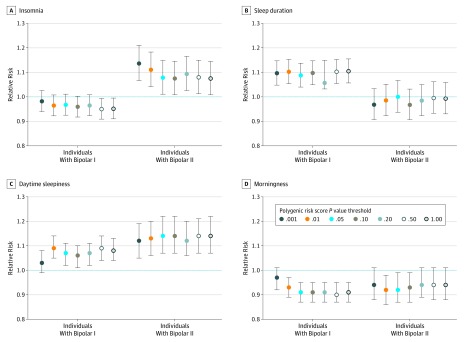
The main analysis included 4672 participants with BD (3132 female participants [67.0%]; 3404 with BD-I [72.9%]) and 5714 control participants (2812 female participants [49.2%]). Insomnia PRS was associated with increased risk of BD-II (relative risk [RR], 1.14 [95% CI, 1.07-1.21]; P = 8.26 × 10⁻⁵) but not BD-I (RR, 0.98 [95% CI, 0.94-1.03]; P = .409) relative to control participants. Sleep-duration PRS was associated with BD-I (RR, 1.10 [95% CI, 1.06-1.15]; P = 1.13 × 10⁻⁵) but not BD-II (RR, 0.99 [95% CI, 0.93-1.06]; P = .818). Associations between (1) insomnia PRS and BD-II and (2) sleep-duration PRS and BD-I were replicated in the Swedish sample of 4366 individuals with BD (2697 female participants [61.8%]; 2627 with BD-I [60.2%]) and 6091 control participants (3767 female participants [61.8%]). Chronotype and daytime-sleepiness PRS were not associated with BD subtypes.
Per this analysis, BD subtypes differ in genetic liability to insomnia and hypersomnia, providing further evidence that the distinction between BD-I and BD-II has genetic validity. This distinction will be crucial in selecting participants for future research on the role of sleep disturbance in BD.
失眠、嗜睡和夜间时型在双相情感障碍(BD)患者中很常见,但这是否反映了共同的遗传易感性尚不清楚。根据 BD 亚型进行分层可以阐明这种关联,并为睡眠和 BD 研究提供信息。
评估睡眠特征的多基因风险评分(PRSs)是否与 BD 亚型 I 和 II 相关。
设计、设置和参与者:这是一项在英国和瑞典进行的病例对照研究,参与者为 BD 患者和对照参与者。使用多项回归来评估与对照参与者相比,失眠、日间嗜睡、睡眠时间和时型的 PRS 是否与 BD 亚型相关。受影响的个体是从双相情感障碍研究网络招募的。对照参与者是从 1958 年英国出生队列和英国血液服务中心招募的。所有参与者均为欧洲血统。
使用来自失眠、睡眠时间、日间嗜睡和时型的全基因组关联研究的等位基因,使用标准化 PRS 进行调整。这些因素包括前 10 个人群主成分、基因分型平台和性别。
通过半结构式精神科访谈和病例记录确定 PRS 与 BD 亚型的关联。
主要分析包括 4672 名 BD 患者(3132 名女性参与者[67.0%];3404 名 BD-I [72.9%])和 5714 名对照参与者(2812 名女性参与者[49.2%])。失眠 PRS 与 BD-II 的风险增加相关(相对风险[RR],1.14[95%CI,1.07-1.21];P=8.26×10⁻⁵),但与 BD-I 无关(RR,0.98[95%CI,0.94-1.03];P=0.409)。睡眠时间 PRS 与 BD-I 相关(RR,1.10[95%CI,1.06-1.15];P=1.13×10⁻⁵),但与 BD-II 无关(RR,0.99[95%CI,0.93-1.06];P=0.818)。在瑞典的 4366 名 BD 患者(2697 名女性参与者[61.8%];2627 名 BD-I [60.2%])和 6091 名对照参与者(3767 名女性参与者[61.8%])中,也复制了(1)失眠 PRS 与 BD-II 和(2)睡眠时间 PRS 与 BD-I 之间的关联。时型和日间嗜睡 PRS 与 BD 亚型无关。
根据这项分析,BD 亚型在失眠和嗜睡方面的遗传易感性不同,这进一步证明了 BD-I 和 BD-II 之间的区别具有遗传有效性。这种区别对于为未来关于睡眠障碍在 BD 中的作用的研究选择参与者至关重要。