Department of Haematology and Oncology, Stavanger University Hospital, N-4011, Stavanger, Norway.
Laboratory for Molecular Biology, Stavanger University Hospital, N-4011, Stavanger, Norway.
BMC Cancer. 2019 Nov 21;19(1):1131. doi: 10.1186/s12885-019-6268-y.
Operable breast cancer patients may experience late recurrences because of reactivation of dormant tumor cells within the bone marrow (BM). Identification of patients who would benefit from extended therapy is therefore needed.
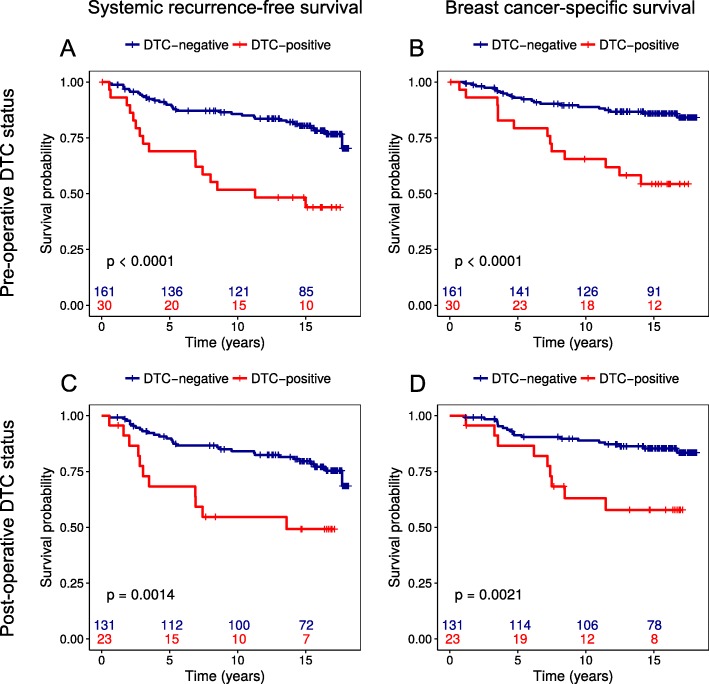
BM samples obtained pre- and post-surgery were previously analysed for presence of disseminated tumor cells (DTC) by a multimarker mRNA quantitative reverse-transcription PCR assay. Updated survival analyses were performed on all patient data (n = 191) and in a subgroup of patients alive and recurrence-free after 5 years (n = 156). DTC data were compared to the mitotic activity index (MAI) of the primary tumors. Median follow-up time was 15.3 years.
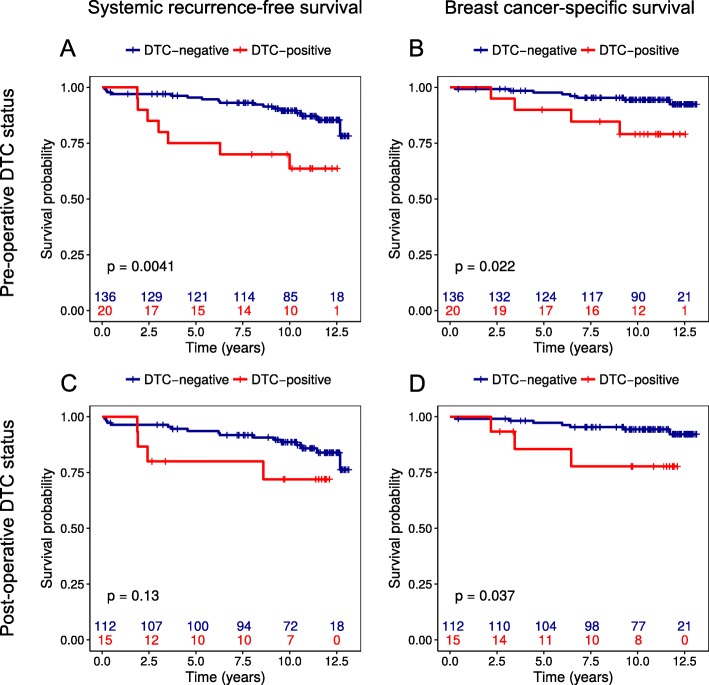
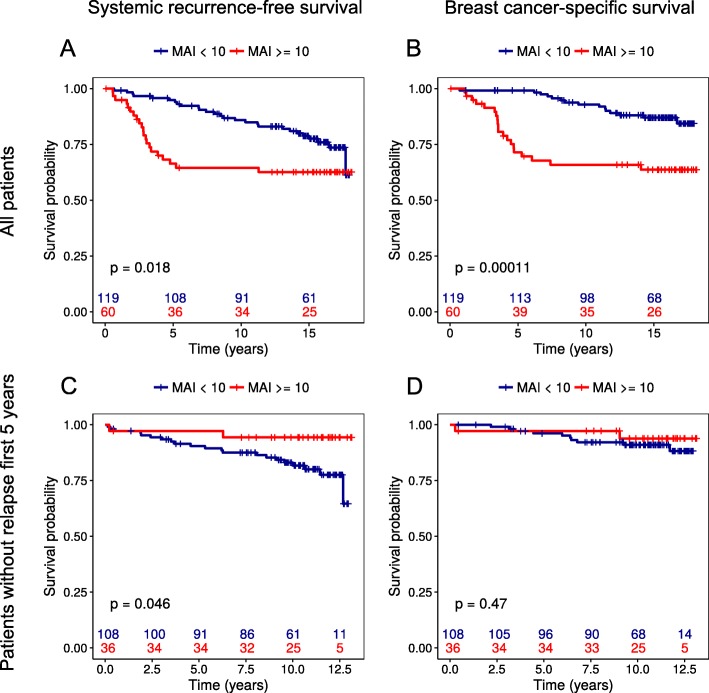
Among the 191 patients, 49 (25.65%) experienced systemic relapse, 24 (49%) within 5-18 years after surgery. MAI and pre- and post-operative DTC status had significant prognostic value based on Kaplan-Meier analyses and multiple Cox regression in the overall patient cohort. With exclusion of patients who relapsed or died within 5 years from surgery, only pre-operative DTC detection was an independent prognostic marker of late recurrences. High MAI (≥10) did not predict late recurrences or disease-specific mortality.
Pre-operative DTC detection, but not MAI status, predicts late recurrences in operable breast cancer.
可手术的乳腺癌患者可能会因骨髓(BM)中休眠肿瘤细胞的重新激活而出现晚期复发。因此,需要确定哪些患者将从延长治疗中受益。
通过多标记物 mRNA 定量逆转录 PCR 检测法,对手术前后获得的 BM 样本进行了先前的播散性肿瘤细胞(DTC)存在分析。对所有患者数据(n=191)和 5 年后存活且无复发的患者亚组(n=156)进行了更新的生存分析。将 DTC 数据与原发性肿瘤的有丝分裂活动指数(MAI)进行了比较。中位随访时间为 15.3 年。
在 191 例患者中,有 49 例(25.65%)发生了系统性复发,其中 24 例(49%)在手术后 5-18 年内复发。根据 Kaplan-Meier 分析和多 Cox 回归分析,MAI 和手术前后的 DTC 状态在总体患者队列中具有显著的预后价值。排除手术后 5 年内复发或死亡的患者后,仅术前 DTC 检测是晚期复发的独立预后标志物。高 MAI(≥10)不能预测晚期复发或疾病特异性死亡率。
术前 DTC 检测,而不是 MAI 状态,可预测可手术乳腺癌的晚期复发。