Wolkite University College of Health and Medical Sciences, Wolkite, Ethiopia.
College of Health and Medical Sciences, School of Nursing and Midwifery, Haramaya University, Harar, Ethiopia.
BMC Pregnancy Childbirth. 2019 Nov 21;19(1):435. doi: 10.1186/s12884-019-2594-y.
Postpartum depression is the most common complication of childbearing age women and is a considerable public health problem. The transition into motherhood is a difficult period that involves significant changes in the psychological, social and physiological aspects, and has increased vulnerability for the development of mental illness. More than 1 in 10 pregnant women and 1 in 20 postnatal women in Ethiopia suffer from undetected depression.
Community based cross sectional study was conducted among 596 postpartum mothers in Ankesha District, North West Ethiopia, from February 01 to March 2, 2018. One stage cluster sampling technique was employed to get the study participants. The objective was to assess the prevalence and associated factors of postpartum depression among mothers who gave birth in the last Twelve months in Ankesha District, Awi Zone, North West Ethiopia, 2018. The interviewer-administered questionnaire was used to collect data and Eden Burg Postpartum Depression Scale was used to assess postpartum depression with cutoff point ≥8. The data were entered into Epi data version 3.1 and exported to SPSS version 24 for analysis. All variables with P < 0.25 in the bivariate analysis were included in the final model and statistical significance was declared at P < 0.05.
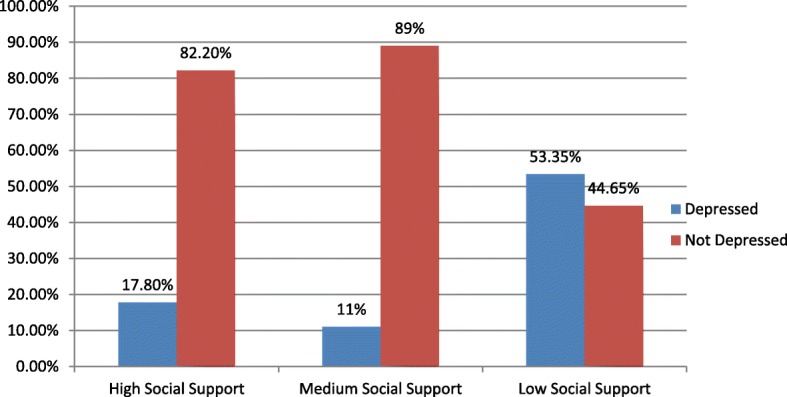
In this study, a total of 596 study participants were involved making a response rate of 97.4%, the prevalence of postpartum depression was 23.7% with 95%CI: 20.3-27.2. From the participant mothers who are divorced/widowed/unmarried (AOR = 3.45 95%CI: 1.35-8.82), unwanted pregnancy (AOR = 1.95 95%CI: 1.14-3.33), unpreferred infant sex (AOR = 1.79 95%CI: 1.13-2.86), infant illness (AOR = 2.08 95%CI: 1.30-3.34) and low social support (AOR = 3.16 95% CI: 1.55-6.43) was independent predictors of postpartum depression.
Almost a quarter (23.7%) of women suffers from postpartum depression. Marital status, unwanted pregnancy, unwanted infant sex, infant illness, and low social support were independent predictors of postpartum depression. Therefore, integration of mental illness with maternal and child health care is important, information communication education and behavioral change communications on postpartum depression are better been given attention.
产后抑郁症是育龄妇女最常见的并发症之一,也是一个相当大的公共卫生问题。成为母亲是一个困难的时期,涉及到心理、社会和生理方面的重大变化,使精神疾病的发展变得更加脆弱。在埃塞俄比亚,超过十分之一的孕妇和二十分之一的产后妇女患有未被发现的抑郁症。
本研究是 2018 年 2 月 1 日至 3 月 2 日在埃塞俄比亚西北 Awī 地区 Ankesha 区进行的一项基于社区的横断面研究。采用单阶段聚类抽样技术获取研究参与者。目的是评估 2018 年在埃塞俄比亚西北 Awī 地区 Ankesha 区过去 12 个月内分娩的母亲中产后抑郁症的流行率及相关因素。采用访谈者管理的问卷收集数据,使用 Eden Burg 产后抑郁症量表( cutoff point≥8)评估产后抑郁症。将数据输入 EpiData 版本 3.1,并导出到 SPSS 版本 24 进行分析。在单变量分析中 P 值<0.25 的所有变量均被纳入最终模型,P 值<0.05 表示具有统计学意义。
在这项研究中,共有 596 名研究参与者,应答率为 97.4%,产后抑郁症的患病率为 23.7%,95%CI:20.3-27.2。从离异/丧偶/未婚的参与者母亲(AOR=3.45 95%CI:1.35-8.82)、意外怀孕(AOR=1.95 95%CI:1.14-3.33)、不喜欢婴儿性别(AOR=1.79 95%CI:1.13-2.86)、婴儿患病(AOR=2.08 95%CI:1.30-3.34)和低社会支持(AOR=3.16 95%CI:1.55-6.43)的母亲中,产后抑郁症是独立的预测因素。
近四分之一(23.7%)的女性患有产后抑郁症。婚姻状况、意外怀孕、不喜欢婴儿性别、婴儿患病和低社会支持是产后抑郁症的独立预测因素。因此,将精神疾病与母婴保健相结合非常重要,需要加强对产后抑郁症的信息传播教育和行为改变交流。