Department of Physiology, Seoul National University College of Medicine, 103 Daehak-ro, Jongro-gu, Seoul, 03080, South Korea.
Department of Biomedical Sciences, Seoul National University College of Medicine, Seoul, 03080, Korea.
Mol Brain. 2019 Nov 21;12(1):96. doi: 10.1186/s13041-019-0517-5.
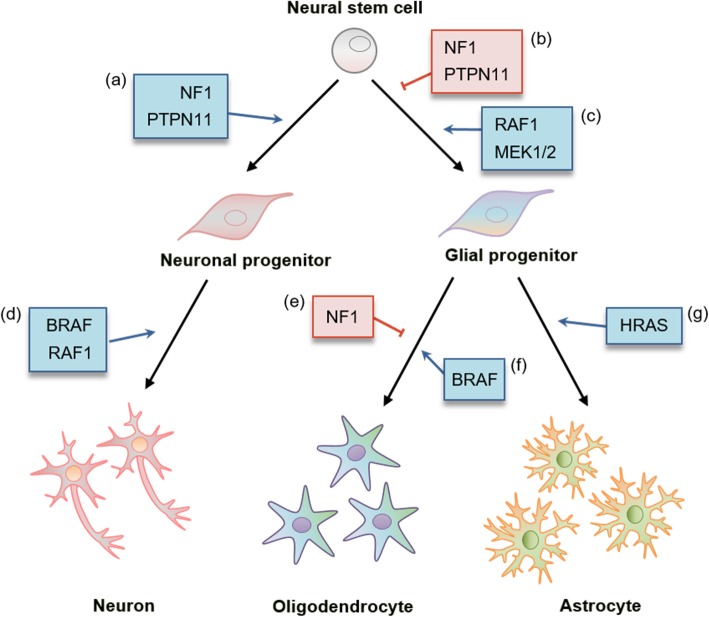
The RAS signaling pathway is involved in the regulation of developmental processes, including cell growth, proliferation, and differentiation, in the central nervous system (CNS). Germline mutations in the RAS signaling pathway genes are associated with a group of neurodevelopmental disorders, collectively called RASopathy, which includes neurofibromatosis type 1, Noonan syndrome, cardio-facio-cutaneous syndrome, and Costello syndrome. Most mutations associated with RASopathies increase the activity of the RAS-ERK signaling pathway, and therefore, most individuals with RASopathies share common phenotypes, such as a short stature, heart defects, facial abnormalities, and cognitive impairments, which are often accompanied by abnormal CNS development. Recent studies using mouse models of RASopathies demonstrated that particular mutations associated with each disorder disrupt CNS development in a mutation-specific manner. Here, we reviewed the recent literatures that investigated the developmental role of RASopathy-associated mutations using mutant mice, which provided insights into the specific contribution of RAS-ERK signaling molecules to CNS development and the subsequent impact on cognitive function in adult mice.
RAS 信号通路参与中枢神经系统 (CNS) 中发育过程的调节,包括细胞生长、增殖和分化。RAS 信号通路基因的种系突变与一组神经发育障碍有关,统称为 RAS 病,包括神经纤维瘤病 1 型、努南综合征、心面肢综合征和 Costello 综合征。大多数与 RAS 病相关的突变会增加 RAS-ERK 信号通路的活性,因此,大多数 RAS 病患者具有共同的表型,如身材矮小、心脏缺陷、面部异常和认知障碍,这些通常伴随着 CNS 发育异常。最近使用 RAS 病小鼠模型的研究表明,与每种疾病相关的特定突变以突变特异性的方式破坏 CNS 发育。在这里,我们综述了最近使用突变小鼠研究 RAS 病相关突变的发育作用的文献,这些文献为 RAS-ERK 信号分子对 CNS 发育的特定贡献以及随后对成年小鼠认知功能的影响提供了深入了解。