Queen Mary University of London, Barts and The London School of Medicine and Dentistry, Blizard Institute, Centre for Cell Biology and Cutaneous Research, 4 Newark Street, London, E1 2AT, UK.
Molecular Biotechnology Center, Department of Molecular Biotechnology and Health Sciences, University of Torino, Turin, Italy.
J Exp Clin Cancer Res. 2019 Nov 21;38(1):472. doi: 10.1186/s13046-019-1472-9.
Alteration of signalling pathways regulating cell cycle progression is a common feature of cancer cells. Several drugs targeting distinct phases of the cell cycle have been developed but the inability of many of them to discriminate between normal and cancer cells has strongly limited their clinical potential because of their reduced efficacy at the concentrations used to limit adverse side effects. Mechanisms of resistance have also been described, further affecting their efficacy. Identification of novel targets that can potentiate the effect of these drugs or overcome drug resistance can provide a useful strategy to exploit the anti-cancer properties of these agents to their fullest.
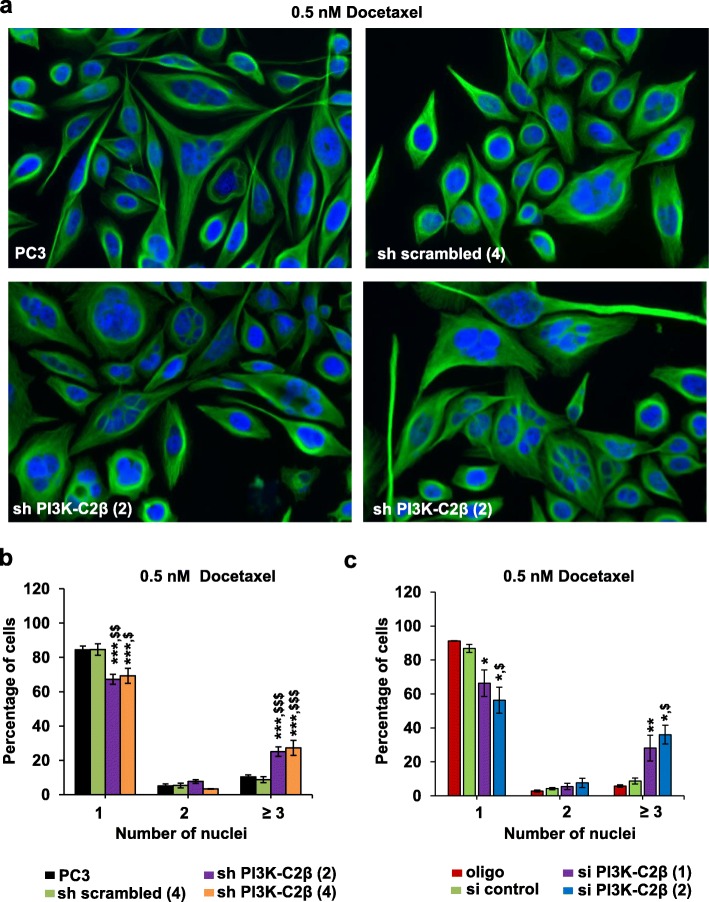
The class II PI3K isoform PI3K-C2β was downregulated in prostate cancer PC3 cells and cervical cancer HeLa cells using selective siRNAs and the effect on cell growth was determined in the absence or presence of the microtubule-stabilizing agent/anti-cancer drug docetaxel. Mitosis progression was monitored by time-lapse microscopy. Clonogenic assays were performed to determine the ability of PC3 and HeLa cells to form colonies upon PI3K-C2β downregulation in the absence or presence of docetaxel. Cell multi-nucleation was assessed by immunofluorescence. Tumour growth in vivo was assessed using a xenograft model of PC3 cells upon PI3K-C2β downregulation and in combination with docetaxel.
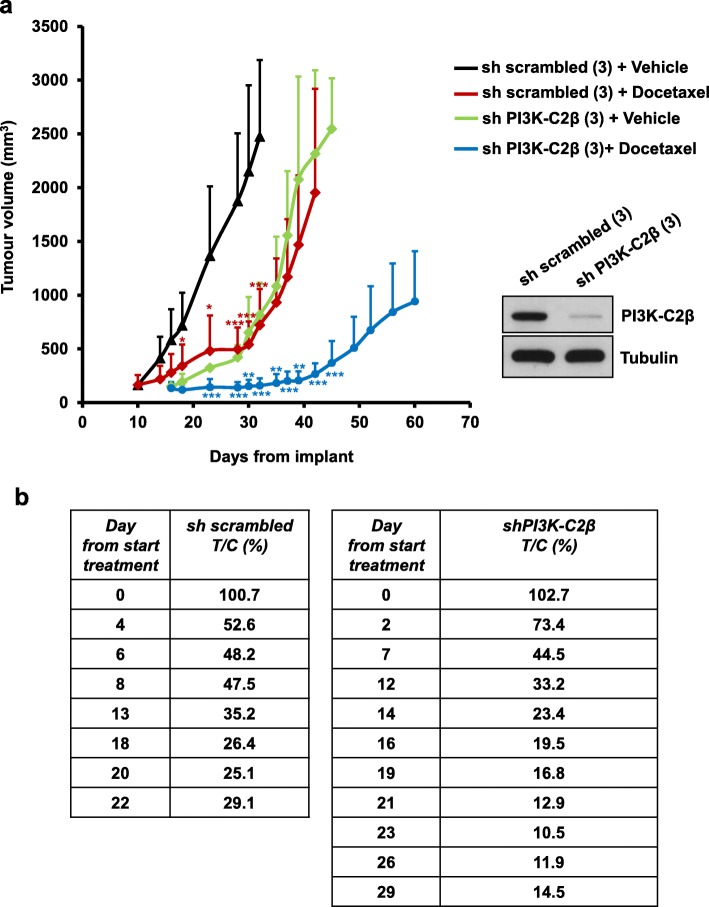
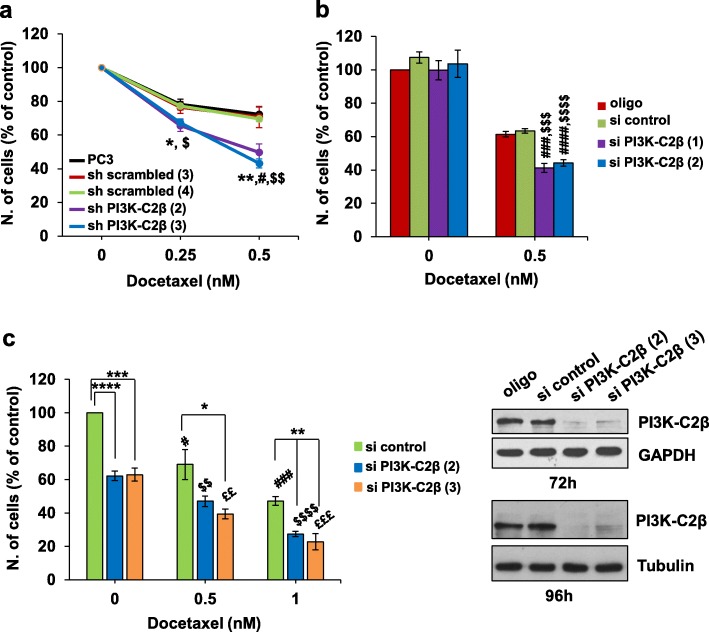
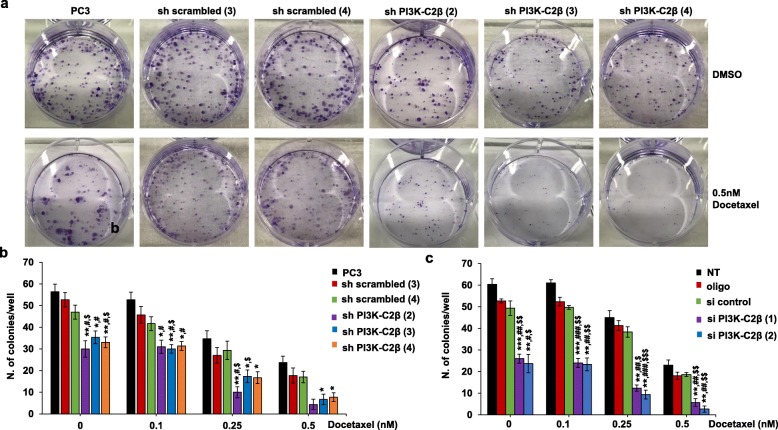
Downregulation of PI3K-C2β delays mitosis progression in PC3 and HeLa cells, resulting in reduced ability to form colonies in clonogenic assays in vitro. Compared to control cells, PC3 cells lacking PI3K-C2β form smaller and more compact colonies in vitro and they form tumours more slowly in vivo in the first weeks after cells implant. Stable and transient PI3K-C2β downregulation potentiates the effect of low concentrations of docetaxel on cancer cell growth. Combination of PI3K-C2β downregulation and docetaxel almost completely prevents colonies formation in clonogenic assays in vitro and strongly inhibits tumour growth in vivo.
These data reveal a novel role for the class II PI3K PI3K-C2β during mitosis progression. Furthermore, data indicate that blockade of PI3K-C2β might represent a novel strategy to potentiate the effect of docetaxel on cancer cell growth.
调节细胞周期进程的信号通路的改变是癌细胞的一个共同特征。已经开发了几种针对细胞周期不同阶段的药物,但由于它们在用于限制不良反应的浓度下对正常细胞和癌细胞的区分能力有限,因此其临床潜力受到了极大限制。耐药机制也已被描述,进一步影响了它们的疗效。鉴定新的靶点,可以增强这些药物的效果或克服耐药性,可以为充分利用这些药物的抗癌特性提供一个有用的策略。
使用选择性 siRNA 下调前列腺癌细胞 PC3 和宫颈癌 HeLa 细胞中的 II 类 PI3K 同工型 PI3K-C2β,并在无或有微管稳定剂/抗癌药物多西紫杉醇的情况下测定对细胞生长的影响。通过延时显微镜监测有丝分裂进程。进行克隆形成实验以确定在无或有 docetaxel 的情况下下调 PI3K-C2β 后 PC3 和 HeLa 细胞形成集落的能力。通过免疫荧光评估细胞多核化。通过下调 PI3K-C2β 并与 docetaxel 联合使用,在 PC3 细胞的异种移植模型中评估体内肿瘤生长。
下调 PI3K-C2β 可延迟 PC3 和 HeLa 细胞的有丝分裂进程,导致体外克隆形成实验中形成集落的能力降低。与对照细胞相比,缺乏 PI3K-C2β 的 PC3 细胞在体外形成更小、更紧凑的集落,并且在细胞植入后的最初几周内在体内形成肿瘤的速度更慢。稳定和瞬时下调 PI3K-C2β 可增强低浓度多西紫杉醇对癌细胞生长的作用。PI3K-C2β 下调与多西紫杉醇联合几乎完全阻止了体外克隆形成实验中集落的形成,并强烈抑制了体内肿瘤的生长。
这些数据揭示了 II 类 PI3K PI3K-C2β 在有丝分裂进程中的新作用。此外,数据表明,阻断 PI3K-C2β 可能是增强多西紫杉醇对癌细胞生长作用的一种新策略。