Bi Benjun, Zhang Shudong, Zhao Yuchi
Orthopaedic Department, The Affiliated Hospital of Qingdao University, Wutaishan Road No. 1677, Huangdao District, Qingdao, Shandong Province, China.
Department of Orthopaedic Surgery, Yantaishan Hospital, Jiefang Road No. 91, Yantai, Shandong Province, China.
J Orthop Surg Res. 2019 Nov 21;14(1):375. doi: 10.1186/s13018-019-1437-x.
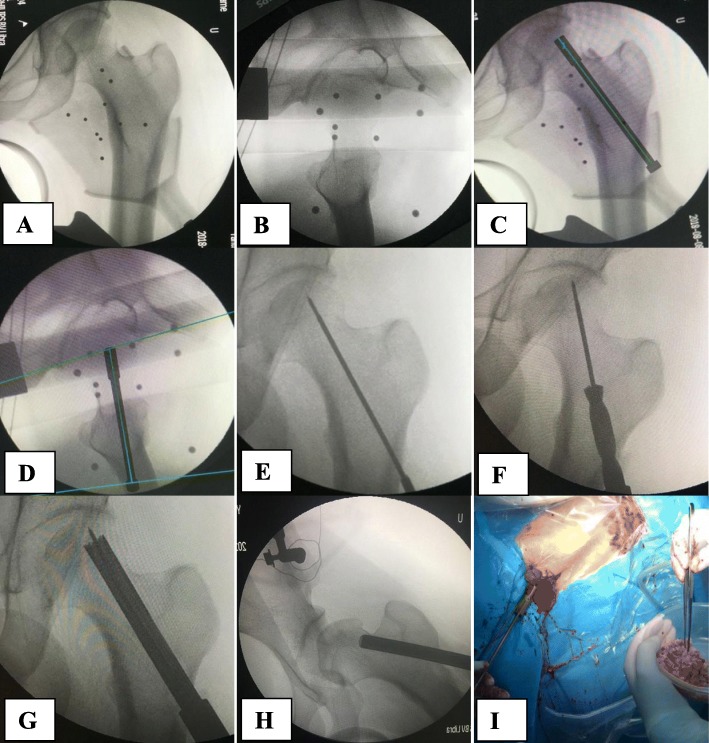
The aim of the current paper is to evaluate the effects of robot-navigation-assisted core decompression compared with conventional core decompression surgery for early-stage osteonecrosis of the femoral head.
Twenty patients with a total of 36 hips who were diagnosed with Association Research Circulation Osseous stage 2 avascular necrosis of the femoral head and who received core decompression with or without robotic assistance were reviewed. The Harris hip score and visual analog scale score were used to assess clinical function. Intraoperative radiation exposure and operation time were used to evaluate the effectiveness of the robot-assisted system.
At a mean follow-up of 26.4 months (24-36 months), the Harris hip score, visual analog scale score, and survival rate of the patients were similar between the conventional and robot-assisted groups. The guidewire insertion time, number of guidewire attempts, and radiation exposure during guidewire insertion were all significantly lower in the robot-assisted group than in the conventional group.
Robot-assisted core decompression of the femoral head is as safe and effective as a conventional core decompression surgery. It can reduce operation time and decrease intraoperative radiation exposure.
本文旨在评估机器人导航辅助下的髓芯减压术与传统髓芯减压术治疗早期股骨头坏死的效果。
回顾性分析20例共36髋诊断为国际骨循环研究学会(ARCO)2期股骨头缺血性坏死且接受了有或无机器人辅助的髓芯减压术的患者。采用Harris髋关节评分和视觉模拟量表评分评估临床功能。采用术中辐射暴露和手术时间评估机器人辅助系统的有效性。
平均随访26.4个月(24 - 36个月),传统组和机器人辅助组患者的Harris髋关节评分、视觉模拟量表评分及生存率相似。机器人辅助组的导丝插入时间、导丝尝试次数及导丝插入过程中的辐射暴露均显著低于传统组。
机器人辅助下的股骨头髓芯减压术与传统髓芯减压术一样安全有效。它可以缩短手术时间并减少术中辐射暴露。