Iztacala Faculty of Higher Studies, National Autonomous University of Mexico, Mexico City, Mexico.
National School of Nursing and Obstetrics, National Autonomous University of Mexico, Mexico City, Mexico.
Hum Resour Health. 2019 Nov 21;17(1):87. doi: 10.1186/s12960-019-0417-x.
Precarization of labor conditions has been expanding over the last three decades as a consequence of global economic transformations. The health workforce labor market is exposed to these transformations as well. In Mexico, analyses of the nursing labor market have documented high levels of unemployment and underemployment; however, precarization has been not considered as a relevant indicator in these analyses. In this study, precarization is analyzed using a quantitative approach to show its prevalence and geographic distribution between 2005 and 2018.
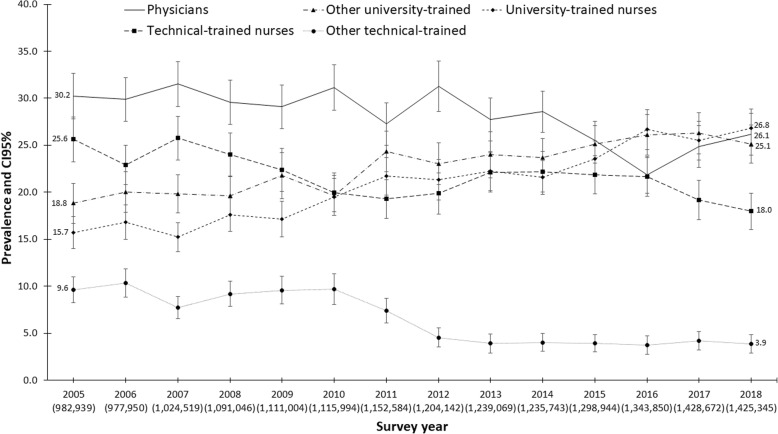
A repeated cross-sectional study was carried out with data from the population-based National Occupation and Employment Survey (ENOE in Spanish) which is administered quarterly to people 15 years or older in over 120 000 households. All individuals who reported having nursing training (technical or university level) were selected for this study. Our main variable was labor precariousness, which included three dimensions: (i) economic, (ii) regulatory, and (iii) occupational safety. We show the evolution of the relative weight of nursing activity between the years 2005 and 2018, the main socio-demographic characteristics of nurses as well as their main labor conditions, and the geographic distribution of precariousness for the 32 federal states in México.
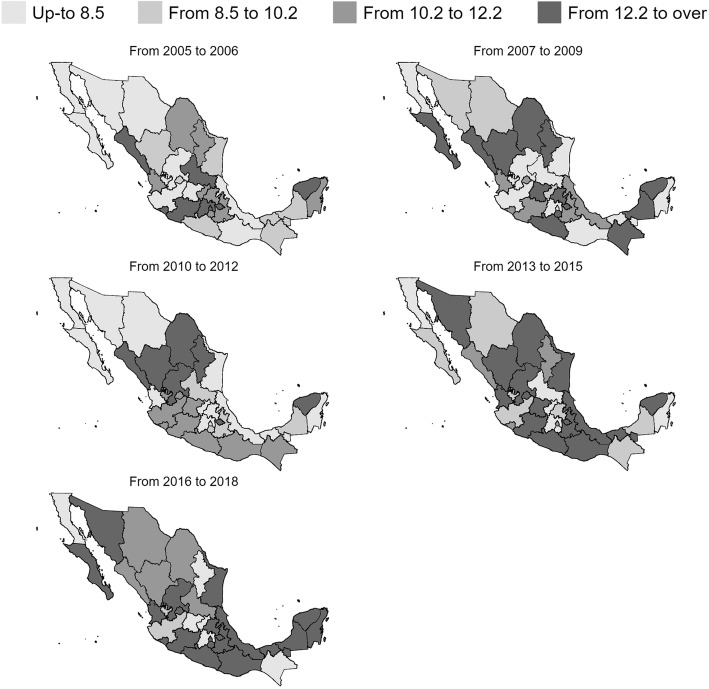
Four of the five indicators of labor precariousness increased among the group of nurses analyzed: (a) the percentage of people with no written contract, (b) the percentage of people with incomes lower than two times the minimum wage, (c) the percentage of nurses without social security, and (d) the percentage of nurses without social benefits. The percentage of nurses that work under some condition of work precariousness increased from 46% in 2005-2006 to 54% in 2018. Finally, the number of states with high precariousness level increased from seven in 2005-2006 to 17 in 2018.
Throughout Mexico, nursing precariousness has expanded reaching 53% by 2018. The advancement of precarization of nursing jobs implies a reduction in the capacity of the Mexican health system to reach its coverage and care goals as nurses represent 52% of all available workers that provide direct services to the population.
过去三十年,随着全球经济转型,劳动力条件不稳定的情况日益加剧。医疗劳动力市场也受到这些变化的影响。在墨西哥,对护理劳动力市场的分析记录了高失业率和就业不足率;然而,在这些分析中,不稳定并没有被视为一个相关指标。在这项研究中,使用定量方法分析不稳定现象,以展示 2005 年至 2018 年期间其普遍性和地理分布。
本研究采用重复的横断面研究方法,数据来自基于人群的全国职业和就业调查(ENOE),该调查每季度对超过 120000 户家庭中 15 岁及以上的人进行。选择所有报告接受过护理培训(技术或大学水平)的个人进行这项研究。我们的主要变量是劳动不稳定,包括三个方面:(一)经济,(二)监管,(三)职业安全。我们展示了 2005 年至 2018 年期间护理活动相对权重的演变,护士的主要社会人口学特征以及他们的主要劳动条件,以及墨西哥 32 个联邦州不稳定的地理分布。
在所分析的护士群体中,劳动不稳定的五个指标中有四个增加:(a)没有书面合同的人数百分比,(b)收入低于最低工资两倍的人数百分比,(c)没有社会保险的护士人数百分比,以及(d)没有社会福利的护士人数百分比。工作不稳定条件下工作的护士比例从 2005-2006 年的 46%增加到 2018 年的 54%。最后,高不稳定程度的州数量从 2005-2006 年的七个增加到 2018 年的十七个。
在整个墨西哥,护理不稳定现象不断扩大,到 2018 年达到 53%。护理工作不稳定程度的提高意味着墨西哥卫生系统实现其覆盖范围和护理目标的能力下降,因为护士占向人口提供直接服务的所有可用工作人员的 52%。