Department of Epidemiology and Biostatistics, School of Public Health, Peking University Health Science Center, 38 Xueyuan Road, Beijing, 100191, China.
Key Laboratory of Molecular Cardiovascular Sciences (Peking University), Ministry of Education, Beijing, China.
Eur J Epidemiol. 2020 Jun;35(6):567-578. doi: 10.1007/s10654-019-00585-4. Epub 2019 Nov 21.
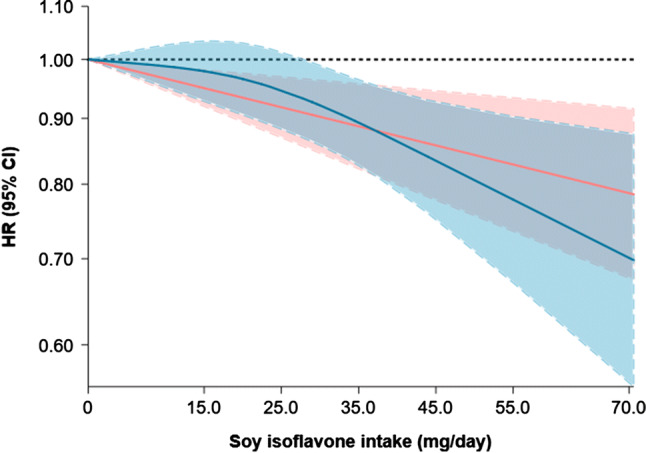
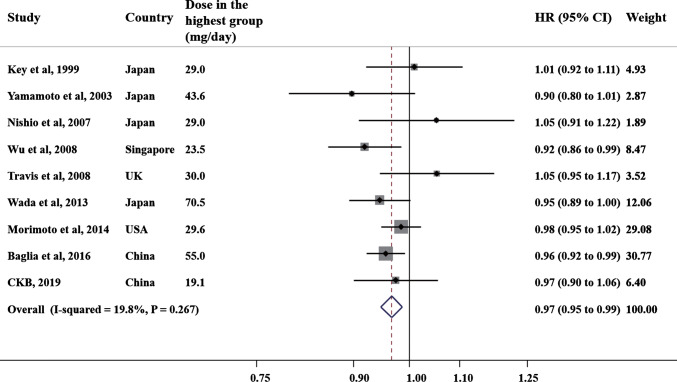
Epidemiological evidence on the association of soy intake with breast cancer risk is still inconsistent due to different soy intake levels across previous studies and small number of breast cancer cases. We aimed to investigate this issue by analyzing data from the China Kadoorie Biobank (CKB) study and conducting a dose-response meta-analysis to integrate existing evidence. The CKB study included over 300,000 women aged 30-79 from 10 regions across China enrolled between 2004 and 2008, and followed-up for breast cancer events until 31 December 2016. Information on soy intake was collected from baseline, two resurveys and twelve 24-h dietary recalls. We also searched for relevant prospective cohort studies to do a dose-response meta-analysis. The mean (SD) soy intake was 9.4 (5.4) mg/day soy isoflavones among CKB women. During 10 years of follow-up, 2289 women developed breast cancers. The multivariable-adjusted relative risk was 1.00 (95% confidence interval [CI] 0.81-1.22) for the fourth (19.1 mg/day) versus the first (4.5 mg/day) soy isoflavone intake quartile. Meta-analysis of prospective studies found that each 10 mg/day increment in soy isoflavone intake was associated with a 3% (95% CI 1-5%) reduced risk of breast cancer. The CKB study demonstrated that moderate soy intake was not associated with breast cancer risk among Chinese women. Higher amount of soy intake might provide reasonable benefits for the prevention of breast cancer.
关于大豆摄入量与乳腺癌风险之间的关联,流行病学证据仍然不一致,这是由于先前研究中的大豆摄入量水平不同以及乳腺癌病例数量较少。我们旨在通过分析中国慢性病前瞻性研究(CKB)的数据并进行剂量-反应荟萃分析来解决这个问题,以整合现有证据。
CKB 研究纳入了 2004 年至 2008 年间来自中国 10 个地区的 30 万余名 30-79 岁女性,随访至 2016 年 12 月 31 日,观察乳腺癌发病情况。大豆摄入量信息通过基线、两次复查和 12 次 24 小时膳食回顾收集。我们还检索了相关的前瞻性队列研究,以进行剂量-反应荟萃分析。
在 CKB 女性中,大豆异黄酮的平均(标准差)摄入量为 9.4(5.4)mg/天。在 10 年的随访期间,有 2289 名女性发生乳腺癌。多变量调整后的相对风险为第 4 quartile(19.1mg/天)与第 1 quartile(4.5mg/天)相比为 1.00(95%置信区间[CI]0.81-1.22)。
前瞻性研究的荟萃分析发现,大豆异黄酮摄入量每增加 10mg/天,乳腺癌风险降低 3%(95%CI 1%-5%)。CKB 研究表明,中国女性中等量的大豆摄入与乳腺癌风险无关。较高的大豆摄入量可能为预防乳腺癌提供合理的益处。