Department of Conservation Biology, Estación Biológica de Doñana - CSIC, C/Americo Vespucio 26, 41092, Seville, Spain.
Animal Demography and Ecology Unit (GEDA), IMEDEA (CSIC/UIB), C/M. Marques 21, 07190, Esporles, Spain.
Sci Rep. 2019 Nov 22;9(1):17352. doi: 10.1038/s41598-019-54026-z.
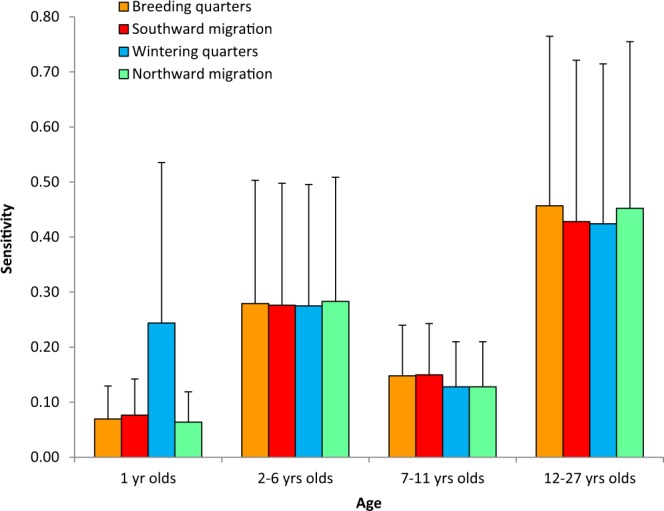
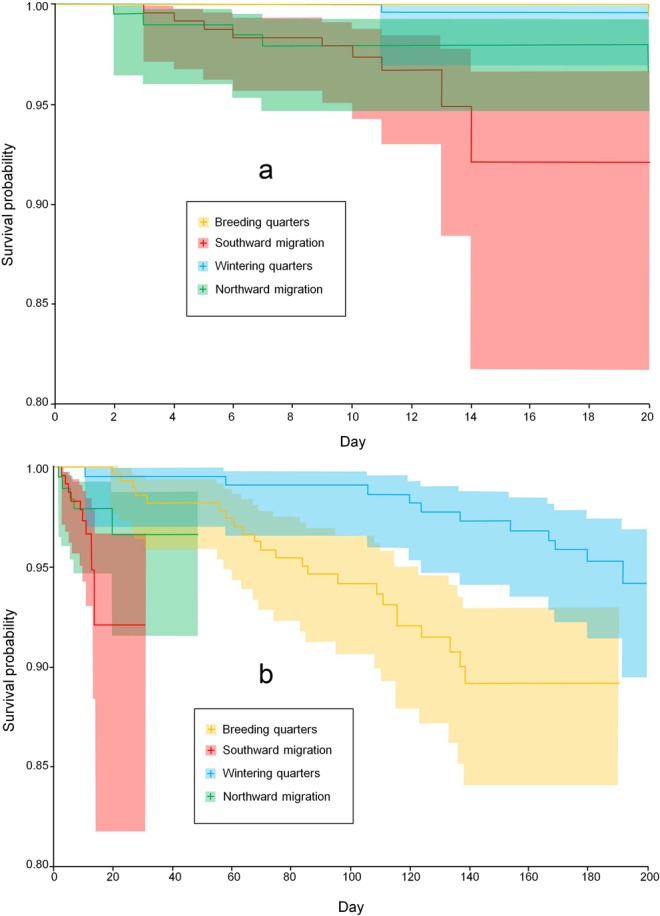
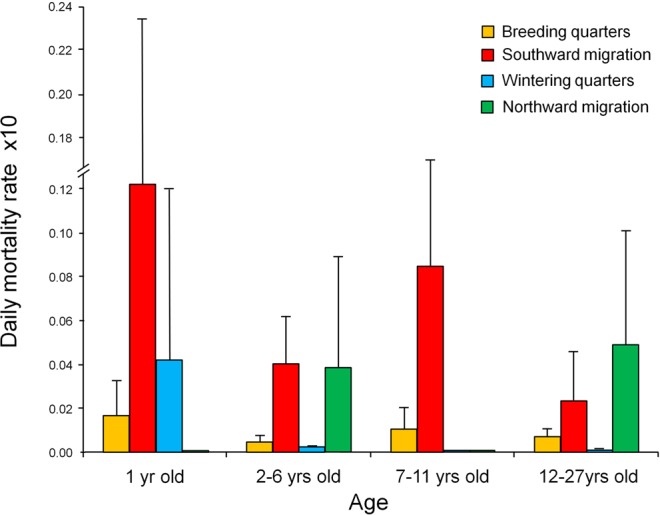
The annual cycle of most animals is structured into discrete stages, such as breeding, migration and dispersal. While there is growing appreciation of the importance of different stages of an organism's annual cycle for its fitness and population dynamics, almost nothing is known about if and how such seasonal effects can change through a species lifespan. Here, we take advantage of the opportunity offered by a long-term satellite/GPS-tracking study and a reliable method of remote death-detection to show that certain stages of both the annual and life cycle of a migratory long-lived raptor, the Black kite Milvus migrans, may represent sensitive bottlenecks for survival. In particular, migratory journeys caused bursts of concentrated-mortality throughout life, but the relative importance of stage-specific survival changed with age. On the other hand, the balance between short-stages of high mortality and long-stages of low mortality made population-growth similarly dependent on all portions of the annual cycle. Our results illustrate how the population dynamics of migratory organisms can be inextricably linked to ecological pressures balanced over multiple stages of the annual cycle and thus multiple areas of the globe, suggesting the frequent need for challenging conservation strategies targeting all portions of a species year-round range.
大多数动物的年周期结构分为离散阶段,如繁殖、迁徙和扩散。虽然人们越来越认识到生物体年周期的不同阶段对其适应性和种群动态的重要性,但几乎不知道这种季节性影响是否以及如何随着物种寿命的变化而变化。在这里,我们利用长期的卫星/GPS 跟踪研究和可靠的远程死亡检测方法提供的机会,表明迁徙性长寿猛禽黑鸢 Milvus migrans 的年周期和生命周期的某些阶段可能代表着生存的敏感瓶颈。特别是,迁徙旅程导致一生中集中死亡的爆发,但特定阶段的生存相对重要性随着年龄的增长而变化。另一方面,高死亡率短阶段和低死亡率长阶段之间的平衡使种群增长同样依赖于年周期的所有部分。我们的研究结果表明,迁徙生物的种群动态如何与跨越年周期多个阶段和全球多个地区的生态压力紧密相关,这表明需要频繁地制定具有挑战性的保护策略,全年针对物种的所有部分。