Research Group Plant Defense Physiology, Max Planck Institute for Chemical Ecology, 07745, Jena, Germany.
Institute of Plant Biology, and Climate Change/Sustainable Development Center, National Taiwan University, Taipei, 106, Taiwan.
Sci Rep. 2019 Nov 22;9(1):17431. doi: 10.1038/s41598-019-53946-0.
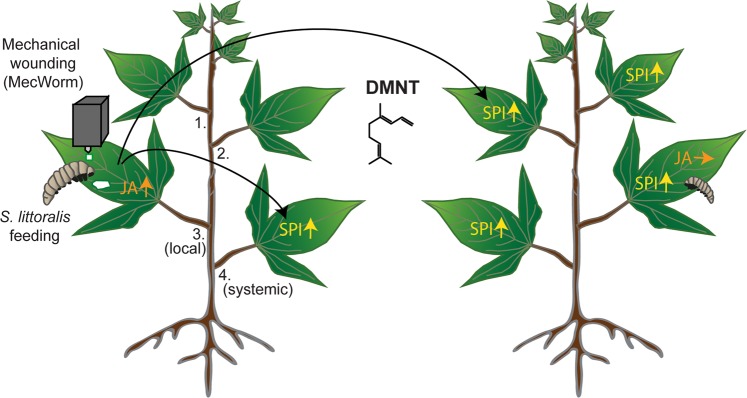
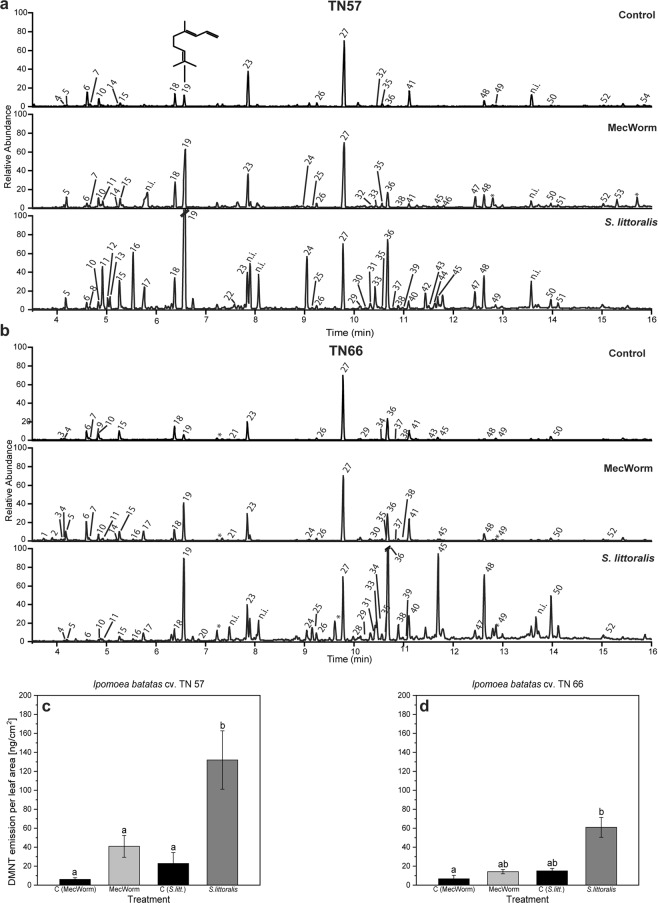
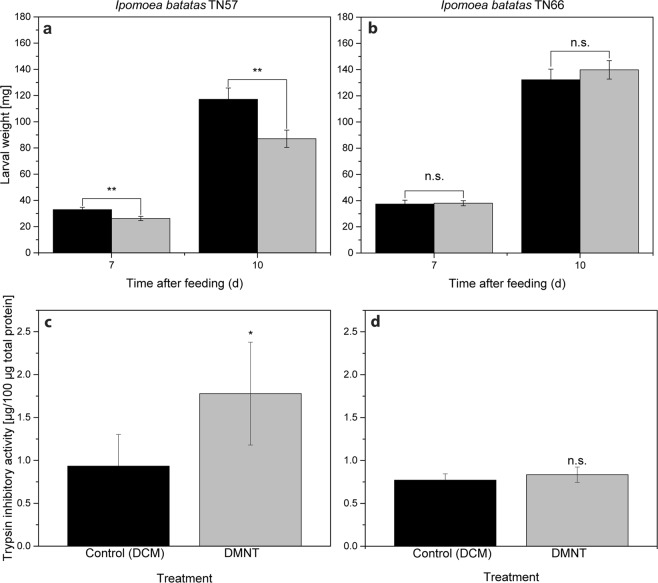
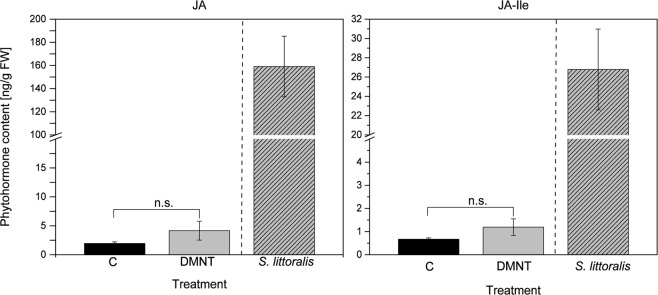
Plants perceive and respond to volatile signals in their environment. Herbivore-infested plants release volatile organic compounds (VOCs) which can initiate systemic defense reactions within the plant and contribute to plant-plant communication. Here, for Ipomoea batatas (sweet potato) leaves we show that among various herbivory-induced plant volatiles, (E)-4,8-dimethyl-1,3,7-nonatriene (DMNT) had the highest abundance of all emitted compounds. This homoterpene was found being sufficient for a volatile-mediated systemic induction of defensive Sporamin protease inhibitor activity in neighboring sweet potato plants. The systemic induction is jasmonate independent and does not need any priming-related challenge. Induced emission and responsiveness to DMNT is restricted to a herbivory-resistant cultivar (Tainong 57), while a susceptible cultivar, Tainong 66, neither emitted amounts comparable to Tainong 57, nor showed reaction to DMNT. This is consistent with the finding that Spodoptera larvae feeding on DMNT-exposed cultivars gain significantly less weight on Tainong 57 compared to Tainong 66. Our results indicate a highly specific, single volatile-mediated plant-plant communication in sweet potato.
植物能够感知和响应环境中的挥发性信号。受草食动物侵害的植物会释放挥发性有机化合物(VOCs),这些化合物可以在植物体内引发系统性防御反应,并促进植物间的通讯。在这里,我们以甘薯(Ipomoea batatas)叶片为例,表明在各种由草食动物诱导的植物挥发物中,(E)-4,8-二甲基-1,3,7-壬三烯(DMNT)是所有挥发物中含量最高的。这种萜烯足以通过挥发性介导的系统诱导邻近甘薯植物中防御性 Sporamin 蛋白酶抑制剂活性。这种系统诱导与茉莉酸无关,也不需要任何与引发相关的挑战。诱导的排放和对 DMNT 的反应仅限于抗草食性品种(台农 57),而敏感品种台农 66 既没有与台农 57 可比的排放量,也没有对 DMNT 做出反应。这与鳞翅目幼虫在 DMNT 暴露的品种上取食时,在台农 57 上的体重明显低于台农 66 的发现是一致的。我们的研究结果表明,在甘薯中存在一种高度特异性的、单一挥发性介导的植物间通讯。