Animal Biotechnology Centre, National Dairy Research Institute, Karnal 132001, Haryana, India.
Department of Developmental Neurobiology, St. Jude Children's Research Hospital, Memphis, TN 38105, U.S.A.
Biosci Rep. 2019 Dec 20;39(12). doi: 10.1042/BSR20191501.
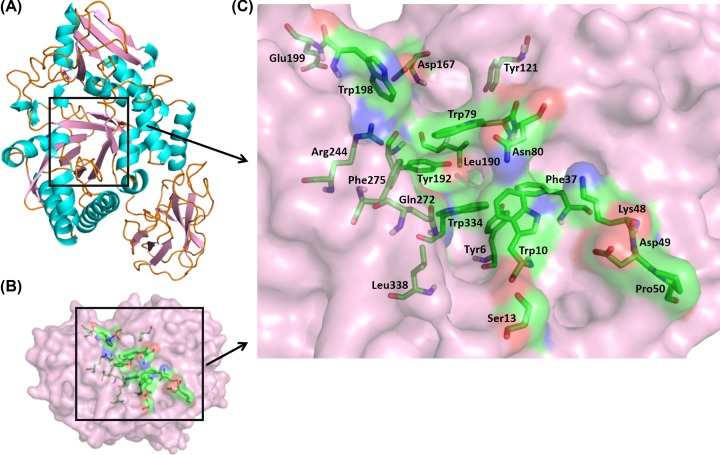
Oviduct-specific glycoprotein (OVGP1) is a high molecular weight chitinase-like protein belonging to GH18 family. It is secreted by non-ciliated epithelial cells of oviduct during estrous cycle providing an essential milieu for fertilization and embryo development. The present study reports the characterization of buffalo OVGP1 through structural modeling, carbohydrate-binding properties and evolutionary analysis. Structural model displayed the typical fold of GH18 family members till the boundary of chitinase-like domain further consisting of a large (β/α)8 TIM barrel sub-domain and a small (α+β) sub-domain. Two critical catalytic residues were found substituted in the catalytic centre (Asp to Phe118, Glu to Leu120) compared with the active chitinase. The carbohydrate-binding groove in TIM barrel was lined with various conserved aromatic residues. Molecular docking with different sugars revealed the involvement of various residues in hydrogen-bonding and non-bonded contacts. Most of the substrate-binding residues were conserved except for a few replacements (Ser13, Lys48, Asp49, Pro50, Asp167, Glu199, Gln272 and Phe275) in comparison with other GH18 members. The residues Trp10, Trp79, Asn80, Gln272, Phe275 and Trp334 were involved in recognition of all six ligands. The α+β sub-domain participated in sugar-binding through Thr270, Gln272, Tyr242 and Phe275. The binding assays revealed significant sugar-binding with purified native and recombinant OVGP1. Phylogenetic analysis revealed that OVGP1 was closely related to AMCases followed by other CLPs and evolution of OVGP1 occurred through several gene duplications. This is the first study describing the structural characteristics of OVGP1 that will further help to understand its interaction with gametes to perform crucial reproductive functions.
输卵管特异性糖蛋白 (OVGP1) 是一种高分子量几丁质酶样蛋白,属于 GH18 家族。它在发情周期中由输卵管的非纤毛上皮细胞分泌,为受精和胚胎发育提供必要的环境。本研究通过结构建模、碳水化合物结合特性和进化分析报告了水牛 OVGP1 的特征。结构模型显示了 GH18 家族成员的典型折叠,直到几丁质酶样结构域的边界,进一步由一个大的 (β/α)8 TIM 桶亚结构域和一个小的 (α+β) 亚结构域组成。与活性几丁质酶相比,在催化中心发现两个关键的催化残基被取代 (天冬氨酸 118 突变为苯丙氨酸,谷氨酸 120 突变为亮氨酸)。TIM 桶中的碳水化合物结合槽由各种保守的芳香族残基排列。与不同糖的分子对接表明,各种残基参与氢键和非键合接触。与其他 GH18 成员相比,除了少数取代 (丝氨酸 13、赖氨酸 48、天冬氨酸 49、脯氨酸 50、天冬氨酸 167、谷氨酸 199、谷氨酰胺 272 和苯丙氨酸 275) 外,大多数底物结合残基都被保守。与其他 GH18 成员相比,与所有 6 种配体结合的残基包括色氨酸 10、色氨酸 79、天冬酰胺 80、谷氨酰胺 272、苯丙氨酸 275 和色氨酸 334。α+β 亚结构域通过苏氨酸 270、谷氨酰胺 272、酪氨酸 242 和苯丙氨酸 275 参与糖结合。结合实验表明,纯化的天然和重组 OVGP1 与糖具有显著的结合能力。系统发育分析表明,OVGP1 与 AMCase 密切相关,其次是其他 CLP,OVGP1 的进化经历了几次基因复制。这是首次描述 OVGP1 的结构特征的研究,这将有助于进一步了解其与配子的相互作用,以发挥关键的生殖功能。