Department of Entomology, College of Agriculture and Life Sciences, Cornell AgriTech, Cornell University, Geneva, NY 14456, USA.
Int J Mol Sci. 2019 Nov 21;20(23):5851. doi: 10.3390/ijms20235851.
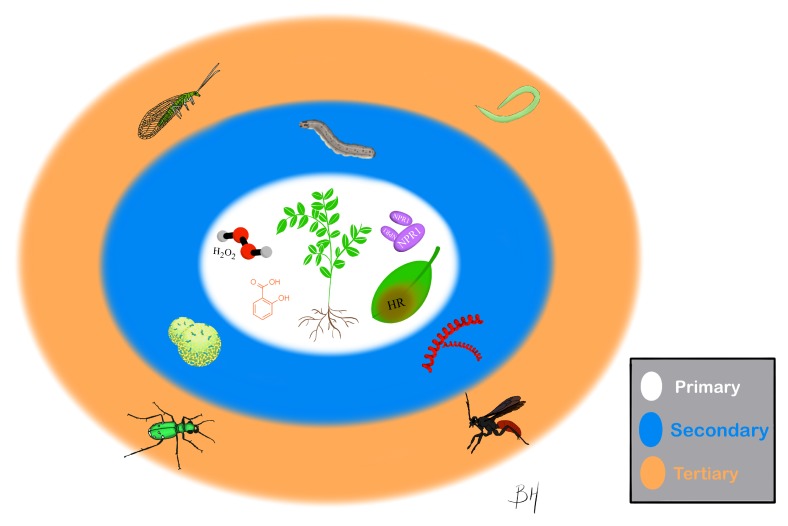
The salicylic acid pathway is one of the primary plant defense pathways, is ubiquitous in vascular plants, and plays a role in rapid adaptions to dynamic abiotic and biotic stress. Its prominence and ubiquity make it uniquely suited for understanding how biochemistry within plants can mediate ecological consequences. Induction of the salicylic acid pathway has primary effects on the plant in which it is induced resulting in genetic, metabolomic, and physiologic changes as the plant adapts to challenges. These primary effects can in turn have secondary consequences for herbivores and pathogens attacking the plant. These secondary effects can both directly influence plant attackers and mediate indirect interactions between herbivores and pathogens. Additionally, stimulation of salicylic acid related defenses can affect natural enemies, predators and parasitoids, which can recruit to plant signals with consequences for herbivore populations and plant herbivory aboveground and belowground. These primary, secondary, and tertiary ecological consequences of salicylic acid signaling hold great promise for application in agricultural systems in developing sustainable high-yielding management practices that adapt to changing abiotic and biotic environments.
水杨酸途径是植物主要防御途径之一,普遍存在于维管植物中,在快速适应动态非生物和生物胁迫方面发挥作用。它的突出性和普遍性使其非常适合于理解植物内部的生物化学如何介导生态后果。水杨酸途径的诱导对诱导它的植物具有主要影响,导致植物适应挑战时发生遗传、代谢组学和生理学变化。这些主要影响反过来又会对攻击植物的草食动物和病原体产生次要后果。这些次要影响既可以直接影响植物攻击者,也可以在草食动物和病原体之间进行间接相互作用。此外,水杨酸相关防御的刺激可以影响自然天敌、捕食者和寄生蜂,它们可以利用植物信号进行招募,从而对草食动物种群和地上及地下植物的草食性产生影响。水杨酸信号转导的这些主要、次要和三级生态后果为在农业系统中应用带来了很大的希望,可以制定可持续的高产管理实践,以适应不断变化的非生物和生物环境。