Feng Chen, Gao Hongtao, Zhou Yonggang, Jing Yan, Li Senquan, Yan Zhao, Xu Keheng, Zhou Fangxue, Zhang Wenping, Yang Xinquan, Hussain Muhammad Azhar, Li Haiyan
College of Life Sciences, Jilin Agricultural University, Changchun, China.
Hainan Yazhou Bay Seed Laboratory, Sanya Nanfan Research Institute of Hainan University, Sanya, China.
Front Plant Sci. 2023 Apr 19;14:1162014. doi: 10.3389/fpls.2023.1162014. eCollection 2023.
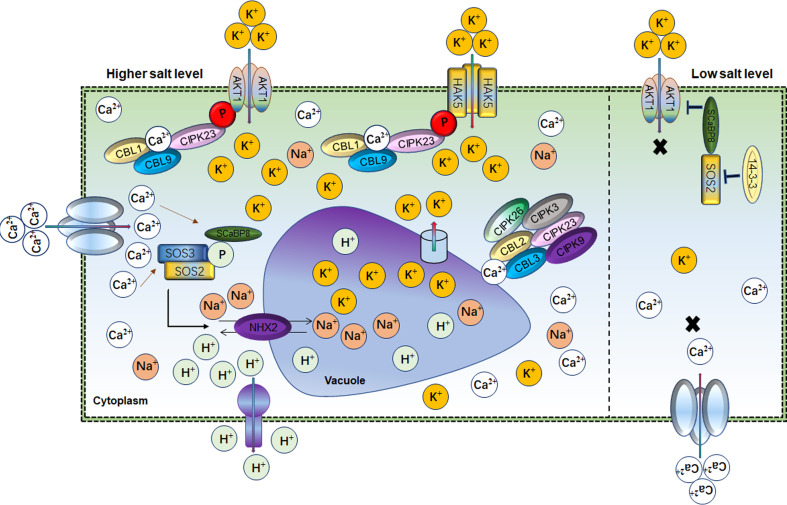
The increasing sodium salts (NaCl, NaHCO3, NaSO4 etc.) in agricultural soil is a serious global concern for sustainable agricultural production and food security. Soybean is an important food crop, and their cultivation is severely challenged by high salt concentration in soils. Classical transgenic and innovative breeding technologies are immediately needed to engineer salt tolerant soybean plants. Additionally, unfolding the molecular switches and the key components of the soybean salt tolerance network are crucial for soybean salt tolerance improvement. Here we review our understandings of the core salt stress response mechanism in soybean. Recent findings described that salt stress sensing, signalling, ionic homeostasis (Na/K) and osmotic stress adjustment might be important in regulating the soybean salinity stress response. We also evaluated the importance of antiporters and transporters such as Arabidopsis K Transporter 1 () potassium channel and the impact of epigenetic modification on soybean salt tolerance. We also review key phytohormones, and osmo-protectants and their role in salt tolerance in soybean. In addition, we discuss the progress of omics technologies for identifying salt stress responsive molecular switches and their targeted engineering for salt tolerance in soybean. This review summarizes recent progress in soybean salt stress functional genomics and way forward for molecular breeding for developing salt-tolerant soybean plant.
农业土壤中日益增加的钠盐(氯化钠、碳酸氢钠、硫酸钠等)是全球可持续农业生产和粮食安全面临的严重问题。大豆是一种重要的粮食作物,其种植受到土壤高盐浓度的严峻挑战。当下迫切需要经典的转基因技术和创新育种技术来培育耐盐大豆植株。此外,揭示大豆耐盐网络的分子开关和关键组成部分对于提高大豆耐盐性至关重要。在此,我们综述了对大豆核心盐胁迫响应机制的理解。最近的研究结果表明,盐胁迫感知、信号传导、离子稳态(钠/钾)和渗透胁迫调节可能在调控大豆盐度胁迫响应中起重要作用。我们还评估了诸如拟南芥钾转运体1(AtKT1)钾通道等反向转运蛋白和转运体的重要性,以及表观遗传修饰对大豆耐盐性的影响。我们还综述了关键植物激素、渗透保护剂及其在大豆耐盐性中的作用。此外,我们讨论了组学技术在鉴定盐胁迫响应分子开关及其在大豆耐盐性定向工程方面的进展。本综述总结了大豆盐胁迫功能基因组学的最新进展以及培育耐盐大豆植株分子育种的未来方向。