Gompels Mark, Michael Skevi, Davies Charlotte, Jones Tim, Macleod John, May Margaret
Department of Immunology, Southmead Hospital, North Bristol NHS Trust, Bristol, UK.
Institute of Statistical Science, School of Mathematics, University of Bristol, Bristol, UK.
BMJ Open. 2019 Nov 24;9(11):e027744. doi: 10.1136/bmjopen-2018-027744.
To estimate trends in HIV testing, positivity and prevalence in UK primary care for 2000-2015 as part of a wider investigation into reasons for late diagnosis of HIV.
Retrospective cohort study using the Clinical Practice Research Datalink (CPRD) which is derived from computerised clinical records produced during consultations in primary care.
404 general practices in England.
5 979 598 adults aged ≥16 years registered between 2000 and 2015 with 45 093 761 person years of observation.
Annual HIV testing rates, proportion of positive tests and prevalence of HIV-infected people recorded in primary care 2000-2015.
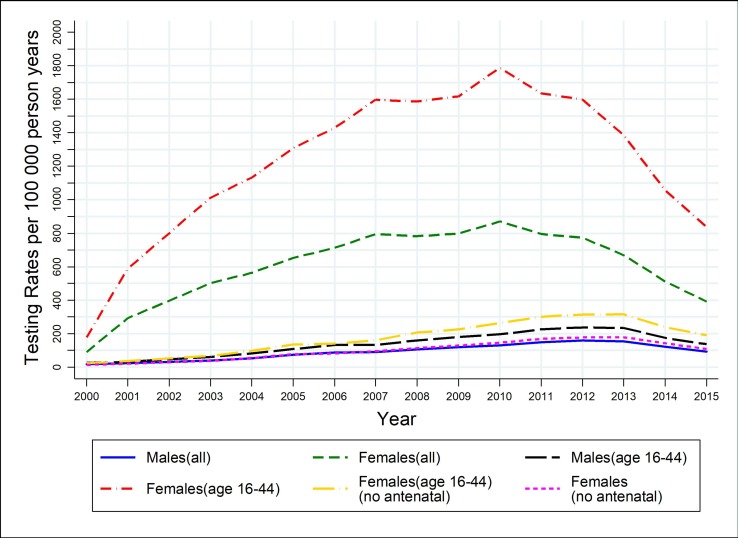
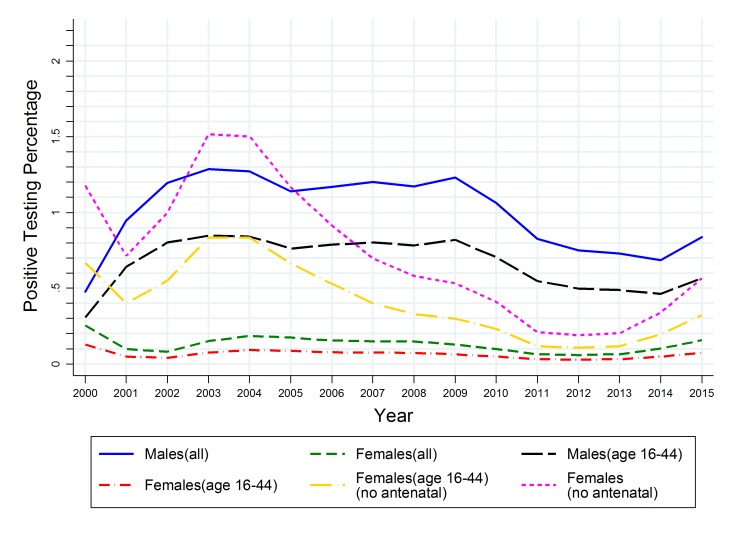
HIV testing in primary care increased from 2000 to 2010, but then declined. Testing was higher in females than in males and in those aged 16-44 years compared with older adults. Rates per 100 000 in women aged 16-44 years were 177 (95% CI 167 to 188); 1309 (95% CI 1282 to 1336); 1789 (95% CI 1757 to 1821) and 839 (95% CI 817 to 862) in 2000, 2005, 2010 and 2015, respectively, and for non-pregnant women: 22.5 (95% CI 19 to 26); 134 (95% CI 125 to 143); 262 (95% CI 250 to 275); 190 (95% CI 179 to 201). For men aged 16-44 years rates were: 26 (95% CI 22 to 29); 107 (95% CI 100 to 115); 196 (95% CI 185 to 206); 137 (95% CI 127 to 146). Over the study period, there were approximately two positive results per 1000 HIV tests. Men were eightfold more likely to test positive than women. The percentage of HIV diagnoses among adults recorded in CPRD may be as low as 55% in London and 67% in the rest of the UK.
HIV testing rates in primary care peaked in 2010 and subsequently declined. Access to testing was higher for women despite the prevalence of HIV being higher in men.
Opportunities remain in primary care for increasing HIV testing to prevent costly late diagnoses and decrease HIV transmission. Interventions to improve targeting of tests and increase adherence to HIV testing guidelines are needed in primary care.
作为对HIV诊断延迟原因进行更广泛调查的一部分,评估2000 - 2015年英国初级医疗保健中HIV检测、阳性率及患病率的趋势。
采用临床实践研究数据链(CPRD)进行回顾性队列研究,该数据链源自初级医疗保健会诊期间生成的计算机化临床记录。
英格兰的404家全科诊所。
2000年至2015年间登记的5979598名年龄≥16岁的成年人,观察人年数为45093761人年。
2000年至2010年初级医疗保健中的HIV检测增加,但随后下降。女性的检测率高于男性,16 - 44岁人群的检测率高于老年人。2000年、2005年、2010年和2015年,16 - 44岁女性每10万人中的检测率分别为177(95%可信区间167至188);1309(95%可信区间1282至1336);1789(95%可信区间1757至1821)和839(95%可信区间817至862),非孕妇为:22.5(95%可信区间19至26);134(95%可信区间125至143);262(95%可信区间250至275);190(95%可信区间179至201)。16 - 44岁男性的检测率为:26(95%可信区间22至29);107(95%可信区间100至115);196(95%可信区间185至206);137(95%可信区间127至146)。在研究期间,每1000次HIV检测中约有两个阳性结果。男性检测呈阳性的可能性是女性的八倍。在CPRD中记录的成年人HIV诊断百分比在伦敦可能低至55%,在英国其他地区为67%。
初级医疗保健中的HIV检测率在2010年达到峰值,随后下降。尽管男性中的HIV患病率较高,但女性的检测机会更多。
初级医疗保健中仍有增加HIV检测以预防代价高昂的延迟诊断和减少HIV传播的机会。初级医疗保健中需要采取干预措施,以改善检测目标定位并提高对HIV检测指南的依从性。