Michelo Charles, Sandøy Ingvild F, Dzekedzeke Kumbutso, Siziya Seter, Fylkesnes Knut
Department of Community Medicine, School of Medicine, University of Zambia, Lusaka, Zambia.
BMC Public Health. 2006 Nov 10;6:279. doi: 10.1186/1471-2458-6-279.
Understanding the epidemiological HIV context is critical in building effective setting-specific preventive strategies. We examined HIV prevalence patterns in selected communities of men and women aged 15-59 years in Zambia.
Population-based HIV surveys in 1995 (n = 3158), 1999 (n = 3731) and 2003 (n = 4751) were conducted in selected communities using probability proportional to size stratified random-cluster sampling. Multivariate logistic regression and trend analyses were stratified by residence, sex and age group. Absence, <30% in men and <15% in women in all rounds, was the most important cause of non-response. Saliva was used for HIV testing, and refusal was <10%.
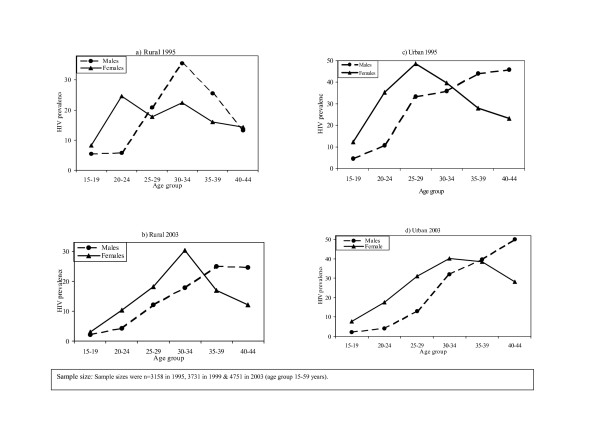
Among rural groups aged 15-24 years, prevalence declined by 59.2% (15.7% to 6.4%, P < 0.001) in females and by 44.6% (5.6% to 3.1%, P < 0.001) in males. In age-group 15-49 years, declines were less than 25%. In the urban groups aged 15-24, prevalence declined by 47% (23.4% to 12.4%, P < 0.001) among females and 57.3% (7.5% to 3.2%, P = 0.001) among males but were 32% and 27% in men and women aged 15-49, respectively. Higher educated young people in 2003 had lower odds of infection than in 1995 in both urban [men: AOR 0.29(95% CI 0.14-0.60); women: AOR 0.38(95% CI 0.19-0.79)] and rural groups [men: AOR 0.16(95% CI 0.11-0.25), women: AOR 0.10(95% CI 0.01-7.34)]. Although higher mobility was associated with increased likelihood of infection in men overall, AOR, 1.71(95% CI 1.34-2.19), prevalence declined in mobile groups also (OR 0.52 95% CI 0.31-0.88). In parallel, urban young people with > or =11 school years were more likely to use condoms during the last casual sex (OR 2.96 95% CI 1.93-4.52) and report less number of casual sexual partners (AOR 0.33 95% CI 0.19-0.56) in the last twelve months than lower educated groups.
Steep HIV prevalence declines in young people, suggesting continuing declining incidence, were masked by modest overall declines. The concentration of declines in higher educated groups suggests a plausible association with behavioural change.
了解艾滋病病毒(HIV)的流行病学背景对于制定有效的针对特定环境的预防策略至关重要。我们调查了赞比亚15至59岁特定社区中男性和女性的HIV流行模式。
1995年(n = 3158)、1999年(n = 3731)和2003年(n = 4751)在选定社区采用按规模比例概率分层随机整群抽样进行基于人群的HIV调查。多变量逻辑回归和趋势分析按居住地、性别和年龄组进行分层。所有轮次中男性未应答率<30%且女性未应答率<15%是未应答的最重要原因。采用唾液进行HIV检测,拒绝检测率<10%。
在15至24岁的农村人群中,女性患病率下降了59.2%(从15.7%降至6.4%,P < 0.001),男性患病率下降了44.6%(从5.6%降至3.1%,P < 0.001)。在15至49岁年龄组中,下降幅度小于25%。在15至24岁的城市人群中,女性患病率下降了47%(从23.4%降至12.4%,P < 0.001),男性患病率下降了57.3%(从7.5%降至3.2%,P = 0.001),但在15至49岁的男性和女性中分别为32%和27%。2003年受过高等教育的年轻人感染几率低于1995年,在城市[男性:调整后比值比(AOR)0.29(95%置信区间0.14 - 0.60);女性:AOR 0.38(95%置信区间0.19 - 0.79)]和农村人群[男性:AOR 0.16(95%置信区间0.11 - 0.25),女性:AOR 0.10(95%置信区间0.01 - 7.34)]中均如此。尽管总体而言较高的流动性与男性感染可能性增加相关,AOR为1.71(95%置信区间1.34 - 2.19),但流动人群中的患病率也有所下降(比值比0.52,95%置信区间0.31 - 0.88)。同时,接受过≥11年学校教育的城市年轻人在过去一次性行为中使用避孕套的可能性更大(比值比2.96,95%置信区间1.93 - 4.52),并且在过去十二个月中报告的临时性伴侣数量更少(AOR 0.33,95%置信区间0.19 - 0.56),低于受教育程度较低的人群。
年轻人中HIV患病率急剧下降,表明发病率持续下降,但总体下降幅度较小掩盖了这一情况。患病率下降集中在受过高等教育的人群中,这表明与行为改变可能存在合理关联。