Department of Ecology and Evolutionary Biology, University of California, Los Angeles, CA 90095.
La Kretz Center for California Conservation Science, Institute of the Environment and Sustainability, University of California, Los Angeles, CA 90095.
Proc Natl Acad Sci U S A. 2019 Dec 10;116(50):25179-25185. doi: 10.1073/pnas.1908771116. Epub 2019 Nov 25.
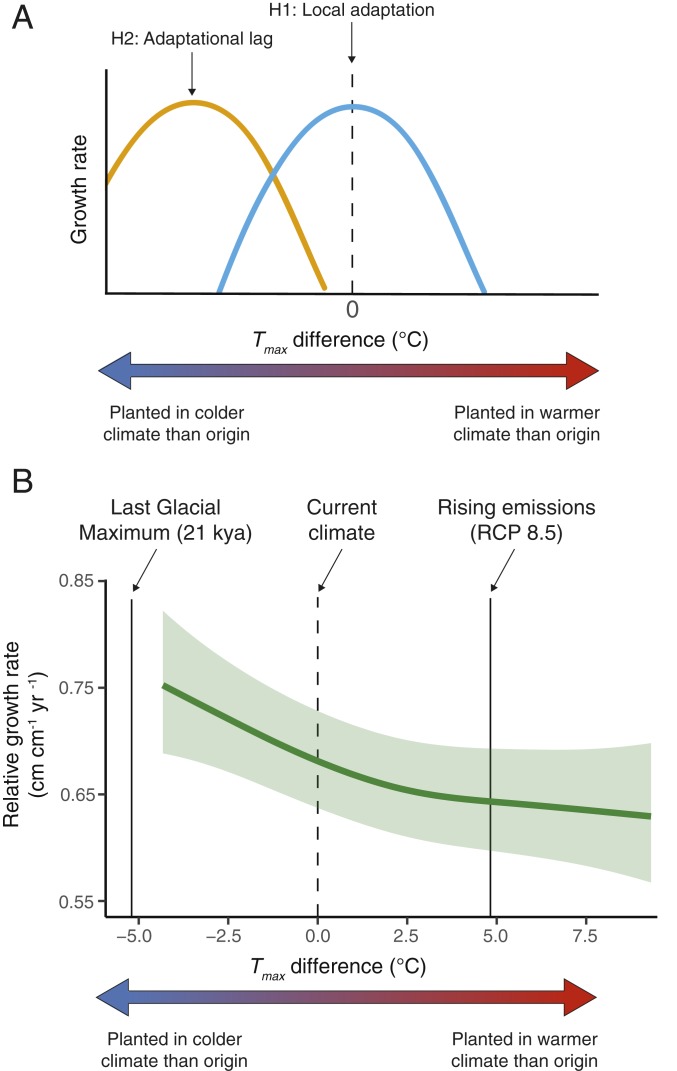
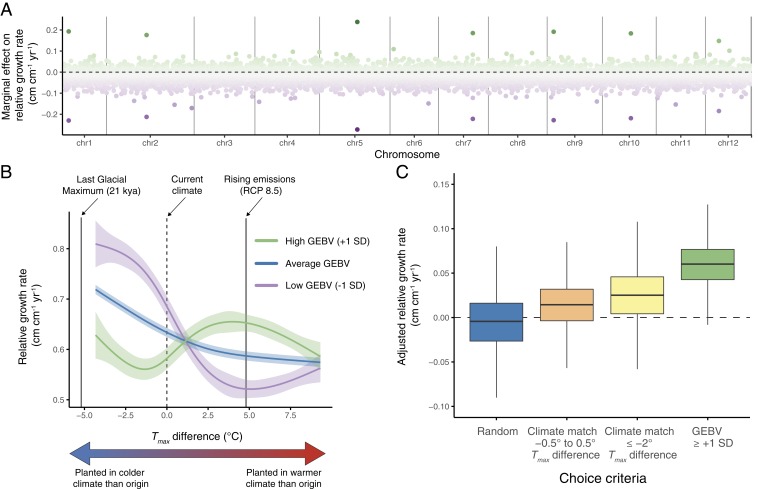
Climate change over the next century is predicted to cause widespread maladaptation in natural systems. This prediction, as well as many sustainable management and conservation practices, assumes that species are adapted to their current climate. However, this assumption is rarely tested. Using a large-scale common garden experiment combined with genome-wide sequencing, we found that valley oak (), a foundational tree species in California ecosystems, showed a signature of adaptational lag to temperature, with fastest growth rates occurring at cooler temperatures than populations are currently experiencing. Future warming under realistic emissions scenarios was predicted to lead to further maladaptation to temperature and reduction in growth rates for valley oak. We then identified genotypes predicted to grow relatively fast under warmer temperatures and demonstrated that selecting seed sources based on their genotype has the potential to mitigate predicted negative consequences of future climate warming on growth rates in valley oak. These results illustrate that the belief of local adaptation underlying many management and conservation practices, such as using local seed sources for restoration, may not hold for some species. If contemporary adaptational lag is commonplace, we will need new approaches to help alleviate predicted negative consequences of climate warming on natural systems. We present one such approach, "genome-informed assisted gene flow," which optimally matches individuals to future climates based on genotype-phenotype-environment associations.
下个世纪的气候变化预计将导致自然系统广泛的不适。这个预测,以及许多可持续的管理和保护实践,都假设物种适应了它们当前的气候。然而,这个假设很少被检验。我们利用大规模的共同花园实验和全基因组测序发现,加利福尼亚生态系统中的基础树种——山谷橡树(),对温度表现出适应滞后的特征,其最快的生长速度出现在比当前种群经历的温度更低的温度下。在现实排放情景下的未来变暖预计将导致山谷橡树进一步适应温度和生长速度的降低。然后,我们确定了预测在温暖温度下生长相对较快的基因型,并证明根据基因型选择种子来源有可能减轻未来气候变暖对山谷橡树生长速度的预测负面影响。这些结果表明,许多管理和保护实践所基于的地方适应的信念,例如使用当地的种子来源进行恢复,可能不适用于某些物种。如果当代的适应滞后是普遍存在的,我们将需要新的方法来帮助缓解气候变化对自然系统的预测负面影响。我们提出了一种这样的方法,即“基于基因组的辅助基因流”,它根据基因型-表型-环境的关联,根据基因型最优地匹配个体与未来气候。