Key Laboratory of Laboratory Medicine, School of Laboratory Medicine and Life Science, Wenzhou Medical University, Wenzhou 325035, China.
Department of Cell Metabolism and Nutrition, Advanced Preventive Medical Sciences Research Center, Kanazawa University, Kanazawa, Ishikawa 920-8640, Japan.
Int J Mol Sci. 2019 Nov 25;20(23):5920. doi: 10.3390/ijms20235920.
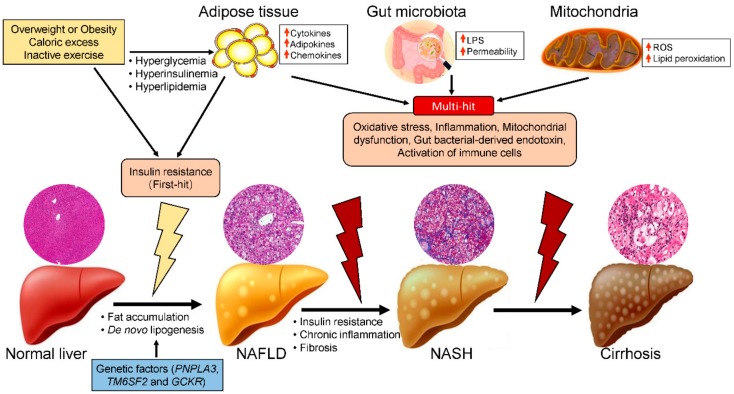
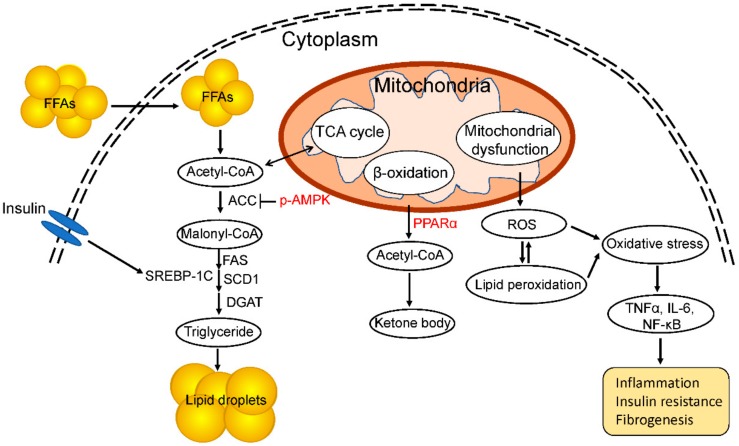
Non-alcoholic fatty liver disease (NAFLD) is a common disease in Western nations and ranges in severity from steatosis to steatohepatitis (NASH). NAFLD is a genetic-environmental-metabolic stress-related disease of unclear pathogenesis. NAFLD is triggered by caloric overconsumption and physical inactivity, which lead to insulin resistance and oxidative stress. A growing body of evidence indicates that mitochondrial dysfunction plays a critical role in the pathogenesis of NAFLD. Mitochondrial dysfunction not only promotes fat accumulation, but also leads to generation of reactive oxygen species (ROS) and lipid peroxidation, resulting in oxidative stress in hepatocytes. Nuclear factor erythroid 2-related factor 2 (Nrf2) is an important modulator of antioxidant signaling that serves as a primary cellular defense against the cytotoxic effects of oxidative stress. The pharmacological induction of Nrf2 ameliorates obesity-associated insulin resistance and NAFLD in a mouse model. Sulforaphane and its precursor glucoraphanin are derived from broccoli sprouts and are the most potent natural Nrf2 inducers-they may protect mitochondrial function, thus suppressing the development of NASH. In this review, we briefly describe the role of mitochondrial dysfunction in the pathogenesis of NASH and the effects of glucoraphanin on its development.
非酒精性脂肪性肝病(NAFLD)是西方国家的一种常见疾病,其严重程度从脂肪变性到脂肪性肝炎(NASH)不等。NAFLD 是一种发病机制尚不清楚的遗传-环境-代谢应激相关疾病。NAFLD 由热量摄入过多和缺乏体力活动引发,导致胰岛素抵抗和氧化应激。越来越多的证据表明,线粒体功能障碍在 NAFLD 的发病机制中起着关键作用。线粒体功能障碍不仅促进脂肪堆积,还导致活性氧(ROS)和脂质过氧化的产生,导致肝细胞氧化应激。核因子红细胞 2 相关因子 2(Nrf2)是抗氧化信号的重要调节剂,作为细胞对氧化应激细胞毒性作用的主要防御机制。Nrf2 的药理学诱导可改善肥胖相关的胰岛素抵抗和 NAFLD 小鼠模型中的情况。萝卜硫素及其前体萝卜硫苷来自西兰花芽,是最有效的天然 Nrf2 诱导剂-它们可能保护线粒体功能,从而抑制 NASH 的发展。在这篇综述中,我们简要描述了线粒体功能障碍在 NASH 发病机制中的作用以及萝卜硫苷对其发展的影响。