Department of Social Medicine, Institute of health sciences, China Medical University, Shenyang, 110122, Liaoning, China.
Research Center of China Medical University Birth Cohort, China Medical University, Shenyang, Liaoning, China.
BMC Pregnancy Childbirth. 2019 Nov 27;19(1):444. doi: 10.1186/s12884-019-2583-1.
The sleep quality of pregnant women in the third trimester is related to mental health. However, there is still a lack of large-scale cohort research exploring this relationship in the second trimester. Thus, we assessed the associations of sleep quality during the second trimester with antenatal stress and antenatal and postnatal depression.
We examined 1152 pregnant women from a prospective cohort study in China to assess the associations of sleep quality in the second trimester with antenatal stress, antenatal depression, and postnatal depression. We used linear regression models and logistic regression models to examine the associations of sleep quality (Pittsburgh Sleep Quality Index [PSQI]) during pregnancy with perinatal stress (Pregnancy Pressure Scale [PPS]) and depression (Edinburgh Postnatal Depression Scale [EPDS]) status. We further assessed the relationship in groups divided according to maternal age.
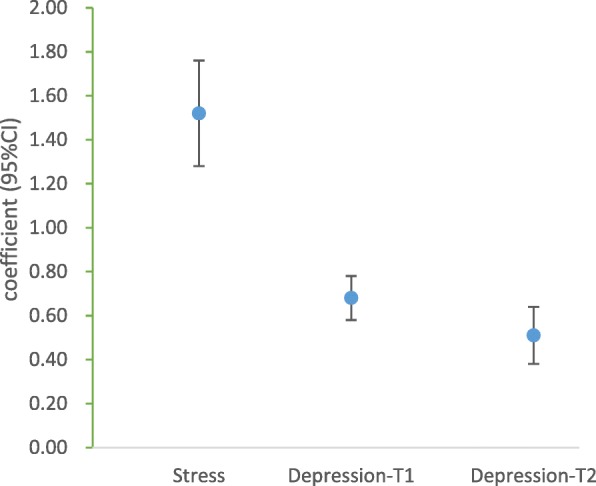
PSQI scores were positively associated with antenatal PPS scores (β: 1.52, 95% confidence interval [CI]: 1.28, 1.76), antenatal EPDS scores (β: 0.68, 95% CI: 0.58, 0.78), and postpartum EPDS scores (β: 0.51, 95% CI: 0.38, 0.64). Poor sleep quality (PSQI scores ≥5) was associated with antenatal stress status (odds ratio [OR]: 2.60, 95% CI: 1.79, 3.77), antenatal depression status (OR: 3.42, 95% CI: 2.48, 4.72), and postpartum depression status (OR: 2.40, 95% CI: 1.58, 3.64) after adjusting maternal age, BMI, gestational age, smoking, educational level, annual household income and social support. The association of poor sleep quality (PSQI scores ≥5) in the second trimester with postnatal depression status was significant among women more than or equal to 30 years old (OR: 4.12, 95% CI: 2.18, 7.78) but not among women less than 30 years old after adjusting covariates above.
Poor sleep quality in the second trimester among Chinese pregnant women is associated with stress and depression symptoms. Strategies to boost sleep quality should be considered during prenatal health care to improve women's mental health status.
孕妇在孕晚期的睡眠质量与心理健康有关。然而,目前仍缺乏大规模队列研究来探讨孕中期的这种关系。因此,我们评估了孕中期睡眠质量与产前压力以及产前和产后抑郁之间的关联。
我们在中国的一项前瞻性队列研究中检查了 1152 名孕妇,以评估孕中期睡眠质量与产前压力、产前抑郁和产后抑郁之间的关联。我们使用线性回归模型和逻辑回归模型来检查怀孕期间睡眠质量(匹兹堡睡眠质量指数 [PSQI])与围产期压力(妊娠压力量表 [PPS])和抑郁(爱丁堡产后抑郁量表 [EPDS])状态之间的关联。我们进一步根据母亲年龄的不同将这些关系进行了分组评估。
PSQI 评分与产前 PPS 评分呈正相关(β:1.52,95%置信区间 [CI]:1.28,1.76)、产前 EPDS 评分(β:0.68,95% CI:0.58,0.78)和产后 EPDS 评分(β:0.51,95% CI:0.38,0.64)。睡眠质量差(PSQI 评分≥5)与产前压力状态(优势比 [OR]:2.60,95% CI:1.79,3.77)、产前抑郁状态(OR:3.42,95% CI:2.48,4.72)和产后抑郁状态(OR:2.40,95% CI:1.58,3.64)相关,调整了母亲年龄、BMI、孕龄、吸烟、教育水平、年家庭收入和社会支持等因素后依然成立。在调整了上述因素后,在年龄大于等于 30 岁的女性中,孕中期睡眠质量差(PSQI 评分≥5)与产后抑郁状态之间的关联具有统计学意义(OR:4.12,95% CI:2.18,7.78),但在年龄小于 30 岁的女性中没有统计学意义。
中国孕妇在孕中期睡眠质量差与压力和抑郁症状有关。在产前保健期间,应考虑改善睡眠质量的策略,以改善女性的心理健康状况。