School of Environmental Sciences, University of East Anglia, Norwich, Norfolk, UK.
Centro de Ecologia Aplicada 'Prof. Baeta Neves' and InBio - Rede de Investigação em Biodiversidade e Biologia Evolutiva, Instituto Superior de Agronomia, Universidade de Lisboa, Lisboa, Portugal.
J Anim Ecol. 2020 Mar;89(3):678-690. doi: 10.1111/1365-2656.13155. Epub 2019 Dec 24.
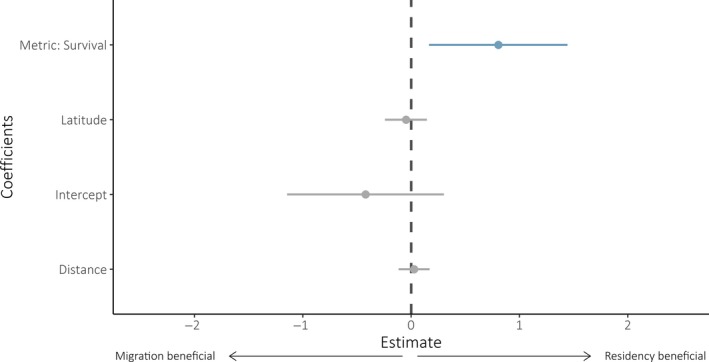
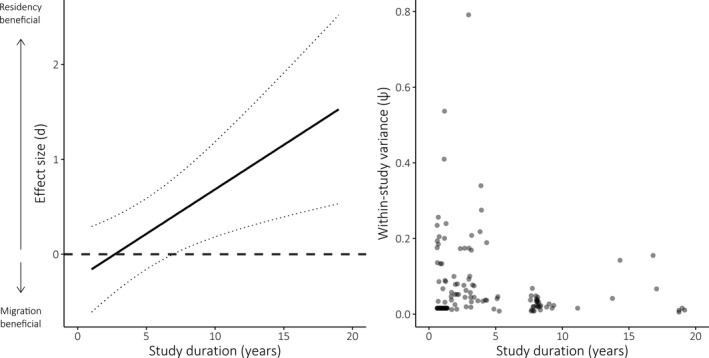
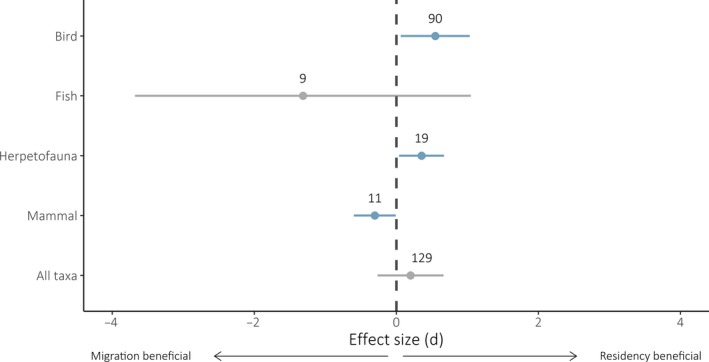
Partial migration-wherein migratory and non-migratory individuals exist within the same population-represents a behavioural dimorphism; for it to persist over time, both strategies should yield equal individual fitness. This balance may be maintained through trade-offs where migrants gain survival benefits by avoiding unfavourable conditions, while residents gain breeding benefits from early access to resources. There has been little overarching quantitative analysis of the evidence for this fitness balance. As migrants-especially long-distance migrants-may be particularly vulnerable to environmental change, it is possible that recent anthropogenic impacts could drive shifts in fitness balances within these populations. We tested these predictions using a multi-taxa meta-analysis. Of 2,939 reviewed studies, 23 contained suitable information for meta-analysis, yielding 129 effect sizes. Of these, 73% (n = 94) reported higher resident fitness, 22% (n = 28) reported higher migrant fitness, and 5% (n = 7) reported equal fitness. Once weighted for precision, we found balanced fitness benefits across the entire dataset, but a consistently higher fitness of residents over migrants in birds and herpetofauna (the best-sampled groups). Residency benefits were generally associated with survival, not breeding success, and increased with the number of years of data over which effect sizes were calculated, suggesting deviations from fitness parity are not due to sampling artefacts. A pervasive survival benefit to residency documented in recent literature could indicate that increased exposure to threats associated with anthropogenic change faced by migrating individuals may be shifting the relative fitness balance between strategies.
部分迁徙——即在同一群体中存在迁徙和非迁徙个体——代表一种行为二态性;为了使其能够随着时间的推移而持续存在,这两种策略都应该产生相等的个体适应性。这种平衡可能通过权衡来维持,其中迁徙者通过避免不利条件获得生存优势,而居民通过尽早获得资源获得繁殖优势。对于这种适应性平衡的证据,几乎没有进行全面的定量分析。由于迁徙者——尤其是长途迁徙者——可能特别容易受到环境变化的影响,因此最近的人为影响可能会导致这些种群中适应性平衡的转变。我们使用多分类元分析来检验这些预测。在审查的 2,939 项研究中,有 23 项包含适合元分析的信息,产生了 129 个效应量。其中,73%(n=94)报告了更高的居民适应性,22%(n=28)报告了更高的迁徙者适应性,5%(n=7)报告了相等的适应性。一旦对精度进行加权,我们发现整个数据集的适应性收益是平衡的,但在鸟类和爬行动物中(采样最好的群体),居民的适应性始终高于迁徙者。居民的适应性优势通常与生存有关,而与繁殖成功率无关,并且随着计算效应量的年限的增加而增加,这表明偏离适应性均等不是由于抽样偏差造成的。最近文献中记录的普遍生存优势可能表明,与迁徙个体面临的与人为变化相关的威胁的增加,可能正在改变策略之间的相对适应性平衡。