Centre for Neutron Scattering, Uppsala University, Box 516, 751 20, Uppsala, Sweden.
Swerim AB, Box 7047, 16407, Kista, Sweden.
Sci Rep. 2019 Nov 29;9(1):17945. doi: 10.1038/s41598-019-54069-2.
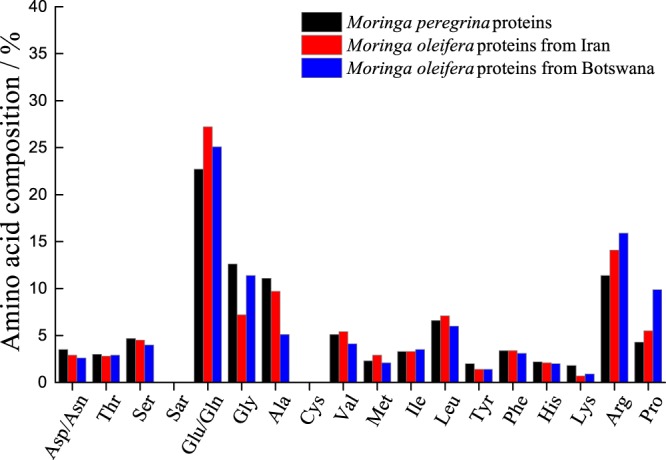
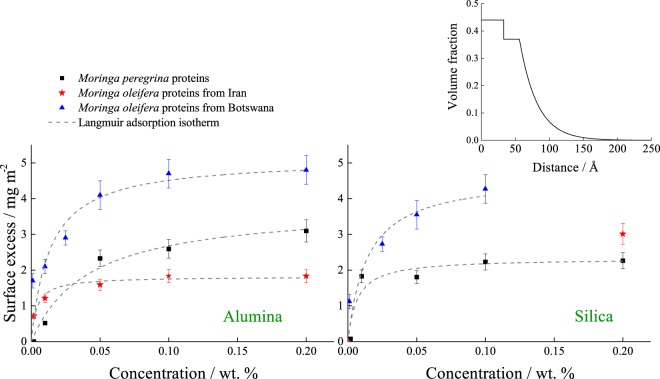
Trees of Moringa oleifera are the most widely exploited species of Moringa and proteins extracted from its seeds have been identified as the most efficient natural coagulant for water purification. Largely for climatic reasons, other Moringa species are more accessible in some regions and this paper presents a comparative study of the adsorption to different materials of the proteins extracted from seeds of Moringa peregrina and Moringa oleifera to explore their use as flocculating agents in regions where each is more readily accessible. Results showed that Moringa peregrina seed proteins had higher adsorption to alumina compared to silica, in contrast to opposite behavior for Moringa oleifera. Both species provide cationic proteins that can act as effective coagulants for the various impurities with different surface potential. Despite the considerable similarity of the amino acid composition, the seed proteins have significantly different adsorption and this presents the opportunity to improve processes by choosing the optimal species or combination of species depending on the type of impurity or possible development of separation processes.
辣木树是辣木属中应用最广泛的物种,从其种子中提取的蛋白质已被鉴定为最有效的天然水净化凝结剂。由于气候原因,在某些地区其他辣木属物种更容易获得,本文对从辣木属植物和辣木属植物种子中提取的蛋白质对不同材料的吸附进行了比较研究,以探索它们在每个物种更容易获得的地区用作絮凝剂的用途。结果表明,与辣木属相反,辣木属植物种子蛋白对氧化铝的吸附比对硅胶的吸附更高。这两个物种都提供阳离子蛋白,可作为不同表面电位各种杂质的有效凝结剂。尽管氨基酸组成有很大的相似性,但种子蛋白的吸附有很大的不同,这为通过选择最佳的物种或物种组合来改善工艺提供了机会,具体取决于杂质的类型或可能开发的分离过程。